
B.S. Abdur Rahman Crescent Institute of Science and Technology (BSACIST) is committed to ensuring safe, affordable, and reliable access to clean water while safeguarding water quality and ecosystems. We advance wastewater treatment and pollution prevention, and promote water-conscious practices. We strengthen water reuse and measurement, and track consumption to drive efficiency. Our ongoing initiatives aim to reduce water stress, protect aquatic ecosystems, and expand safe water access, with progress demonstrated through defined metrics and regular monitoring.
B.S. Abdur Rahman Crescent Institute of Science and Technology, developed in follow with the Government of India and the State Department of Water Resources, River Development and Ganga Rejuvenation, aims to promote sustainable water governance through education, awareness, and practical action. By aligning policy objectives with hands-on learning, the program fosters a culture of responsible water use, conservation, and innovation among students, faculty, and the broader community.
A. ON-CAMPUS INITIATIVES
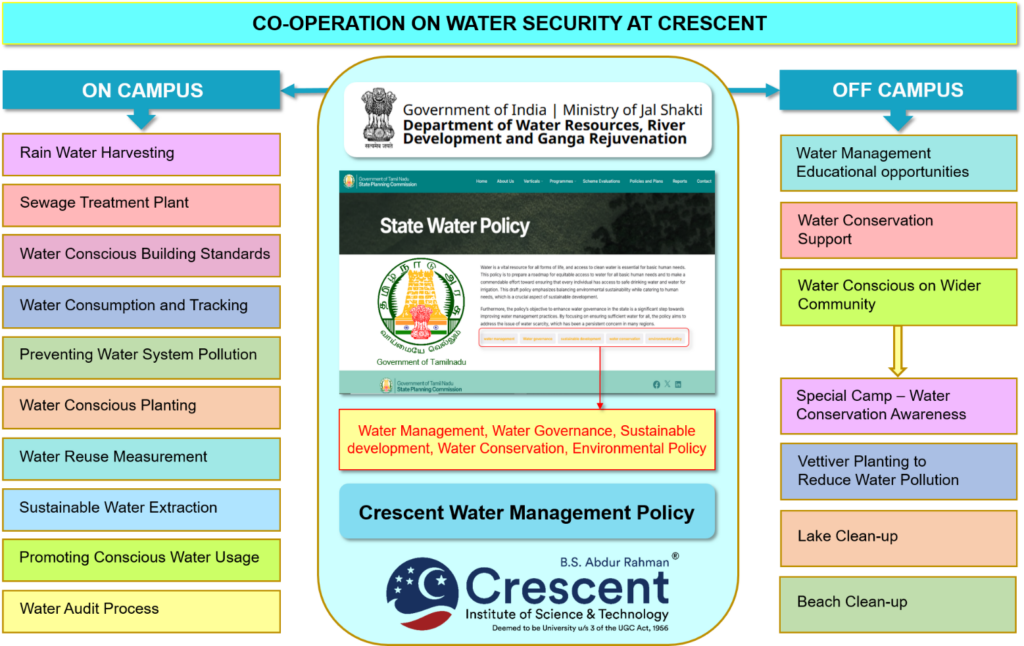
B.S. Abdur Rahman Crescent Institute of Science and Technology offers an on-campus, comprehensive suite of water sustainability modules designed for hands-on learning and real-world impact. Rain Water Harvesting and Water Reuse Measurement focus on capture, storage, and efficient reuse, while Sewage Treatment and Sustainable Water Extraction address treatment processes and ecological limits. Water Conscious Building Standards and Water Consumption and Tracking emphasize design, monitoring, and data-driven decision making. Preventing Water System Pollution, Water Conscious Planting, and Promoting Conscious Water Usage foster proactive stewardship through practical practices, landscaping, and behavior-change campaigns. Finally, the Water Audit Process ties everything together with systematic assessment, benchmarking, and actionable improvement plans to achieve campus-wide water efficiency gains.
1. Rain Water Harvesting
This initiative focuses on the design, installation, and monitoring of rainwater capture systems. Students learn to size storage, select appropriate conveyance, and assess treatment needs for reuse. It covers practical hands-on activities from guttering to filtration and distribution for non-potable uses. Emphasis is placed on systems that integrate with campus buildings and landscaping. The goal is to maximize local water supply while reducing stormwater runoff and demand on municipal sources.

2. Sewage Treatment Plant
This module provides exposure to wastewater treatment processes, from preliminary screening to advanced treatment and discharge considerations. Students explore microbiological and mechanical treatment principles, safety protocols, and environmental impacts. It includes simulations or visits to treatment facilities to understand reuse and resource recovery. Understanding regulatory frameworks and monitoring parameters is a key outcome. The aim is to foster responsible stewardship of wastewater, protecting water bodies and public health.
3. Water Conscious Building Standards
Participants examine sustainable building practices that minimize water use and wastage. Topics include low-flow fixtures, rainwater reuse, and landscape irrigation strategies. The module integrates with architecture and facilities management to evaluate whole-building water footprints. Students assess lifecycle costs and performance metrics to promote water efficiency in campus projects. The objective is to embed water-conscious design into campus development and maintenance.
4.Water Consumption and Tracking
This initiative trains students to monitor both personal and institutional water usage. They learn methods for data collection, metering, and baseline establishment. The focus is on identifying patterns, leaks, and opportunities for conservation through targeted interventions. Analytical tools and dashboards help communicate findings to stakeholders. The end goal is continuous improvement through transparent, data-driven water governance.
5. Preventing Water System Pollution
Education and practical activities teach how contaminants can enter water systems and the measures to prevent them. Students study pollution sources, containment strategies, and best practices for safe handling and disposal. The module emphasizes prevention planning, emergency response, and community awareness. It fosters proactive behavior to protect water quality across campus operations. The overarching aim is to safeguard drinking water and ecological health.
6. Water Conscious Planting
This initiative promotes landscaping with water-efficient species and smart irrigation. Students plan and implement drought-tolerant landscapes, soil moisture management, and rainfall-based irrigation schedules. They learn to balance aesthetics with conservation, including mulching and soil health practices. The module covers maintenance routines and monitoring to ensure long-term water savings. The result is a resilient, attractive campus environment that uses less water.
7. Water Reuse Measurement
Participants quantify reclaimed water use and evaluate system performance. They design measurement protocols, collect data, and analyze efficiency and reliability. The module covers quality checks, regulatory considerations, and practical reporting. Students compare different reuse schemes and their impact on campus water budgeting. The objective is to demonstrate tangible benefits and optimize reuse operations.
8. Sustainable Water Extraction
This initiative examines how to align water extraction with natural recharge and ecological limits. Students analyze local hydro resources, seasonal variability, and ecological flows. They learn to model sustainable yields and assess risk factors for over-extraction. The module emphasizes governance, policy alignment, and stakeholder engagement. The goal is to ensure campus usage supports long-term water sustainability.
9. Promoting Conscious Water Usage
Behavior change campaigns encourage reduced water waste and greater stewardship. Students design outreach strategies, messaging, and incentives to influence daily habits. They study social, cultural, and psychological factors affecting water use. The module includes peer-led initiatives, campaigns, and campus events. The aim is to cultivate a culture of mindful water consumption across the campus community.
10. Water Audit Process
A systematic evaluation of water use and opportunities for improvement, this module guides students through audit methodologies. They perform site surveys, data collection, and benchmarking against best practices. Students develop actionable recommendations and prioritized improvement plans. The process emphasizes transparency, stakeholder involvement, and ongoing monitoring. The outcome is a clear roadmap for campus water efficiency gains.
B. OFF-CAMPUS INITIATIVES
1.Water Management Educational Opportunities
This program engages the public and external stakeholders with workshops, seminars, and hands-on demonstrations on water management. It partners with local schools, NGOs, and government bodies to spread best practices for water conservation and pollution prevention. The curriculum covers rainwater harvesting, wastewater reuse, and safe water handling. Community centers host recurring events to raise awareness and empower residents to implement efficient water use at home. Outcomes include increased adoption of water-saving technologies beyond campus borders.
- Special Camp – Water Conservation Awareness
A special camp program focuses on immersive awareness and hands-on learning about water conservation. Activities include interactive demonstrations, field trips to local water bodies, and student-led outreach projects. The camp fosters youth leadership in environmental stewardship and provides materials for teachers to integrate water topics into curricula. Outcomes target increased knowledge retention and replication of camp concepts in schools and community groups.
- Water for Peace – World Water Day Celebration
A guest lecture titled “Water for Peace – World Water Day Celebration” was held on 21 March 2024, organized by the Institution of Engineers (India), Kancheepuram Local Centre, in collaboration with the Department of Civil Engineering, Crescent Institute. Dr. Sekhar Raghavan, the Rain Man and Director of the Rain Centre, Chennai, spoke on rainwater harvesting, emphasizing its critical role in water security for India and Chennai. The talk covered preventing silt deposition, maintaining filters, and ensuring proper roof drainage to sustain water access. He highlighted the Akash Ganga Trust and encouraged students to pursue project proposals with IEI funding opportunities. About 70 B.Tech Civil students attended, linking the lecture to courses in Stormwater, Hydrology, and Water Resources Engineering. The session concluded with felicitation and a vote of thanks, underscoring water stewardship and community engagement.
2. Water Conservation Support
A dedicated support network offers technical guidance, funding information, and resource referrals for external communities undertaking water-saving projects. The institute shares dashboards, case studies, and problem-solving sessions to help partners tailor solutions to local conditions. Services include site assessments, feasibility analyses for retrofits, and monitoring plans to track savings and environmental impact. The aim is to scale campus expertise into municipal or neighborhood-scale conservation efforts. Stakeholder engagement remains central to sustained impact.
- Vetiver Planting to Reduce Water Pollution
The initiative uses Vetiver grass to stabilize soil, reduce runoff, and mitigate pollution in catchment areas around water systems. Training covers plant selection, placement strategies, and maintenance to maximize pollutant filtration and erosion control. Partnerships with nurseries and landscape architects help scale Vetiver deployment in public spaces and rural sites. The program also monitors ecological benefits and documents improvements in water quality and soil health.
3. Water Conscious on Wider Community
This initiative extends water stewardship beyond the campus by collaborating with neighborhood associations and public spaces to promote water-wise landscaping, efficient irrigation, and leak detection. Workshops demonstrate low-water-use techniques and drought-tolerant plantings suitable for local climates. The program also enables community gardens to model sustainable water use, serving as living laboratories for students and residents alike. Regular outreach builds a culture of mindful consumption across the wider community.
- Lake Clean-up
Organized lake clean-up drives mobilize volunteers, students, and local residents to remove litter and pollutants from nearby water bodies. The effort includes pre-event planning, safety protocols, and post-cleanup data collection to measure pollutant loads and ecosystem recovery. Educational components emphasize watershed protection and pollution prevention practices. The initiative strengthens community ties and raises awareness of the link between land-use decisions and water quality.
- Beach Clean-up
Beaches and coastal areas around the region are prioritized for periodic cleanup events. Volunteers collect marine debris, monitor plastic pollution, and report findings to local authorities for remediation. Educational briefings highlight the impact of waste on marine life and human health, plus strategies for reducing single-use plastics. The program encourages student internships and community involvement for sustained environmental stewardship beyond campus.
Water Management and Reuse Policy
Issue: 04; Revised on 2023
| Policy Created on | July 2009 |
| 1st Revision amended on | IQAC Meeting held on 27th October 2017 |
| 2nd Revision amended on | IQAC Meeting held on 31st March 2021 |
| 3rd Revision amended on | IQAC Meeting held on 16th June 2023 |
Responsible Executive : Director (IQAC)
Responsible Office : Internal Quality Assurance Cell,
Student Affairs, Estate Office, Academic Office, Library and SDG Cell
Contacts : Registrar and Director (IQAC)
6.1 STATEMENT OF POLICY
The B.S. Abdur Rahman Crescent Institute of Science and Technology is committed to achieving the following objectives in alignment with Sustainable Development Goal 6 (SDG 6) – Clean Water and Sanitation:
a) Ensure universal and equitable access to safe and affordable drinking water for all stakeholders.
b) Provide adequate and equitable sanitation and hygiene for all, with special attention to the needs of women, girls, and vulnerable groups.
c) Improve water quality by reducing pollution, eliminating dumping, and minimizing the release of hazardous chemicals and materials.
d) Halve the proportion of untreated wastewater and substantially increase recycling and safe reuse globally.
e) Substantially increase water-use efficiency across all sectors and ensure sustainable withdrawals and freshwater supply to address water scarcity.
f) Implement integrated water resources management at all levels, including transboundary cooperation as appropriate.
g) Protect and restore water-related ecosystems, including mountains, forests, wetlands, rivers, aquifers, and lakes.
h) Expand international cooperation and capacity-building support to developing countries in water- and sanitation-related activities and programs.
i) Support and strengthen the participation of local communities in improving water and sanitation management.
6.2 REASON FOR THIS POLICY
The policy aims to provide all stakeholders with adequate water supply, sanitation, and hygiene. It emphasises maximising the collection and treatment of sewage generated and the reuse of treated wastewater sustainably, thereby reducing dependency on freshwater resources. The policy promotes treating wastewater as an economic resource.
6.3 RESPONSIBILITIES
6.3.1 Policy Principles
a) The campus shall provide adequate water supply and maximize water reuse by adhering to the following principles:
- Equitable access to safe and affordable drinking water for all stakeholders.
- Access to adequate sanitation and hygiene, ending open defecation, with special attention to vulnerable groups.
- Calculation of water usage per person (students, staff, and faculty) annually.
- Improving water quality by reducing pollution and increasing recycling and safe reuse.
- Utilization of recycled/treated wastewater for beneficial purposes, such as irrigation and toilet flushing.
- Implementation of integrated water resources management at all levels.
- Protection and restoration of water-related ecosystems on campus.
- Expansion of rainwater harvesting initiatives.
- Collaboration with government, NGOs, and industries in water-related activities.
- Support for student and staff participation in water management.
6.4.1 Water Reuse Policy Objectives
- Establish a comprehensive policy to maximize water reuse across the university.
- Ensure that all new buildings adhere to water-conscious building standards that facilitate water reuse.
- Implement systems for tracking and measuring water consumption and reuse.
6.4.2 Water Reuse
- Water Reuse Policy: maximise water reuse across the university.
- Water Reuse Measurement: Measure water reuse across the university.
6.5 DISSEMINATION OF POLICY
a) Display signage promoting water use efficiency across the campus.
b) Conduct awareness programs at regular intervals to increase water-use efficiency.
c) Post the policy on the Institute’s website and update it as necessary.
6.6 ENFORCEMENT OF POLICY
a) The Director (Planning & Development) and Deputy Director monitor compliance and address breaches.
b) Awareness of the policy among students, staff, and visitors is essential.
c) Breaches may lead to disciplinary action as per the Institute’s code of conduct.