

B.S. Abdur Rahman Crescent Institute of Science and Technology (BSACIST) has demonstrated a strong commitment to promoting lifelong learning by ensuring that educational resources are accessible to all individuals, regardless of their background. This initiative aligns with the university’s mission to foster an inclusive educational environment that supports continuous learning and community engagement. BSACIST is deeply committed to SDGs through inclusive outreach and STEM capacity building, prioritizing inclusive, quality education for all.
BSACIST is pleased to organize a public-facing executive education program that emphasizes the critical role of quality education in shaping a resilient, innovative, and inclusive society. Building on BSACIST’s track record of NEP-aligned initiatives, vocational training, and specialized workshops (including electrochemical corrosion techniques and IFRS insights), this program will deliver hands-on, practitioner-led sessions designed for working professionals, educators, and public sector participants. By integrating experiential learning, industry partnerships, and accessible formats (with no registration fees where feasible), BSACIST will demonstrate how high-quality pedagogy, modern curricula, and governance reforms translate into measurable outcomes—better employability, lifelong learning, and equitable access to education. The institute will collaborate with universities, industry bodies, and government partners to ensure content is relevant, scalable, and aligned with SDG 4, thereby reinforcing the public value of quality education and reinforcing BSACIST’s leadership in executive education and lifelong learning.
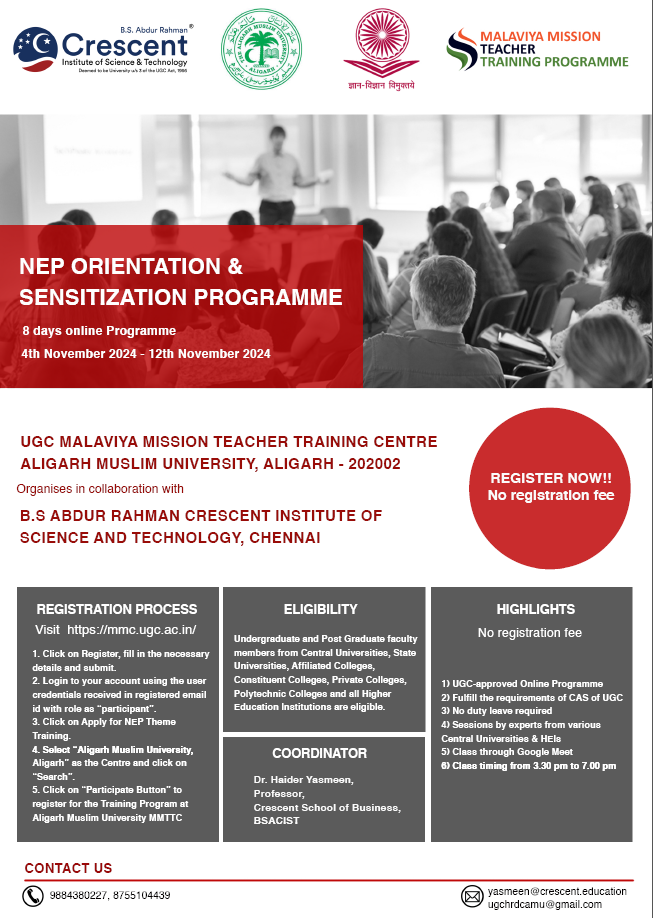
Poster for NEP Orientation & Sensitization Program
The NEP-Nov 2024 online orientation organized by UGC Malaviya Mission Teacher Training Centre in collaboration with Crescent Institute of Science and Technology (BSACIST) exemplifies BSACIST’s commitment to SDG 4: Quality Education. By delivering an eight-day, online, expert-led program to undergraduates and postgraduates from diverse institutions, BSACIST expands access to high-quality educational experiences beyond traditional classrooms. The event feature set—lectures by eminent professors, industry professionals, and NEP 2020 governance sessions—demonstrates a robust, practice-oriented approach that translates policy-level insights into actionable knowledge for a broad audience, thereby democratizing educational opportunity and fostering lifelong learning.
The programme emphasizes experiential learning and interdisciplinary engagement, aligning with BSACIST’s aim to elevate educational quality through collaborative design and real-world relevance. Activities such as e-content creation, integration of AI and technology in curricula, and discussions on inclusive pedagogy reflect a commitment to modernizing pedagogy while ensuring inclusivity and accessibility. By coordinating with multiple universities and offering no registration fee, BSACIST not only enhances its own educational offerings but also strengthens public understanding of NEP 2020, teacher education reforms, and governance in higher education—embodying SDG 4’s mandate to provide inclusive, equitable, and quality education for all.

REPORT
EDUCATIONAL EVENT – POSTER FOR THE EVENT
08 Days Online NEP 2020 Orientation and Sensitization Programme
The 8 days online-National Education Policy Programme (2020) was a great eye-opener for the course coordinator and the course participants. The programme is a joint initiative of UGC Malaviya Mission Teacher Training Centre, Aligarh Muslim University, Aligarh and BSA Crescent Institute of Science and Technology, Chennai. The Malaviya Mission Teacher Training Programme is laid down in the Career Advancement Scheme (CAS) of UGC.
The programme was basically meant for undergraduate and post graduate faculty members from central universities, state universities, affiliated colleges, constituent colleges, private colleges, polytechnic colleges and all higher education institutions. The sessions were handled through on- line mode using google meet platform and was scheduled in the afternoon, during off working hours. No duty leave was required to be obtained. Each session was scheduled for 1 hour and 30 minutes. Two sessions were fixed in a day and a total of 16 sessions were scheduled for 8 days. Twenty-two (22) participants, both from Crescent and from other universities participated in the programme (both lists provided below).
- Eminent Professors from Central Universities, Industry Professional and experts from Ministry of Education were chosen as speakers to provide orientation and sensitize participants on the various dimensions of National Education Policy (2020). On day 1-1st slot, we had Prof. Asiya Choudhary from the Department of Commerce, AMU, speaking on the importance of Entrepreneurship Development. She emphasized on the fact that we need to create more job providers rather than job seekers in order to increase the job employment opportunities every year, thereby contributing to India’s economy, which continues to remain as one of the fastest-growing economies of the world. The focus should be on becoming an entrepreneurial university. On day 1-2nd slot, Prof. Sajid Jamal from Department of Education, AMU pointed out that designing interesting and industry relevant curriculum and pedagogy would facilitate in the holistic growth of students.
- The 2nd day-1st slot and 3rd day-1st slot was on e-content creation. The session was conducted by Prof. Aasim Zafar from Dept of CSE, AMU. The speaker, very diligently touched upon several important topics such as need for on-line teaching, e-PG Pathshala, development of MOOC courses by university professors, funding for development of MOOC courses, Swayam platform for MOOCs, life-cycle of MOOC course etc. The participants found the sessions to be very useful and interesting. On 2nd day-2nd slot, Prof. MN Mustafa from School of Education, Central University of Kerala highlighted the complimenting role of teaching and research. He focused on ethics integrity value addition and quality when it comes to research.
- For day 3-2nd slot, Ms. Farha Haider, Data Scientist, Nokia, Canada was invited to speak on the significance of Integrating AI & Technology in Academic Curriculum, both at school and university level. She made it very clear that the students should start preparing themselves for a futuristic world where AI, Machine Learning, Robotics will be used extensively in businesses across the globe. A number of new jobs will be created in the place of old jobs which might soon become obsolete. She also underlined the fact that university-school connect and industry-school connect are equally important as industry-university connect, because the foundation needs to be strong right from school education. She pointed out the differences across countries with regard to integration of AI and technology in academic curriculum.
- The 4th day, slot 1 was handled by Prof. Masroor Alam, Dept. of Civil Engineering, ZHCET, AMU on the topic, Climate Change and Problem of Pollution. He stressed that people are not realizing the ill-effects that global warming and pollution would have on the entire world. He explained very clearly the concept of greenhouse effect, glacier melting, sea-level rising and increase in concentration of CO2, which demands our immediate attention. He said there is an urgent need to introduce a lot of courses on environmental sustainability for sensitization in schools and universities, conducting awareness program and carrying out research studies pertaining the same in order to avoid further damage to the planet.
- The 2nd slot of the 4th day was taken over by Prof. Nasreen, Department of Education, AMU, on Handling Student Diversity and Inclusive Education where she focused on the necessity to have diversity of students in educational institution. She also reiterated the need to create an environment where all students experience a sense of belongingness and are valued, respected, and safe. All students need to have equal access to learning opportunities, especially children with special need, from marginalized section and children in difficult circumstances as highlighted by NCF (National Curriculum Framework, India).
- On day 5, 1st slot, Prof. Anisur Rahman, JMI spoke on the Current Opportunities & Challenges of Higher Education in India and in the 2nd slot, Dr. Shaheer Siddiqui, Dept. of Education, AMU, spoke on Indian Pedagogy. Prof. Shaheer spoke about ancient evolution of pedagogy and how modern education is built on the foundation of the ancient education system. He started off with Shri Aurobindo’s Philosophy, the five levels of education and continued with Charles Darwin’s theory, the poems of Sufis, Upanishads, inspirations from Adi Shankara’s Vedanta, Swami Vivekananda’s teachings etc. He highlighted what was told by Shri Rabindranath Tagore that only education will give us freedom of mind, freedom of heart and freedom of will. His session was very inspiring and resourceful.
- On day 6th-1st slot, the session was on the topic Teacher Centric and Student Centric Approach, Prof. Asmer Beg from Dept. of Politics, AMU, explained very clearly that teaching students is like science, whether it is teacher centric approach or student centric approach or a combination of both, the teaching-learning should be on the basis of logic and fact. Only then education will have positive impact on students.
- The 6th Day-2nd slot was handled by Prof. Anjan Chakravarty, Director, UGC MMTTC, North Bengal University, Siliguri. He spoke about the significance of Interdisciplinary Research Collaboration. There is a compelling need to collaborate with other specializations in order to come out with better research findings and solutions to solve societal problems.
- The 7th day, slot 1 was conducted by Prof. Jasim Ahmad, IASE, Jamia Millia Islamia, on the topic Holistic & Multidisciplinary Education and slot 2 was handled by Dr. Shefali Nagpal, BPS Mahila University, Sonepet on the topic An Overview of Indian Knowledge System (Indigenous Knowledge). She shared that IKS is based on deep understanding of human beings, nature and existence. She gave example of Aurvedic medicines belonging to India’s traditional health care system.
- The last day, 1st session was handled by Dr. Shakila T. Shamsu, Officer on Special Duty (OSD), NEP, Ministry of Education, Govt of India, New Delhi. She spoke on Governance & Management of Higher Education as Envisaged in NEP 2020. Her session was very dynamic leading to a number of queries on the different facets of NEP (2020) from the participants. The speaker answered all the queries very patiently and clearly.
- The last session by Prof. Kidwai, former Director, UGC-HRDC, AMU was very experience driven and inspiring. His topic for deliberation was on “Academic Leadership”. This was the most important topic of the NEP programme, because, if an academic leader does not have the charisma and is not having the required traits and persona of a good leader, then the whole academic system fails, jeopardizing the growth and development of students, faculty members, society and country as a whole.
- The 8 days programme ended with a valedictory session by the team, AMU wherein feedback was provided by the participants. On the whole, the participants felt it was a very knowledge driven programme and appreciated every speaker for their amazing and expert lecture session. The Director of MMTTC, AMU, Prof. Faiza Abbasi congratulated the coordinator for the smooth execution of the programme. The participants also appreciated the coordinator of the programme for constantly keeping them interested and connected with the speakers.
Resource Persons-Programme Schedule
Day No. | Date | Session I (3.30 – 5:00 p.m.) |
| Session II (5.30 – 7.00 p.m.) |
1. |
04.11.2024 Monday | Prof. Asiya Choudhary Department of Commerce, AMU Entrepreneurship Development | Prof. Sajid Jamal Department of Education, AMU Curriculum Design & Development | |
2. |
05.11.2024 Tuesday |
Prof. Aasim Zafar Dept. of Computer Science, AMU e-Content Creation-I | Prof. MNM Alias Mustafa Dean, School of Education, Central University of Kerala, Kasargod Interconnectivity of Teaching & Research | |
3. | 06.11.2024 Wednesday | Prof. Aasim Zafar Dept. of Computer Science, AMU e-Content Creation-II | Ms. Farha Haider Data Scientist, Canada Integrating AI & Technology in Curriculum | |
4. |
07.11.2024 Thursday | Prof. Masroor Alam Dept. of Civil Engg., ZHCET, AMU Climate Change and Problem of Pollution | Prof. Nasrin Department of Education, AMU Handling Student Diversity and Inclusive Education | |
5. |
08.11.2024 Friday | Prof. Anisur Rahman JMI, New Delhi Current Opportunities & Challenges of Higher Education in India | Dr. Shaheer Siddiqui Dept. of Education, AMU Indian Pedagogy | |
6. |
09.11.2024 Saturday | Prof. M. Asmer Beg Dept. of Political Science, AMU Teacher Centric & Student Centric Methods of Teaching | Prof. Anjan Chakravarty Director, UGC MMTTC North Bengal University, Siliguri Interdisciplinary Research Collaboration | |
7. |
11.11.2024 Monday | Prof. Jasim Ahmad IASE, Jamia Millia Islamia, New Delhi Holistic & Multidisciplinary Education | Dr. Shefali Nagpal BPS Mahila University, Sonepat An Overview of IKS | |
8. |
12.11.2024 Tuesday | Dr. Shakila T. Shamsu Former OSD, NEP, Ministry of Education, Govt of India, New Delhi Governance & Management of Higher Education as Envisaged in NEP 2020 | Prof. A.R. Kidwai Former Director Erstwhile UGC HRDC, AMU Academic Leadership |
Participant’s List
S.No. | Name | Designation | Institutional Address | Affiliated University |
1. | Dr. V. Viswanath | Assistant Professor | Government First Grade College, Bangarpet | Bangalore University, Bangalore |
2. | Thameemul Ansari Juvairiyyah Habib Mohamed | Assistant Professor | Crescent School of Pharmacy | B.S. Abdur Rahman Crescent Institute of Science & Technology |
3. | Mr. Santhosh George | Assistant Professor | Pavanatma College | Mahatma Gandhi University, Kottayam |
4. | Sabiyath Fatima Nakeeb | Professor | BSACIST | B.S. Abdur Rahman Crescent Institute of Science & Technology |
5. | Dr. Bhaskar Jyoti Sarmah | Assistant Professor | Jorhat Institute of Science and Technology | Assam Science and Technology University |
6. | Miss. Srijita Majumdar | Assistant Professor | Chandernagore College | The University of Burdwan |
7. | Dr. R.A.M. Jainaf Nachiya | Assistant Professor | B.S. Abdur Rahman Crescent Institute of Science and Technology | B.S. Abdur Rahman Crescent Institute of Science & Technology |
8. | Dr. Sipra Samanta | Assistant Professor | Haldia Government College | Vidyasagar University, Midnapore |
9. | Dr. Susmita Basu | Assistant Professor | Haldia Government College | Vidyasagar University, Midnapore |
10. | Dr. Pawan Kumar Tripathi | Assistant Professor | Jagadguru Rambhadracharya Divyang State University, Chitrakoot | Jagadguru Rambhadracharya Handicapped University |
11. | Dr. Jose Prakash Dharmian | Assistant Professor | Crescent School of Pharmacy | B.S. Abdur Rahman Crescent Institute of Science & Technology |
12. | Dr. Kannan G. | Associate Professor | B.S. Abdur Rahman Crescent Institute of Science and Technology | B.S. Abdur Rahman Crescent Institute of Science & Technology |
Participant’s List
13. | Raja Navamanisubramanian | Assistant Professor | Crescent School of Pharmacy | B.S. Abdur Rahman Crescent Institute of Science & Technology |
14. | Prakash R. | Associate professor | Crecent School of Pharmacy | B.S. Abdur Rahman Crescent Institute of Science & Technology |
15. | Mohamed Sheik Sirajuddeen Mohamed Abdullah | Associate Professor | B.S. Abdur Rahman Crescent Institute of Science and Technology | B.S. Abdur Rahman Crescent Institute of Science & Technology |
16. | Kehkeshan Fatma | Assistant Professor | Women’s College, Aligarh Muslim University | Aligarh Muslim University, Aligarh |
17. | Dr. Md. Sahnewaz Sanu | Assistant Professor | Pandit Deendayal Upadhyaya Govt. Model College, Katlicherra | Assam University, Silchar |
18. | Dr. Rohit Sagar | Assistant Professor | Shri Ram Murti Gupta Govt. P.G. College, Chharra, Aligarh | Raja Mahendra Pratap Singh State University, Aligarh |
19. | Dr. Arshi Ayub Ansari | Assistant Professor | Mahila Vidyalaya Degree College, Aminabad, Lucknow | University of Lucknow |
20. | Dr. Sadaf Haneef | Assistant Professor | Women’s College, AMU, Aligarh | Aligarh Muslim University, Aligarh |
21. | Dr. Saran Pal Singh | Professor | Pandit Deen Dayal Upadhyay Rajkiya Mahavidyalaya, Tilhar, Shahjahanpur | Mahatama Jyotiba Phule Rohikhand University, Bareilly |
22. | Dr. Md. Salim Zaweed | Assistant Professor | Presidency University | Presidency University |
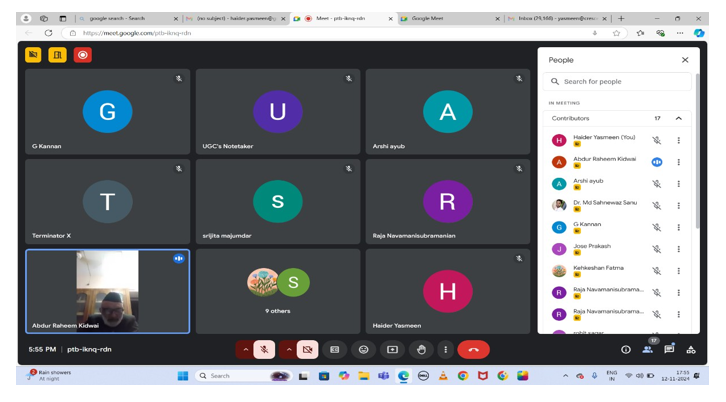
EDUCATIONAL EVENT 1B – SCREENSHOT FOR THE EVENT
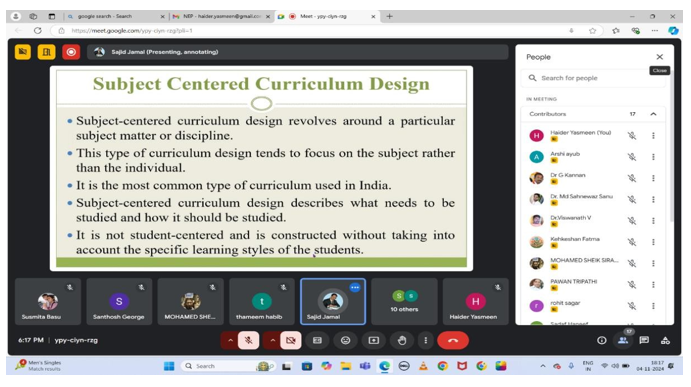
EDUCATIONAL EVENT – SHARING THE COURSE CONTENT
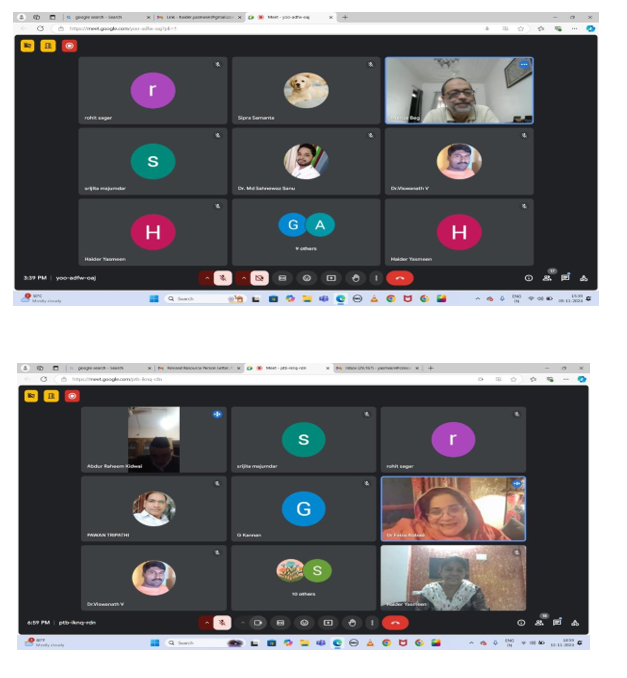
EDUCATIONAL EVENT – ONLINE LECTURE CONTENT
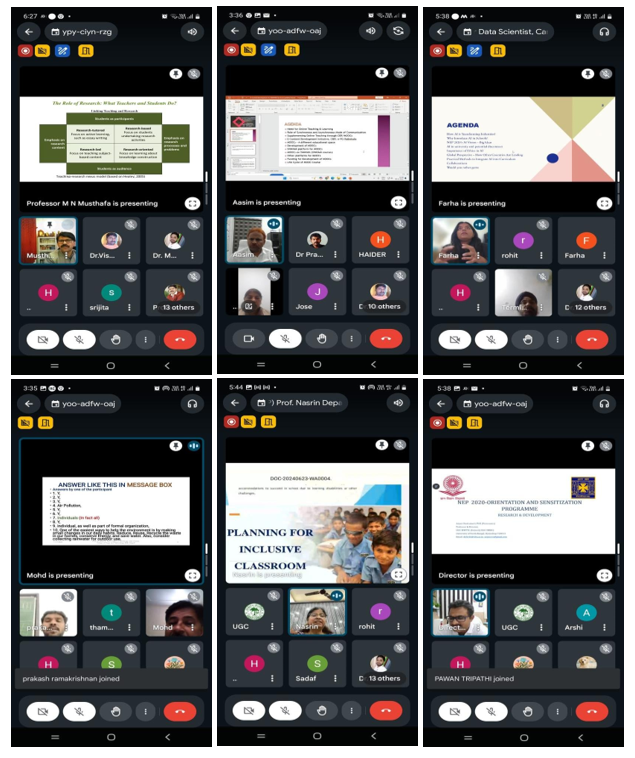
EDUCATIONAL EVENT – ONLINE LECTURE – A SNAPSHOT
The NEP Programme ended on a positive note with lots of though provoking learnings. Sharing the salient features of NEP for your reference (doc attached).
Thank You
Prof. Dr. Haider Yasmeen Coordinator-NEP (2020)
24.11.2024
A two-day workshop on “Electrochemical Corrosion Techniques: Theory and Hands-on Training” was organized by the Department of Civil Engineering, and Department of Chemistry, B.S. Abdur Rahman Crescent Institute of Science & Technology in association with AMPP India section (SZ) & NIIS (SZ) on 08.03.2024 and 09.03.2024.
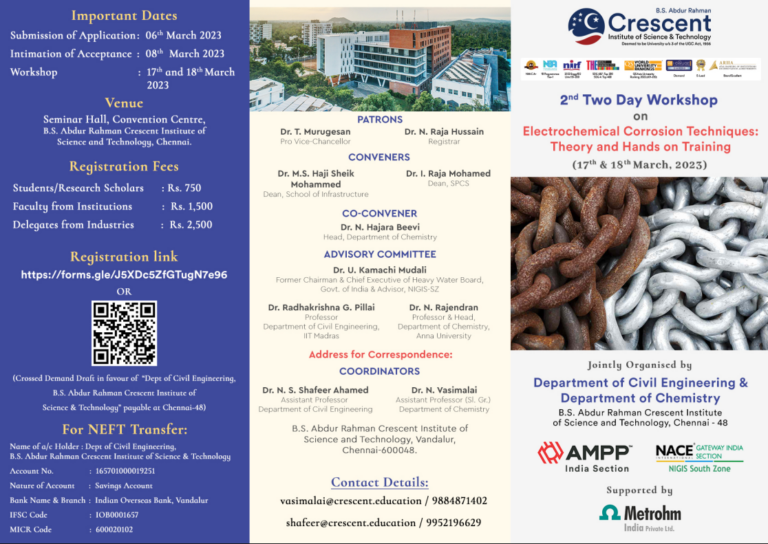
BROCHURE OF THE WORKSHOP
REPORT
SCHOOL OF INFRASTRUCTURE
DEPARTMENT OF CIVIL ENGINEERING
Ref. : 766/Dean(SoI)/0424 Date: 04.04.2024
Date: 08.03.2024 – 09.03.2024 Time: 9.30 am to 4.00 pm
I. Preamble:
A two-day workshop on “Electrochemical Corrosion Techniques: Theory and Hands-on Training” was organized by the Department of Civil Engineering, and Department of Chemistry, B.S. Abdur Rahman Crescent Institute of Science & Technology in association with AMPP India section (SZ) & NIIS (SZ) on 08.03.2024 and 09.03.2024.
II. ABOUT THE SPEAKERS AND TOPICS
• Advanced Electrochemical Techniques: Dr. S. Ningshen, Head, CSTD & CEPS, IGCAR, Kalpakkam
• Advanced Techniques of Monitoring – Electrochemical Impedance Spectroscopy: Dr. S. Ramanathan, Professor, Department of Chemical Engineering, IIT Madras
• Corrosion Testing of Steel in Concrete: Dr. Radhakrishna G. Pillai, Professor, Department of Civil Engineering, IIT Madras
• Basics of Electrochemistry, Testing and Monitoring: Dr. S. Rangarajan, Former Head, Water & Steam Chemistry Division, BARCF, Kalpakkam
• Basics of Corrosion and its Forms: Dr. S. C. Vanithakumari, SO/F, Corrosion Science & Technology Division, IGCAR, Kalpakkam
• Electrochemical Behaviour of Coated Steel Rebars in Concrete: Dr. M.S. Haji Sheik Mohammed, Dean, School of Infrastructure, BSACIST
• Inhibitors for Corrosion Protection: Dr. T.M. Sridhar, Assistant Professor & Head (i/c), Department of Analytical Chemistry, Madras University
• Applications of Nanomaterials for Corrosion Control: Dr. N. Vasimalai, Asst. Prof. (Sel. Gr.), Department of Chemistry, BSACIST
• Galvanic Anode Cathodic Protection: Dr. Roopa V, Asst. Prof. (Sr. Gr.), Department of Civil Engg., BSACIST
ABOUT THE SESSION:
The purpose of the two-day workshop is to train postgraduate students, research scholars, faculty members of arts & science and engineering colleges, and industry personnel in electrochemical analytical equipments and related theory. The workshop aims to provide knowledge on the latest advancements in electrochemical corrosion and its control techniques in the fields of science and technology. It is intended to serve as an introduction to the use of electrochemical techniques in corrosion applications, with an emphasis on the use of modern instruments to acquire pertinent data. The workshop also aims to provide practical insight into corrosion aspects and to train participants in the proper interpretation of data for use in corrosion prediction, prevention, and monitoring.
The session details and programme schedule are given below:
DAY 1 – March 8, 2024 (Friday) |
| |
Time | Topic | Speaker / Resource Person |
8.30 – 9.30 a.m. | Registration | |
9.30 – 9.35 a.m. | About the Workshop | Dr. M.S. Haji Sheik Mohammed Dean, School of Infrastructure, BSACIST |
9.35 – 9.45 a.m. | Felicitation & Inauguration of Workshop | Dr.S.Ningshen Head, CSTD & CEPS, IGCAR, Kalpakkam |
9.45 – 10.30 a.m. | Basics of Corrosion and its Forms | Dr. S.C. Vanithakumari, SO/F, Corrosion Science & Technology Dicision, IGCAR, Kalpakkam |
10.30 – 11.15 a.m. | Basics of Electrochemistry, Testing and Monitoring | Dr.S.Rangarajan, Former Head, Water & Steam Chemistry Division, BARCF, Kalpakkam |
11.15 – 11.30 a.m. | Tea Break | |
11.30 – 12.30 noon | Advanced Electrochemical Techniques | Dr.S.Ningshen Head, CSTD & CEPS, IGCAR, Kalpakkam |
12.45 – 2.00 p.m. | Lunch Break | |
2.00 – 3.00 p.m. | Corrosion Testing of Steel in Concrete | Dr. Radhakrishna G Pillai, Professor, Department of Civil Engineering, IIT Madras |
3.00 – 4.00 p.m. | Hands-on Training on Basic Electrochemical Testing Techniques | Faculty members of BSACIST & Research Scholars of IIT Madras and BSACIST |
4.00 p.m. | High Tea | |
DAY 2 – March, 9, 2024 (Saturday) |
| |
Time | Topic | Speaker / Resource Person |
9.00 – 9.30 a.m. | Galvanic Anode Cathodic Protection | Dr. Roopa V, Asst Professor (Sr. Gr.), Department of Civil Engineering, BSACIST |
9.30 – 10.00 a.m. | Electrochemical Behaviour of Coated Steel Rebars in Concrete | Dr. M.S. Haji Sheik Mohammed Dean, School of Infrastructure, BSACIST |
10.30 – 11.00 a.m. | Applications of Nanomaterials for Corrosion Control | Dr. N. Vasimalai, Asst. Professor (Sel. Gr.) Department of Chemistry,BSACIST |
11.00 – 11.15 a.m. | Tea break | |
11.15 – 12.00 a.m. | Inhibitors for Corrosion Protection | Dr. T.M. Sridhar, Assistant Professor, Head (i/c), Department of Analytical Chemistry, University of Madras. |
12.00 – 01.00 p.m. | Advanced Techniques of Monitoring – Electrochemical Impedance Spectroscopy | Dr. S. Ramanathan, Professor, Department of Chemical Engineering, IIT Madras |
12.45 – 2.00 p.m. | Lunch Break | |
2.00 – 3.30 p.m. | Hands – on Training on Advanced Electrochemical Testing Techniques | Dr. S. Ramanathan, Professor, Department of Chemical Engineering, IIT Madras Research Scholars of IIT Madras and BSACIST |
3.30 to 3.45 p.m. | MCQ on Topics of Day 1 and 2 | Research Scholars of BSACIST |
4.00 to 4.30 p.m. | Valediction, Certificate Distribution & High Tea | |
Dr. Mohd. Umar recited the Qirath and the workshop began with the blessings of almighty.
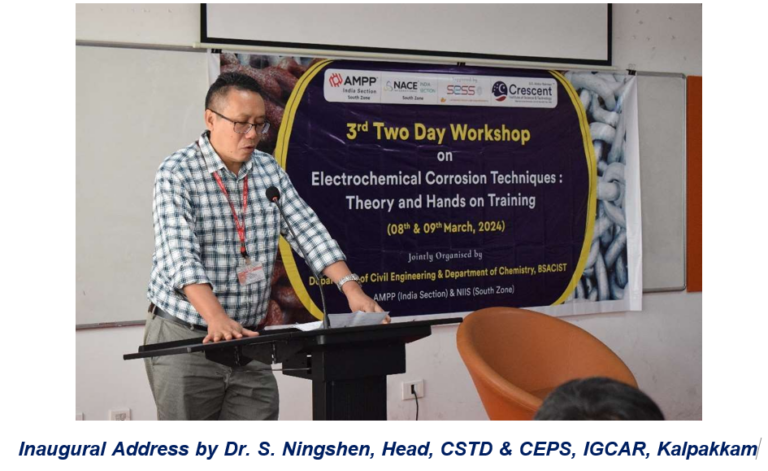
Dr. M.S. Haji Sheik Mohammed, Dean, School of Infrastructure, briefed about the workshop and the workshop was inaugurated by Dr. S. Ningshen, Head, CSTD & CEPS, IGCAR, Kalpakkam.
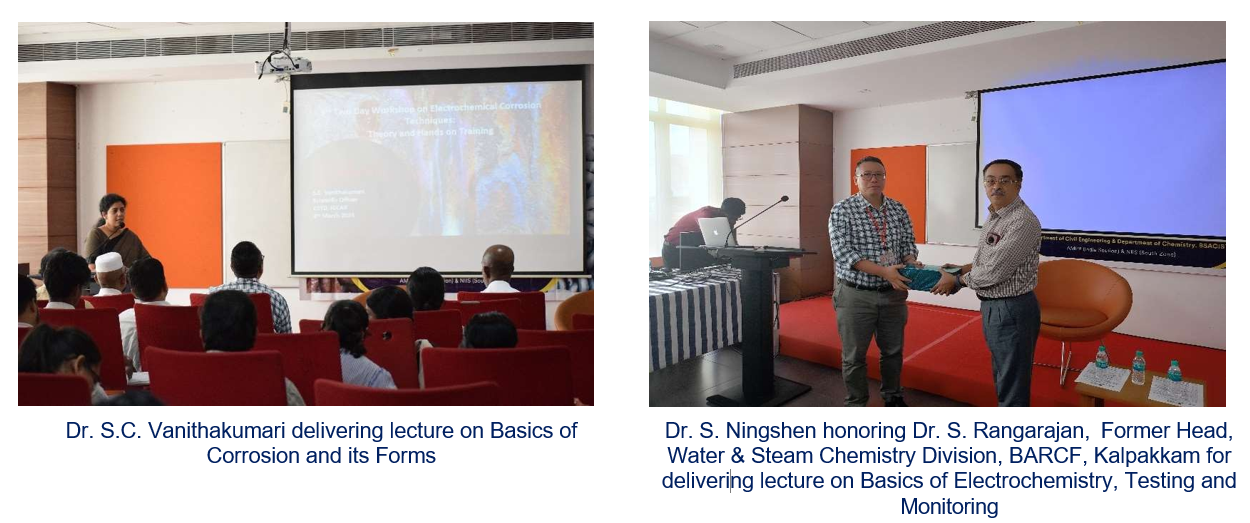
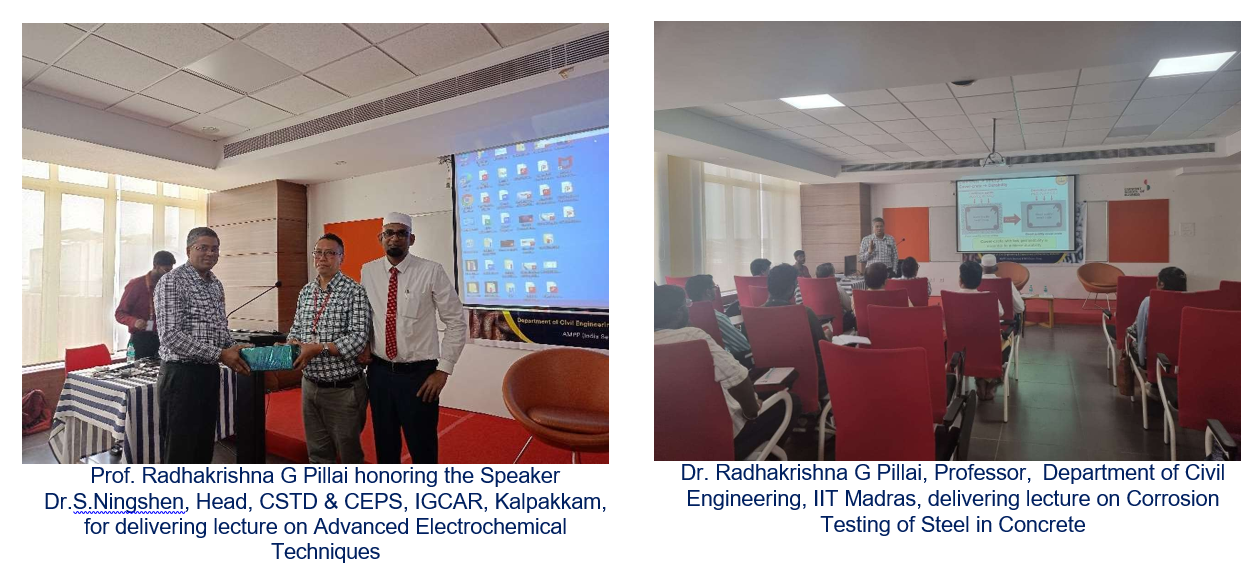
Following the inaugural ceremony, the speakers delivered the thematic lectures on the various topics as per the schedule. All the lectures were very informative and interesting to the participants.
During the Hands-on training session, the participants were exposed to various electrochemical testing techniques / experiments such as Electrochemical impedance spectroscopy, impressed voltage test, half cell potential test, macrocell corrosion test, carbonation test and the determination of chloride threshold etc. The participants were also facilitated to perform the experiments under the mentoring of expertise faculty and research scholars.
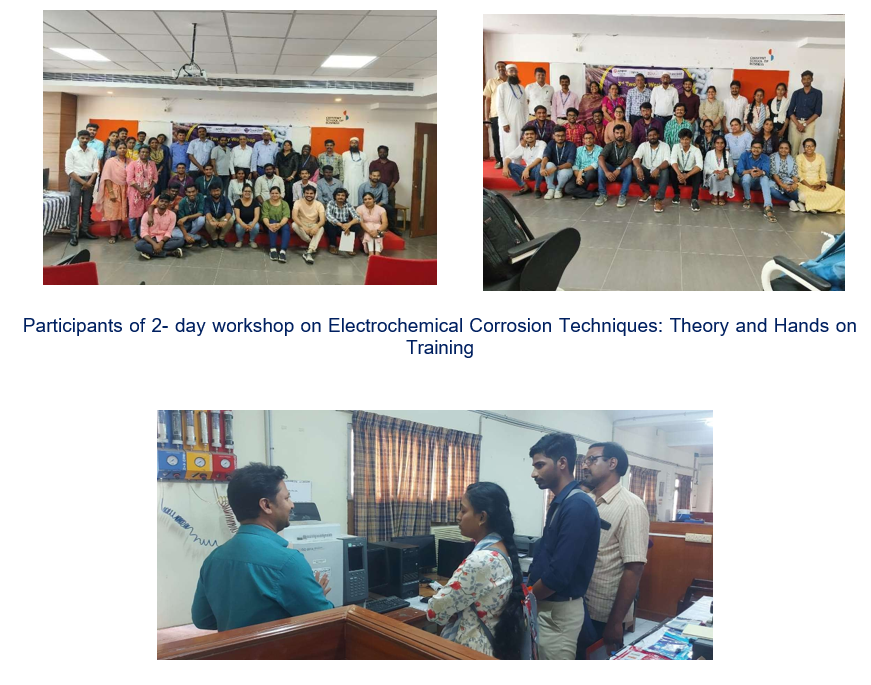
Hands on training session on 8th March 2023 (Afternoon) at Chemistry Laboratory
The following are the details of participants of ECT 2024:
S.No |
Name |
Designation |
Institution |
1 |
Ms. Benisha P.V |
Research Scholar |
University of Madras |
2 |
Ms. Dharshini A |
Research Scholar |
Anna University |
3 |
Mr. Dilrabin K |
Research Scholar | National Institute of Technology, Calicut |
4 |
Ms. Hemalatha C |
Research Scholar | B.S. Abdur Rahman Crescent Institute of Science and Technology |
5 |
Ms. Immaculate Mercy J |
Research Scholar | B.S. Abdur Rahman Crescent Institute of Science and Technology |
6 |
Mr. Jabastin S |
Research Scholar |
University of Madras |
7 |
Mr. Prem Kumar S |
II Year, Msc., Chemistry |
Vivekananda College, Madurai |
8 |
Mr. Ranjith Kumar R |
II Year, Msc., Chemistry |
Vivekananda College, Madurai |
9 |
Ms. Siani Michel |
Research Scholar | National Institute of Technology, Calicut |
10 |
Ms. Srividya T |
Research Scholar | SRM Institute of Science and Technology |
11 |
Mr. Suriyapandi M |
II Year, Msc., Chemistry |
Vivekananda College, Madurai |
12 |
Mr. Symonds Fradrick J |
Research Scholar | B.S. Abdur Rahman Crescent Institute of Science and Technology |
13 |
Ms. Cheranmadevi P |
Research Scholar |
Anna University |
14 |
Mr. Muniyan P |
Research Scholar |
Anna University |
15 |
Ms. Veera Muthammal V |
Research Scholar | B.S. Abdur Rahman Crescent Institute of Science and Technology |
16 |
Mr. Ashar Eqbal | II Year, M.Tech., Structural Engineering | B.S. Abdur Rahman Crescent Institute of Science and Technology |
17 |
Ms. Charumathi M | I Year, M.Tech., Structural Engineering | B.S. Abdur Rahman Crescent Institute of Science and Technology |
18 |
Ms. Divyalakshmi M |
II Year, M.Sc Chemistry | B.S. Abdur Rahman Crescent Institute of Science and Technology |
19 |
Mr. Hirthik Ramkumar A | I Year, M.Tech., Structural Engineering | B.S. Abdur Rahman Crescent Institute of Science and Technology |
20 |
Mr. Inzamam Ul Haq A |
I Year, M.Sc., Chemistry | B.S. Abdur Rahman Crescent Institute of Science and Technology |
21 | Mr. Mohammed Yasin A M | II Year, M.Tech., Structural Engineering | B.S. Abdur Rahman Crescent Institute of Science and Technology |
22 |
Mr. Muhammed Ibrahim L | I Year, M.Tech., Structural Engineering | B.S. Abdur Rahman Crescent Institute of Science and Technology |
23 |
Mr. Narendran P |
II Year, M.Sc Chemistry | B.S. Abdur Rahman Crescent Institute of Science and Technology |
24 |
Mr. Naveen E | I Year, M.Tech., Structural Engineering | B.S. Abdur Rahman Crescent Institute of Science and Technology |
25 |
Mr. Praveen J | I Year, M.Tech., Structural Engineering | B.S. Abdur Rahman Crescent Institute of Science and Technology |
26 |
Ms. Priya M | II Year, M.Sc., Chemistry | B.S. Abdur Rahman Crescent Institute of Science and Technology |
27 |
Mr. Saran T | I Year, M.Tech., Structural Engineering | B.S. Abdur Rahman Crescent Institute of Science and Technology |
28 |
Mr. Nabeel Abdullah | Final Year, B.Tech., Civil Engineering | B.S. Abdur Rahman Crescent Institute of Science and Technology |
29 |
Mr. Ramesh Kumar R |
Assitant Professor | Ramakrishna Mission Vivekananda College , Chennai |
30 |
Mr. Sahik Davood | I Year, M.Tech., Structural Engineering | B.S. Abdur Rahman Crescent Institute of Science and Technology |
31 |
Dr. Sivaramakrishnan S |
Associate Professor | Sairam Institute of Technology, Chennai |
32 | Ms. Mary Rebekah Sharmila S |
Research Scholar | B.S. Abdur Rahman Crescent Institute of Science and Technology |
33 |
Ms. Abirami R |
Research Scholar |
University of Madras |
34 |
Ms. Bidisha Panda |
Internship Student | B.S. Abdur Rahman Crescent Institute of Science and Technology |
35 |
Dr. Purnima |
Post Doctrate | Indian Institute of Technology, Madras |
36 |
Dr. Krishna Unni A S |
Post Doctrate | Indian Institute of Technology, Madras |
37 |
Mr. Umesh Hule |
Research Scholar | Indian Institute of Technology, Madras |
38 |
Ms. Shefali Aggarwal |
Research Scholar | Indian Institute of Technology, Madras |
39 |
Ms. Swapna S | II Year, M.Sc., Chemistry | B.S. Abdur Rahman Crescent Institute of Science and Technology |
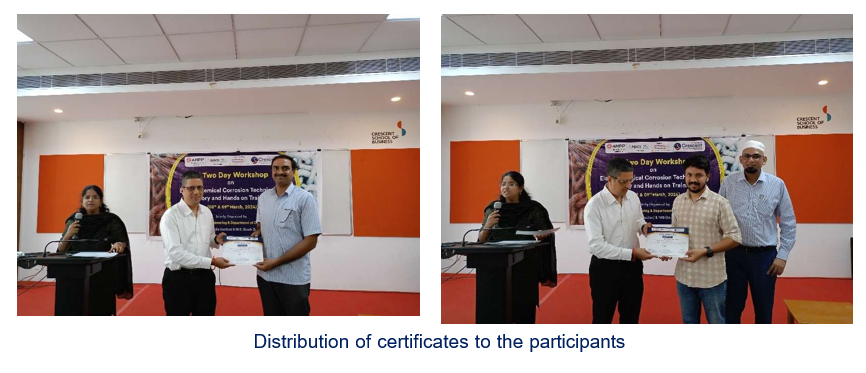
A Quiz was conducted at the end of 2 days workshop. The first three winners were Mr. Umesh Hule, Ms. Shefali Aggarwal and Dr. Purnima. They were awarded with cash prizes of Rs. 1000 , Rs.750 and Rs. 500 respectively. The certificate for participation was distributed to the participants by Dr. S. Ramanathan, Professor, Department of Chemical Engineering, IIT Madras. Vote of thanks was proposed by Dr. N . H a j a r a B e e v i , Head, Department of Chemistry. The organizers heartly thank and acknowledge the support from sponsors M/s. Sri Easwari Scientific Solution Pvt Ltd, Chennai and M/s. Leading Edge Lab Equipments limited, Coimbatore for the smooth conducte of ECT 2024.
III. OUTCOME
The outcomes of the two-day workshop on electrochemical corrosion and its control techniques include:
- Providing an introduction to the use of electrochemical techniques in corrosion
- Emphasizing the use of advanced electrochemical instruments and techniques to acquire pertinent data.
- Offering insight knowledge on practical aspects of
- Providing an opportunity for participants to acquire knowledge on state-of-the-art instruments in laboratory sessions designed to complement the lecture sessions.
- Emphasizing techniques for proper interpretation of data for use in corrosion prediction, prevention, and monitoring.