

Sustainability Literacy & Knowledge Assessment for All Students at B.S. Abdur Rahman Crescent Institute of Science and Technology
B.S. Abdur Rahman Crescent Institute of Science and Technology has an assessment tool to evaluate sustainability literacy and knowledge of all students. This tool helps the institution understand students’ current awareness of sustainability, identify knowledge gaps, and support continuous improvement in sustainability education.
The assessment is carried out using a structured Sustainability Literacy & Knowledge Questionnaire, which measures in the section (1), how well students understand sustainability concepts and the relevance of the Sustainable Development Goals (SDGs). Through this approach, the institution can ensure that students build a strong baseline of sustainability knowledge before moving toward more practical learning.
It also evaluates students’ knowledge in key sustainability areas in section (2) such as climate, energy, and water, which are essential for understanding environmental impact. By assessing these topics, the institution can identify where students need additional training and strengthen learning activities aligned with resource and environmental awareness.
The tool includes sections (3) related to waste management and circularity, helping the institution measure whether students understand sustainable waste practices. This supports the development of responsible campus behavior and encourages students to think about reduction, reuse, segregation, and waste minimization as part of sustainability actions.
To go beyond factual knowledge, the questionnaire in section (4) and (5) incorporates Institutional practices and scenario-based questions that test how students apply sustainability knowledge in real-life or campus-related situations. This helps the institution evaluate decision-making ability and ensures that students can use their learning to respond appropriately to sustainability challenges.
The results from this assessment are used to inform education strategy and targeted interventions across student groups. By analyzing performance trends, BS Abdur Rahman Crescent Institute of Science and Technology can refine teaching methods, strengthen curriculum components, and plan workshops or support programs that address identified gaps.
Overall, this sustainability assessment tool enables BS Abdur Rahman Crescent Institute of Science and Technology to demonstrate measurable learning outcomes over time using comparable evidence. By tracking sustainability knowledge improvement across students, the institution reinforces its commitment to building informed and responsible graduates who can contribute to social and environmental impact.
BSACIST – Sustainability Literacy Assessment, used to evaluate students’ sustainability knowledge. It displays an Overall Literacy Score of 80%, indicating that the participant has achieved full proficiency across the assessed sustainability areas. It also provides a section-wise breakdown of performance, covering Concepts & SDG, Climate/Energy/Water, Waste/Circularity, Institutional Practices, and Scenarios, helping to clearly identify strengths and learning coverage. To support continuous improvement, the system presents Suggested Next Steps, recommending targeted action through brief workshop sessions and practical sharing on energy and waste management with staff, followed by a repeat assessment after the interventions to monitor progress over time. Overall, this demonstrates that the tool not only measures sustainability literacy but also supports evidence-based educational planning and measurable impact in sustainability learning, aligned with sustainability-focused evaluation practices in higher education.
Screenshots of the Sustainability Literacy & Knowledge Questionnaire assessing students’ sustainability understanding and practical competence. (Figure 1.1 – 1.11)
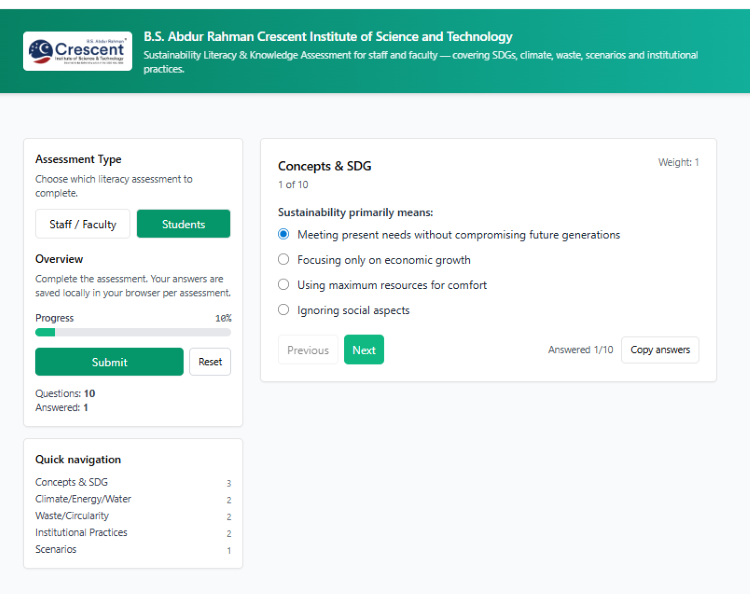
Figure 1.1
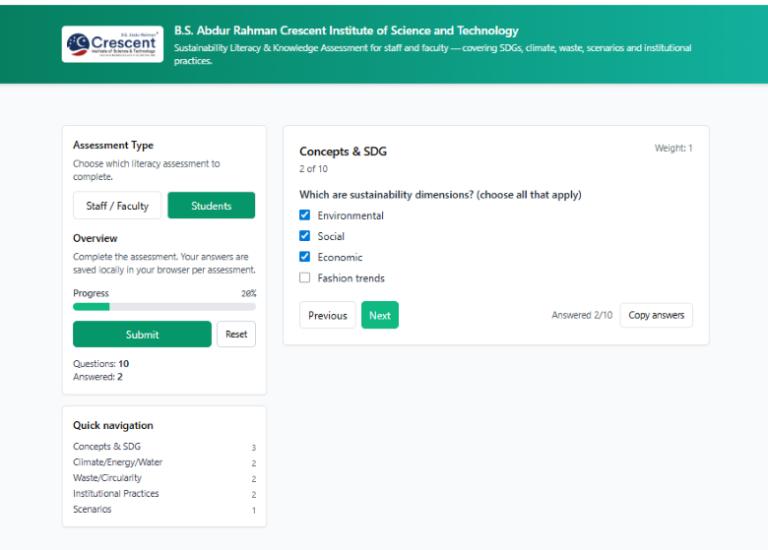
Figure 1.2
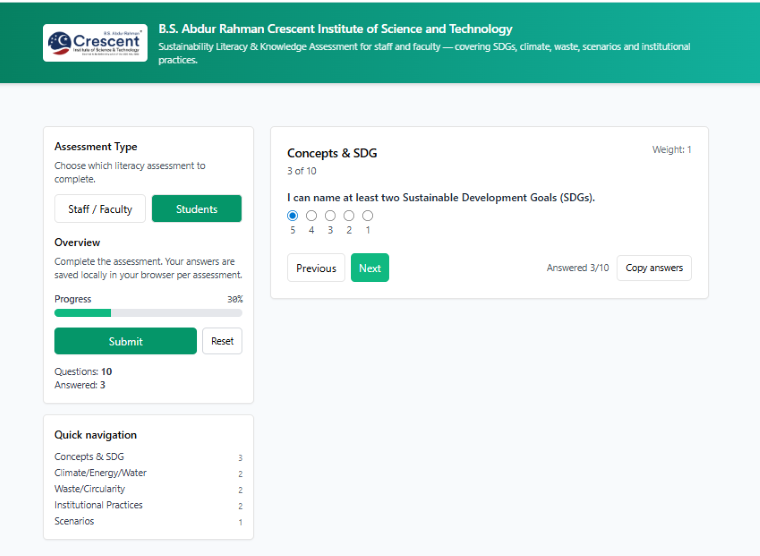
Figure 1.3
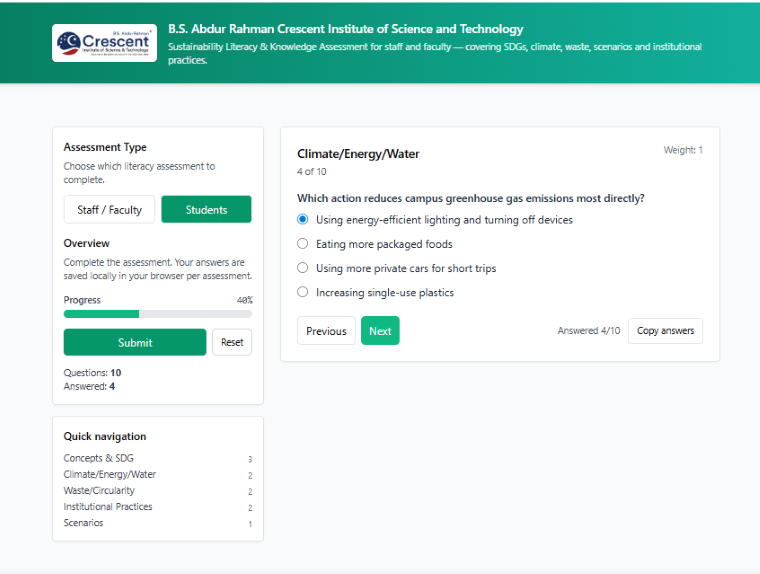
Figure 1.4
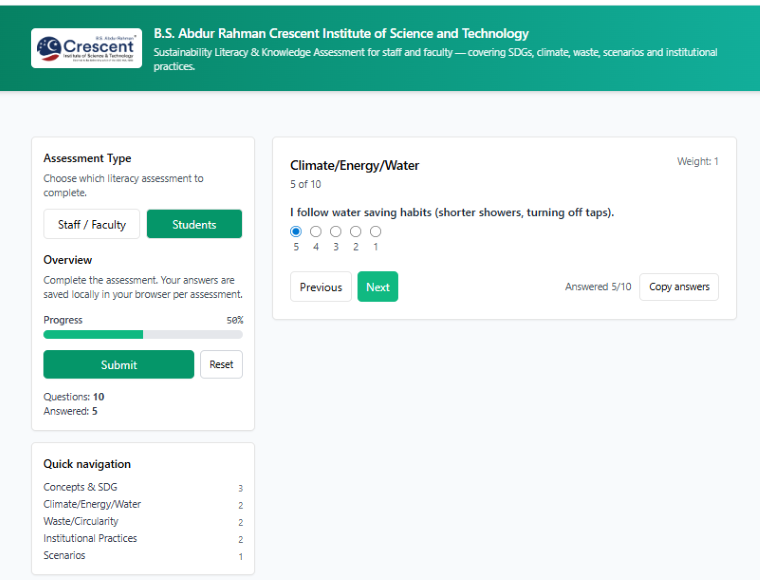
Figure 1.5
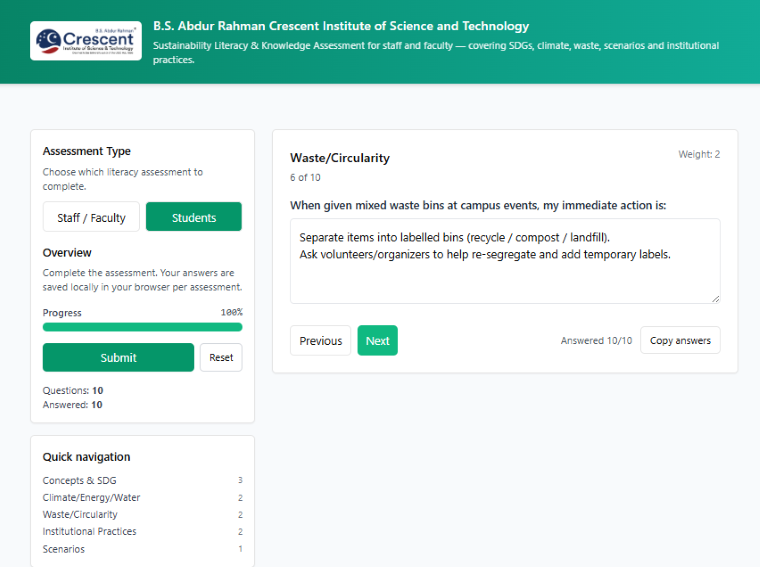
Figure 1.6
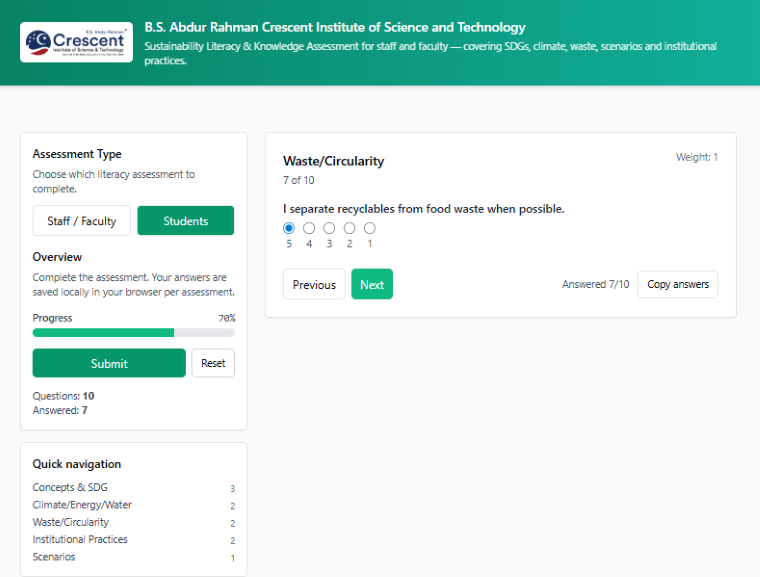
Figure 1.7
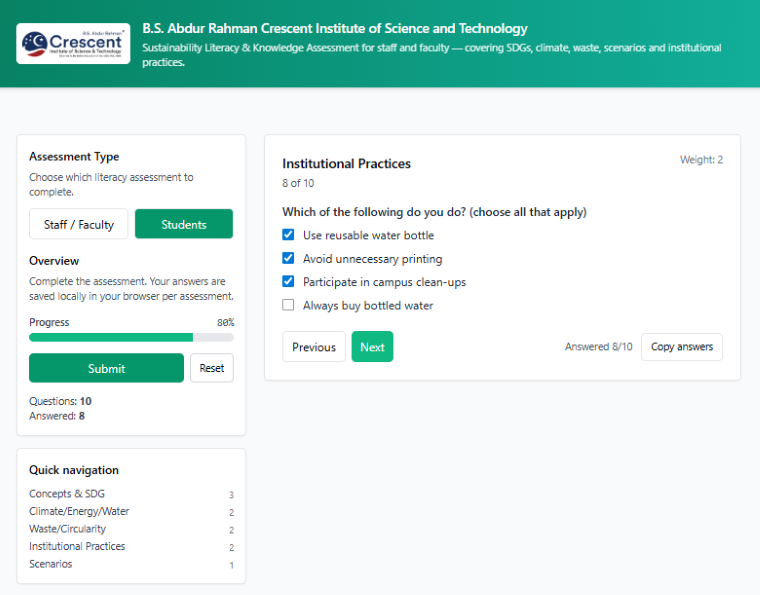
Figure 1.8
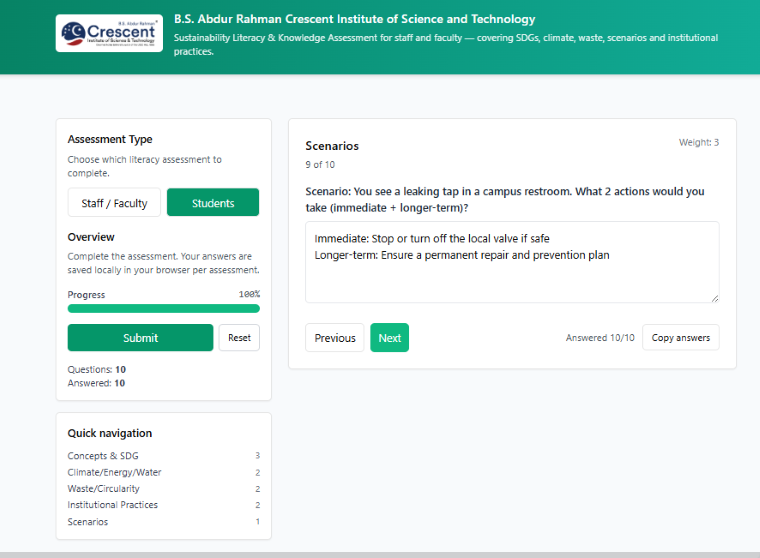
Figure 1.9
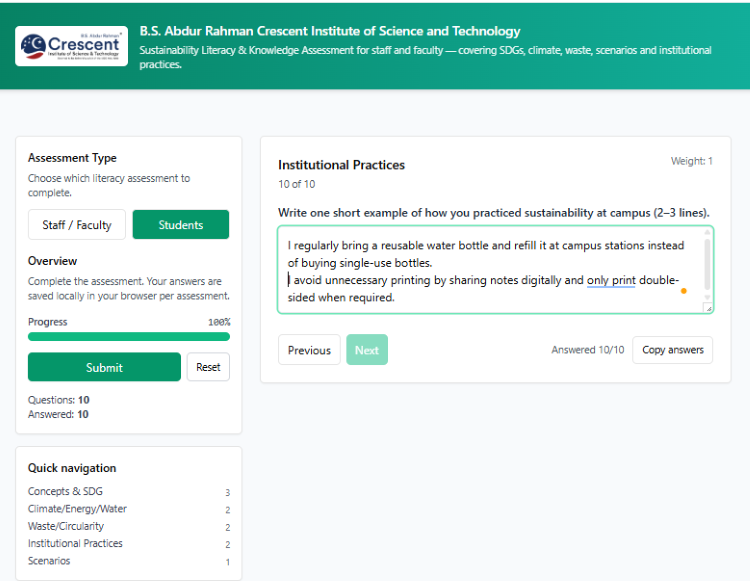
Figure 1.10
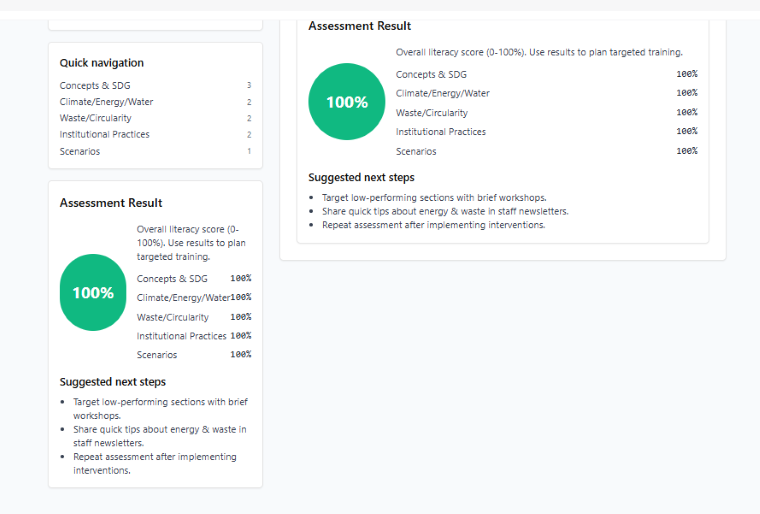
Figure 1.11