
B.S. Abdur Rahman Crescent Institute of Science and Technology is committed to advancing Sustainable Development Goal (SDG 7) by ensuring universal access to reliable, affordable, and modern energy for all within our campus community. Through energy-efficient building upgrades, smart energy management, and the integration of on-site renewable energy, we strive to reduce energy demand, lower operating costs, and improve indoor environmental quality for students, faculty, and staff. Our ongoing initiatives—ranging from LED retrofits and inverter-driven HVAC systems to cloud-based controls and solar installations—reflect a clear dedication to sustainable development, resilience, and leadership in energy stewardship.
The Crescent Energy Club, in association with IGEN (The Institution of Green Engineers) an NGO, organized the ENERGY99 awareness program at Mannivakkam Village with the objective of promoting energy conservation and sustainable living. The initiative aimed to empower the local community by introducing the “9 Energy Mantras”, which provide simple and practical ways to reduce energy usage, lower electricity expenses, and contribute to environmental protection.
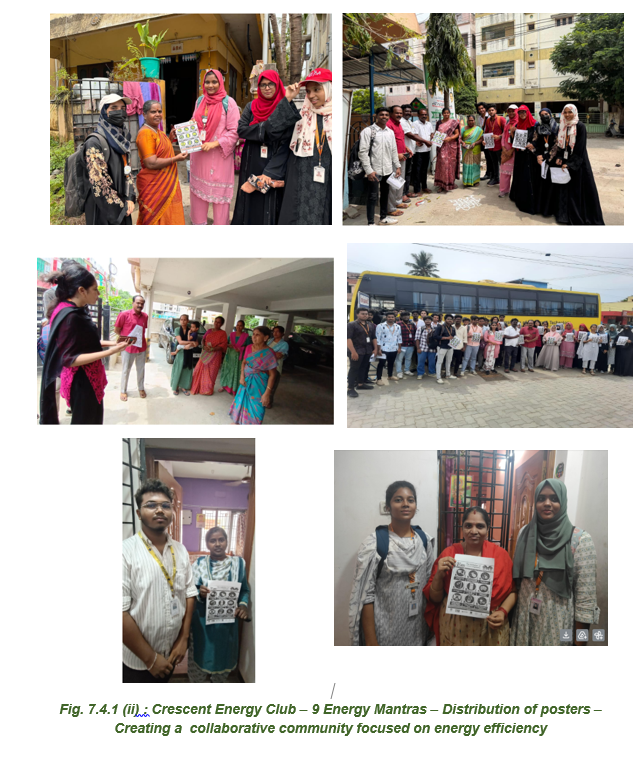
As part of the outreach, the team visited over 100 households, directly engaging with residents and educating them on energy-efficient practices. Through interactive discussions and demonstrations, villagers were encouraged to adopt small but impactful changes to support resource conservation and climate action.
This initiative helped strengthen community awareness on sustainability and highlighted the role of responsible energy use in achieving a greener future
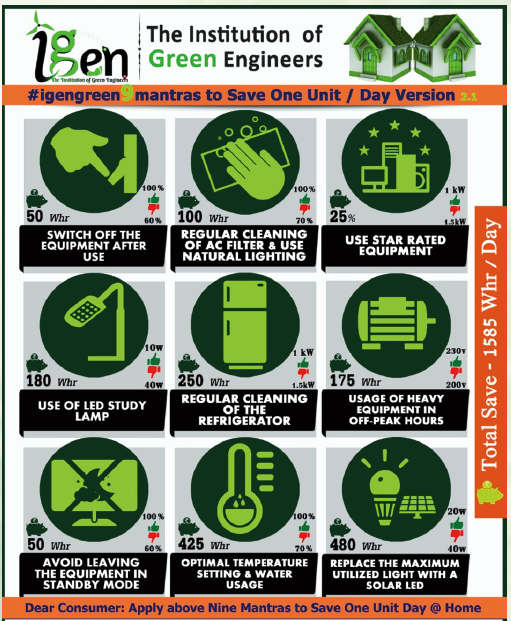
Fig. 7.4.1 (i) – Crescent Energy Club – 9 Energy Mantras designed to reduce energy consumption and lower electricity costs

The club’s outreach efforts extend beyond mere education; they actively involve community members in various activities. This interactive approach not only raises awareness but also builds a network of individuals committed to environmental conservation, demonstrating the club’s dedication to creating a collaborative community focused on energy efficiency.
Impact and Future Directions
The outcomes of these outreach programs are significant, as they lead to increased knowledge and awareness of clean energy practices among community members. The Crescent Energy Club’s initiatives have inspired many to adopt energy-efficient habits, contributing to a broader movement towards sustainability. Looking ahead, the club plans to continue its efforts by organizing more educational events and workshops, ensuring that the local community remains engaged and informed about the importance of energy efficiency and clean energy solutions. Through these ongoing initiatives, the Crescent Energy Club aims to create lasting change and promote a culture of sustainability within the community.
B.Campus-to-Community: Local Outreach for Energy Efficiency – ECOZEST 2.0 (25th September 2024)
The Ecozest 2.0 event aims to promote energy-conscious behavior and practical sustainability practices among the local community, with a broader emphasis on clean energy awareness and community empowerment.
The ECOZEST 2.0 initiative, organized under the Crescent Energy Club at BS Abdur Rahman Crescent Institute of Science & Technology, was designed to advance by fostering the local community outreach and promoting energy efficiency. The program, themed “Innovate – Inspire – Impact,” sought to transform energy efficiency concepts into tangible practices through a sequence of integrated activities that combine knowledge dissemination, applied learning, and community engagement. Central to the outreach strategy was the Seminar on the Role of Engineers in Climate Action, which situates energy transitions, efficiency improvements, and renewable energy adoption within the broader responsibilities of engineers as agents of sustainable development. This theoretical foundation was complemented by hands-on workshops and interactive sessions that translated conceptual understanding into practical competencies, enabling participants to explore resource efficiency, waste reduction, and sustainable design principles in a campus and community context.
The ECOZEST 2.0 emphasizes
SDG 7: Affordable and Clean Energy
Engineers plays a crucial role in shaping the future of energy systems. Through discussions and activities conducted in Ecozest 2.0, students gain insights into:
- Transitioning toward renewable and clean energy sources
- Improving energy efficiency through technological innovation
- Developing sustainable energy solutions for communities
This nurtures the next generation of engineers to contribute to a low-carbon future.
SDG 13: Climate Action
Climate change mitigation requires collective participation and technical expertise. By focusing on:
- Climate action seminars
- Tree-planting awareness
- Waste-to-resource initiatives
- Seed ball making workshop
Outreach activities were deliberately crafted to be participatory and interdisciplinary, leveraging competitions and creative workshops to embed energy-conscious behaviors. Activities such as seed ball making and upcycling campaigns were designed to illustrate the broader principles of material efficiency, circular economy, and energy-aware decision-making, linking micro-initiatives to macro-environmental benefits. These experiences reinforced the message that energy efficiency is not solely a technical concern but a social practice requiring engagement across diverse stakeholder groups. The event’s promotional materials consistently emphasized renewable energy awareness and sustainable practices, reinforcing the notion that energy efficiency is a shared engineering responsibility with meaningful implications for local communities.
Implementation and leadership were structured through clear governance and accountable delivery mechanisms. The Ecozest 2.0 program was organized by the Crescent Energy Club, with leadership roles spanning the Dean of Student Affairs, Chief Proctor, Faculty Coordinator, and Club President, ensuring organizational continuity, logistical coordination, and academic relevance. The involvement of a notable external member, Mr. Dinesh S.P (Founder of Seerakku/Mzoid), as chief guest, provided a real-world lens on energy and climate action, bridging academic discussions with industry perspectives and emphasizing pathways from theory to practice. This leadership configuration supported a programmatic flow from ideation to execution, with supervisory oversight ensuring alignment with institutional goals, student development objectives, and community impact aspirations.
In terms of impact, the ECOZEST 2.0 outreach connected SDG 7 (Affordable and Clean Energy) and SDG 13 (Climate Action) through curated content focused on energy transitions, energy efficiency, and sustainable engineering solutions. The event created opportunities for participants to internalize the link between engineering education and climate-resilient development, highlighting how technical competencies in energy systems, renewable integration, and efficiency optimization can translate into practical actions within campus operations and local communities. While the campus-centric nature of the activities fostered a controlled environment for experimentation and learning, the program’s design explicitly recognized the potential for scalable community outreach beyond the campus, suggesting pathways for knowledge transfer, student-led service projects, and partnerships with local organizations to magnify impact. The outreach activities thus served as a catalyst for cultivating energy-conscious mindsets, problem-solving creativity, and a sense of social responsibility among participants, with the anticipation that engaged students would translate their learning into concrete action in both campus and nearby communities.
The event identifies several cross-cutting links to broader sustainability objectives. By addressing energy transitions and efficiency, the initiative contributed to SDG 7’s targets related to access to affordable, reliable, sustainable, and modern energy services, while the climate-focused seminars and projects aligned with SDG 13 by promoting mitigation and adaptation awareness. The local community emphasis, though primarily campus-based, underscored the potential for extrapolating energy efficiency principles to neighborhood and municipal contexts through student-driven outreach, service learning, and collaborations with local partners. This alignment illustrates how higher education institutions can serve as incubators for practical, scalable energy solutions that benefit broader society.
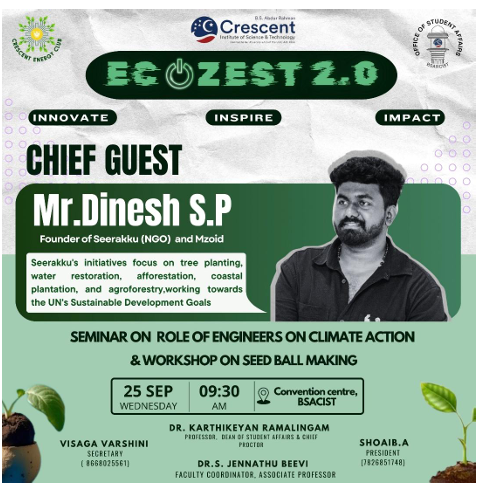
Fig. 7.4.1 (iii) : Poster – ECOZEST 2.0
ECOZEST 2.0 represents a deliberate and structured approach to local community outreach for energy efficiency within a university setting, employing a blend of theoretical exploration, experiential learning, and strategic partnerships to cultivate an energy-conscious culture. While the campus focus provides a ready environment for experimentation and learning, the initiative recognizes and articulates the potential for extending its benefits to local communities through scalable outreach, student-led projects, and collaborative engagements with external stakeholders. The program thereby advances SDG by translating engineering education into practical, community-oriented energy efficiency actions, while laying a foundation for enhanced measurement, accountability, and expansion in future iterations.
C. Community Outreach for Renewable Energy Adoption and Environmental Impact Reduction (SMaGEES 2024)
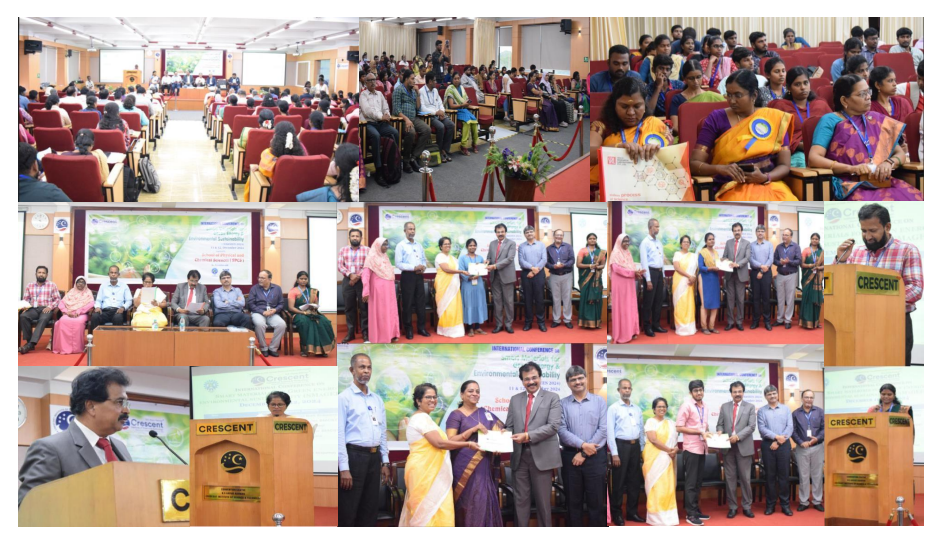
The SMaGEES 2024 an International conference, hosted by the B.S. Abdur Rahman Crescent Institute’s School of Physical and Chemical Sciences, demonstrates the pivotal role universities can play in bridging research and community action to accelerate renewable energy adoption and reduce environmental impacts. With ~300 participants from education community and industry community over two days, the event showcased advances in smart materials, energy storage, and sustainable technologies, emphasizing direct university outreach to local and regional communities. While the conference effectively disseminated knowledge and fostered networking, it also highlighted opportunities to strengthen the measurement of community impact, formalize partnerships, and document scalable demonstrations that translate campus-level innovations into neighborhood- and municipal-scale energy improvements.
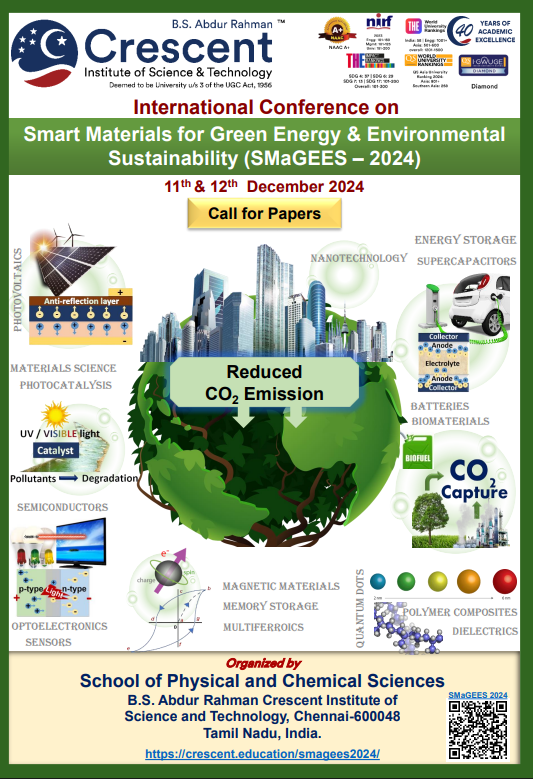
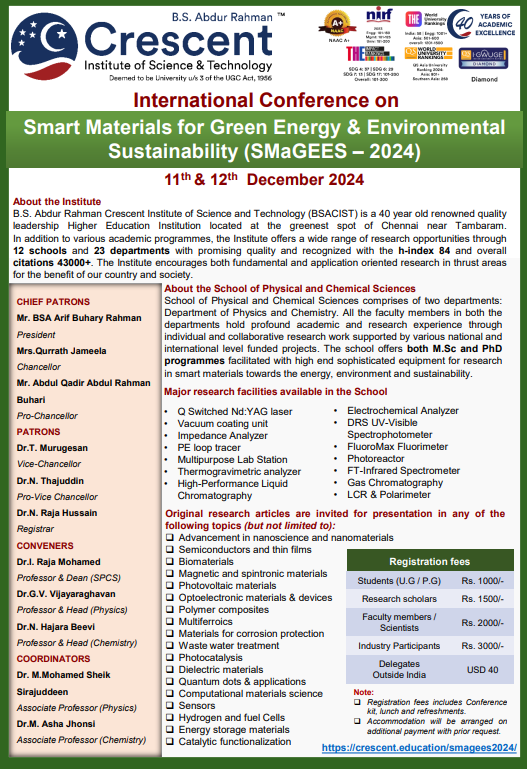
Purpose and scope:
To illuminate how universities can
(a) promote renewable energy adoption,
(b) reduce environmental footprints through community-oriented outreach, and
(c) operationalize findings from smart materials and green energy research into practical applications beyond campus.
Relevance to SDGs: Aligns with SDG 7 (Affordable and Clean Energy) and SDG 13 (Climate Action) by translating research into community benefits and building capacity for energy-efficient practices, renewable integration, and sustainable infrastructure within local contexts.
SMaGEES 2024, two-day gathering at BS Abdur Rahman Crescent Institute of Science and Technology, featuring keynote plenaries, technical talks, and demonstrations. The event underscored the need for universities to extend outreach activities beyond academic discourse to catalyze tangible energy transitions.
Structure and content: The conference offered a curated program across energy storage, electrode and material science, solar energy, green polymers, and sustainable construction materials, complemented by 12 keynote/invited talks and 110 oral/poster presentations. The program integrated demonstrations and industry sponsorships to facilitate knowledge transfer to local communities.
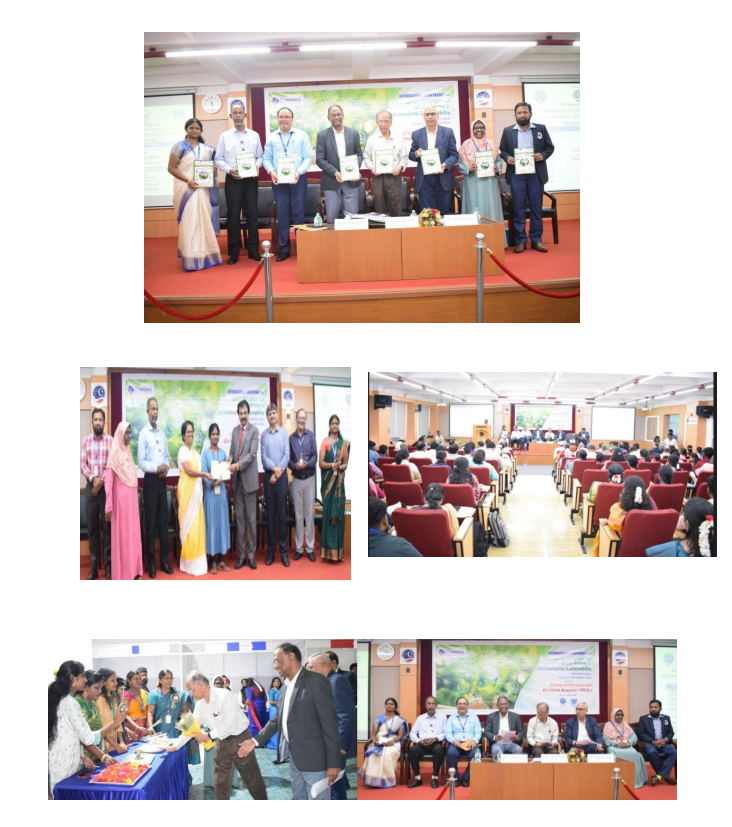
Leadership and governance: Organized by the School of Physical and Chemical Sciences with a leadership team including senior academic leaders (Dean, HoD) and associate professors. External voices included distinguished figures (e.g., Padma Bhushan Dr. T. Ramasami), lending credibility and enhancing outreach potential.
Outreach mechanisms: Hybrid dissemination through technical sessions, poster exhibitions, industry partnerships, and publicly accessible demonstrations designed to connect research outcomes with community needs. The sponsorship ecosystem (CSIR, state science bodies, corporate partners) signals a sustainable model for future outreach initiatives.
Thematic emphasis: Smart materials for green energy and environmental sustainability, with practical implications for energy efficiency, renewable energy deployment, storage solutions, and carbon reduction strategies.
Link to communities: Although primarily a research-forum, the conference provided pathways for knowledge transfer to local schools, NGOs, and industry partners. The presence of industry sponsors and regional bodies offers a platform for co-developed outreach programs, pilot implementations, and capacity-building activities within the surrounding communities.
Knowledge-to-action gap: While the event showcased cutting-edge science, explicit mechanisms to translate sessions into on-the-ground community actions require strengthening (e.g., follow-up programs, pilot projects, and scaled demonstrations).
Knowledge advancement: Accelerated diffusion of insights on energy materials, storage technologies, and sustainability practices among attendees, researchers, and practitioners.
Capacity building and networks: Expanded networks between universities, industry, NGOs, and local government entities, enabling potential collaborative outreach projects and technology deployments in communities.