

B.S. Abdur Rahman Crescent Institute of Science and Technology is committed to advancing Sustainable Development Goal (SDG 7) by ensuring universal access to reliable, affordable, and modern energy for all within our campus community. Through energy-efficient building upgrades, smart energy management, and the integration of on-site renewable energy, we strive to reduce energy demand, lower operating costs, and improve indoor environmental quality for students, faculty, and staff. Our ongoing initiatives—ranging from LED retrofits and inverter-driven HVAC systems to cloud-based controls and solar installations—reflect a clear dedication to sustainable development, resilience, and leadership in energy stewardship.
A.BSACIST Energy Management: External Audit-Driven Self-Assessment and Roadmap for a Resilient, Energy-Efficient Campus
B.S. Abdur Rahman Crescent Institute of Science and Technology, adopts a proactive, self-analytic approach to energy management, enhanced by an external Energy Audit. The institute commissioned an independent assessment to validate its energy landscape while preserving data ownership. The audit evaluated key systems—lighting, HVAC, motors, pumping, DG sets, and rooftop solar—along with utility bills and transformer loading, establishing a credible baseline and prioritized savings opportunities.
This external review catalyzes BSACIST’s ongoing energy performance improvements. It translates usage and peak-demand patterns into quantified ECMs with clear savings and payback, enabling phased investment and informed decision-making. By integrating the auditor’s findings with internal data and operations, BSACIST can verify savings, monitor progress with dedicated meters, and align initiatives with sustainability goals, including renewable energy integration and carbon reduction. This collaboration underscores the university’s leadership in responsible energy management and a path toward a more resilient, energy-efficient campus.
Actionable Measures for Energy Conservation
The energy efficiency plan encompasses a range of actionable measures, including the replacement of Fluorescent Tube Lamps (FTL) with energy-efficient LED lamps, which alone can save 19,200 kWh annually. Other significant initiatives include rectifying solar water heaters in the ladies’ hostel, upgrading existing air conditioning units to 5-star rated split ACs, and replacing conventional ceiling fans with energy-efficient Brushless DC electric motor fans. Each of these measures has been meticulously calculated to ensure substantial reductions in energy consumption while maintaining comfort and operational efficiency across the campus facilities.
ESM. No | Energy Saving Measures | Annual Savings | Investment | Payback | |
kWh | Rs. | Rs. | Months | ||
Short-Term Payback | |||||
1 | Replace FTL Lamps with LED and reduce power consumption | 9,600 | 97,920 | 60,000 | 7 |
2 | Improve Solar roof top panel generation efficiency | 1,76,012 | 14,08,096 | 10,00,000 | 9 |
Long-Term Payback | |||||
3 | Replace conventional ceiling fans with BLDC fans | 25,200 | 2,57,040 | 7,00,000 | 33 |
4 | Replace old Window AC with Energy Efficient 5 star rated split AC | 1,33,650 | 13,63,230 | 54,45,000 | 48 |
5 | Replace street light with solar power light and reduce power consumption | 657 | 6,701 | 30,000 | 54 |
6 | Explore roof top solar PV possibility to generate electrical energy | 2,18,400 | 17,47,200 | 84,00,000 | 58 |
Summary of Savings | |||||
Annual | Total Savings & Investment and Average Payback | 5,63,519 | 48,80,187 | 1,56,35,000 | 38 |
Total kWh Savings in Percentage | 11 | ||||
Total Cost Savings in Percentage | 10 | ||||
Total CO2 reduction in Tons | 410 | ||||
Enhancing Energy Management Through Monitoring
Additionally, the audit highlights the importance of monitoring and controlling energy usage through the installation of dedicated energy meters and a demand controller. These systems will provide real-time data on energy consumption, enabling the management to make informed decisions about energy usage patterns and identify further opportunities for savings. By actively managing demand and optimizing energy consumption, the institute can avoid penalties associated with exceeding contract demand, thereby enhancing overall financial efficiency.
Towards a Sustainable Future: A Commitment to Energy Efficiency
In conclusion, the energy efficiency plan at Crescent Institute is a comprehensive strategy that not only aims to reduce energy consumption but also fosters a culture of sustainability within the campus community. By implementing these measures, the institute is poised to make significant strides toward achieving its renewable energy goals while setting a benchmark for energy efficiency in educational institutions across the region. The commitment to continuous improvement and innovation in energy management will ultimately contribute to a greener and more sustainable future for the institute and its stakeholders.
The energy audit report for Crescent Institute of Science & Technology conducted by SLR Industrial Solutions provides a comprehensive analysis of energy consumption and identifies areas of energy waste. Here’s a synthesized summary based on the report, focusing on energy wastage identification

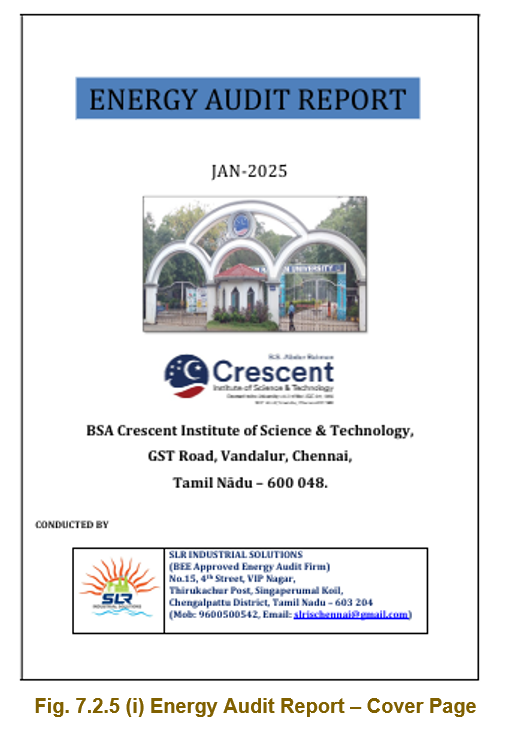
B. The Gist of the Audit Report is provided in the following sections.
1.Overall Energy Consumption:
- The total annual energy consumption is approximately 42,73,653 kWh/ Annum, with significant contributions from air conditioning (54%), fans (14%), and lighting (8%).
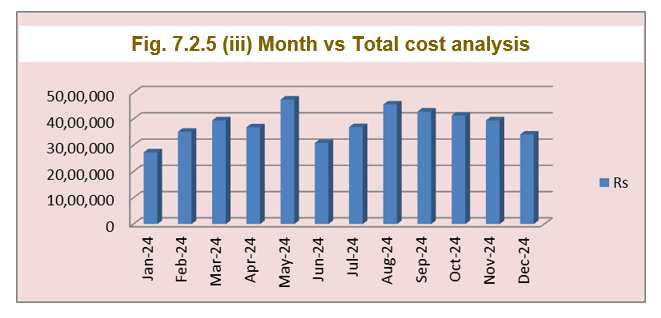
- The electricity bill amounts to Rs. 4,57,21,919 annually, indicating a high operational cost due to energy consumption.
Month Vs. Energy Consumption Analysis
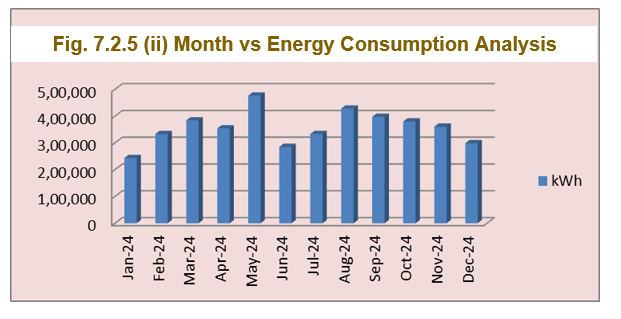
Power consumption is varied in months due to season variation.
Month vs. Total Cost Analysis
2.Key Areas of Energy Waste:
- Air Conditioning: The audit highlights that the air conditioning systems are a major source of energy consumption. Recommendations include maintaining set temperatures above 24°C and replacing old window AC units with energy-efficient 5-star rated split ACs.
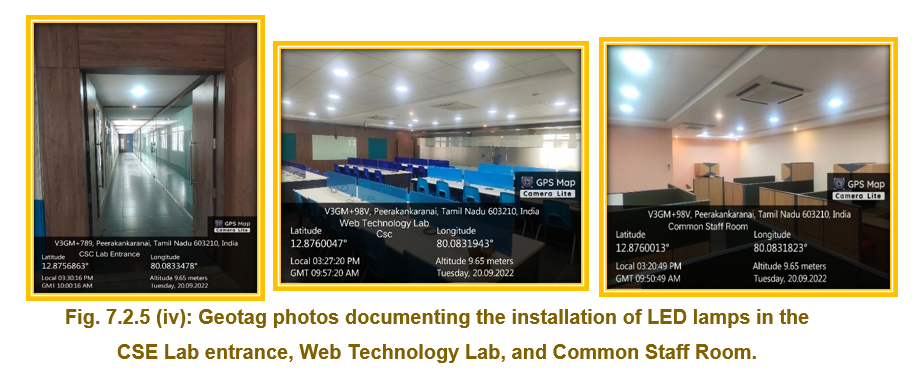
- Lighting: While 75% of lamps have been replaced with LED lights, there are still areas, such as the Men’s hostel and Canteen, where fluorescent tube lamps (FTLs) are in use. Replacing these with LEDs could save significant energy.
75% lamps are replaced with LED lamps to reduce energy consumption
SL NO | BUILDING | QTY | TOTAL WATTS | Operating Hours/day | kWh/day |
1 | AUDITORIUM | 206 | 4487 | 8 | 36 |
2 | SCIENCE BLOCK | 435 | 5684 | 12 | 68 |
3 | AERO BLOCK | 573 | 6964 | 12 | 84 |
4 | MAIN BLOCK | 382 | 6252 | 12 | 75 |
5 | MBA BLOCK | 123 | 2597 | 12 | 31 |
6 | FIRST YEAR BLOCK | 217 | 4305 | 12 | 52 |
7 | LIFE SCIENCE BLOCK | 108 | 2828 | 12 | 34 |
8 | NEW STAFF QUARTERS | 383 | 5135 | 12 | 62 |
9 | LADIES HOSTEL | 664 | 8359 | 12 | 100 |
10 | CAMPUS STREET LIGHT | 286 | 8570 | 12 | 103 |
11 | MEDICAL | 35 | 589 | 12 | 7 |
12 | PHARMACY | 143 | 2575 | 12 | 31 |
13 | GM OFFICE | 47 | 910 | 8 | 7 |
14 | MAIN CANTEEN | 45 | 1042 | 12 | 13 |
15 | VC OFFICE | 100 | 620 | 8 | 5 |
16 | VC VILLA | 51 | 571 | 12 | 7 |
17 | GUEST HOUSE | 37 | 680 | 12 | 8 |
18 | DRIVERS CABIN | 8 | 120 | 12 | 1 |
19 | OLD STAFF QUARTERS | 53 | 1005 | 12 | 12 |
20 | SPORTS LIGHTING | 64 | 12800 | 8 | 102 |
21 | HR OFFICE | 27 | 500 | 8 | 4 |
22 | PARANTS WAITING HALL | 12 | 166 | 8 | 1 |
24 | NEW ARCHITECTURE BLOCK | 614 | 10808 | 12 | 130 |
25 | CIVIL YARD CLASS ROOMS | 40 | 650 | 12 | 8 |
26 | CSB ROOM MENS HOSTEL | 47 | 780 | 12 | 9 |
27 | ROBOTICS LAB | 22 | 280 | 12 | 3 |
28 | RESEARCH SCHOLAR ROOM CHEMISTRY | 4 | 144 | 12 | 2 |
29 | FOOD WASTE MANAGEMENT PLANT | 26 | 640 | 12 | 8 |
30 | SOLAR STREET LIGHT | 10 | 250 | 12 | 3 |
31 | MENS HOSTEL | 1007 | 13219 | 12 | 159 |
32 | MBA PHASE 1 | 49 | 595 | 12 | 7 |
33 | MBA PHASE 2 | 170 | 3108 | 12 | 37 |
34 | COMPUTER SCIENCE LAB | 51 | 690 | 12 | 8 |
35 | PURCHASE OFFICE (EO) | 2 | 30 | 8 | 0 |
36 | CIIC BLOCK | 328 | 5479 | 12 | 66 |
37 | CIIC 2ND FLOOR STUDIO | 13 | 225 | 12 | 3 |
38 | DRAWING HALLS & LABS(MECH) | 60 | 709 | 12 | 9 |
39 | CANTEENS | 119 | 1984 | 12 | 24 |
40 | OUTDOOR LIGHTING | 63 | 1306 | 12 | 16 |
TOTAL | 6624 | 117,656 |
| 1,334 | |
- Pumps and Blowers: The existing pumps are noted to be old and inefficient. The report suggests replacing them with energy-efficient models to reduce power consumption. Similarly, the STP blowers are recommended for replacement with more efficient tri-lobe blowers.
3. Renewable Energy Utilization:
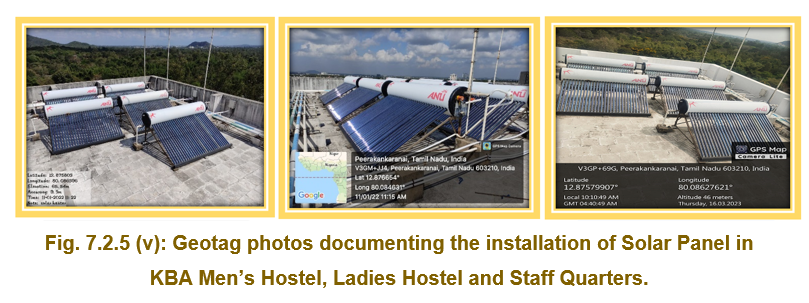
- The report indicates that the solar water heaters in the ladies’ hostel are not operational, leading to reliance on electric heaters. Rectifying these systems could reduce energy waste.
- The solar rooftop panels are underperforming due to some panels being non-functional. Addressing these issues could enhance energy generation and reduce dependency on grid electricity.
4. Demand Management:
- The report identifies that the maximum recorded demand has exceeded the contract demand, leading to demand penalties. Implementing a demand controller could help manage peak loads and avoid penalties.
5. Energy Conservation Measures (ECMs):
- The audit outlines several ECMs with potential savings:
- Replace FTLs with LEDs: Estimated savings of 19,200 kWh annually.
- Rectify solar water heaters: Potential savings of 20,930 kWh annually.
- Replace old ACs with energy-efficient models: Estimated savings of 45,000 kWh annually.
- Install demand controllers: Savings of 21,120 kWh annually.
- The audit outlines several ECMs with potential savings:
The energy audit report reveals significant opportunities for energy savings at B.S. Abdur Rahman Crescent Institute of Science & Technology. By focusing on the identified areas of high energy consumption, such as air conditioning, lighting, and inefficient pumps, and by implementing the recommended energy conservation measures, the institute can substantially reduce energy waste, lower operational costs, and enhance sustainability. Regular energy reviews and monitoring will be essential to track progress and ensure continued energy efficiency improvements.