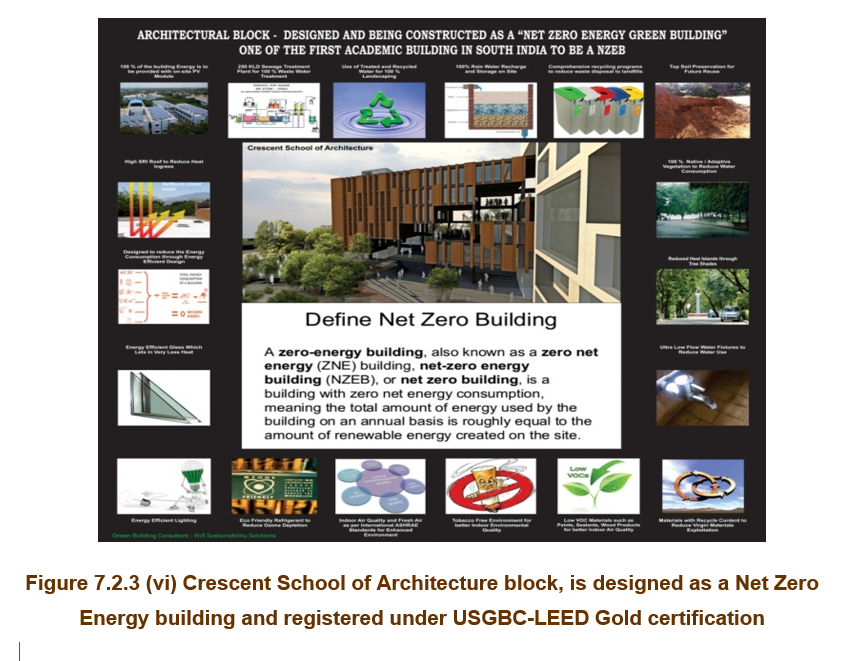


B.S. Abdur Rahman Crescent Institute of Science and Technology is committed to advancing Sustainable Development Goal (SDG 7) by ensuring universal access to reliable, affordable, and modern energy for all within our campus community. Through energy-efficient building upgrades, smart energy management, and the integration of on-site renewable energy, we strive to reduce energy demand, lower operating costs, and improve indoor environmental quality for students, faculty, and staff. Our ongoing initiatives—ranging from LED retrofits and inverter-driven HVAC systems to cloud-based controls and solar installations—reflect a clear dedication to sustainable development, resilience, and leadership in energy stewardship.
Achieving Carbon Neutrality at BSACIST:
An Integrated Approach to Sustainable Campus Operations
B. S. Abdur Rahman Crescent Institute of Science and Technology (BSACIST) has adopted a comprehensive carbon management program that markedly lowers its carbon footprint through innovative and sustainable practices. The institute’s annual total carbon emissions amount to 7,369 tons, with a per capita footprint of 1.05 tons—significantly below the national average of 1.58 tons per person. This reflects a 33.54% reduction relative to the national average, underscoring BSACIST’s commitment to environmental sustainability and carbon reduction.
According to the CO2 Baseline Database for the Indian Power Sector (Central Electricity Authority of India), grid electricity emits about 820g CO2 equivalents per kWh. In 2024, our solar power plant generation avoided approximately 4,000 tons of CO2 emissions by displacing fossil fuel-based electricity.
A. Green Infrastructure – Strategic carbon offsetting through Ecological Interventions:
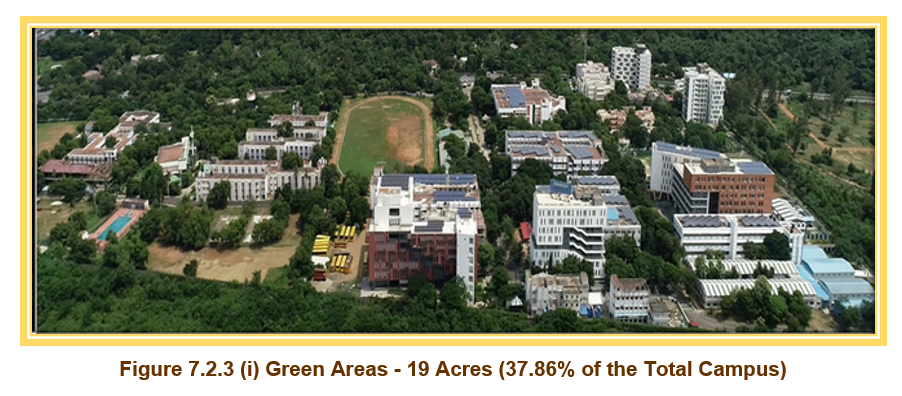
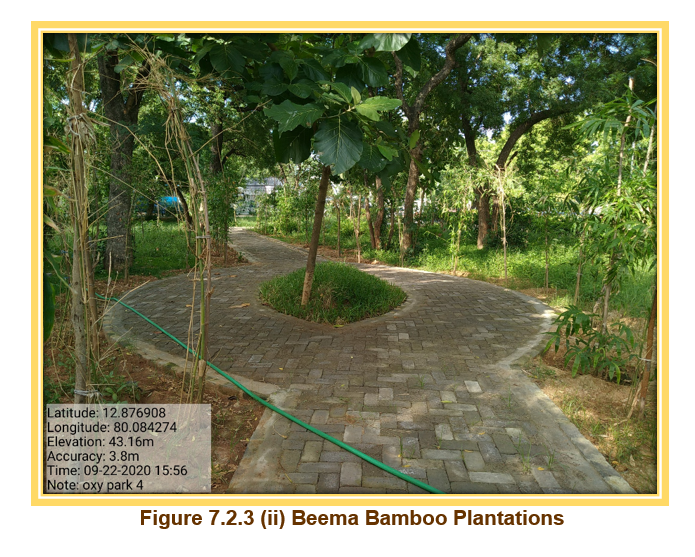
The carbon offsetting strategy at BSACIST is multifaceted, leveraging green spaces and renewable energy initiatives to mitigate carbon emissions. The campus spans 19 acres of green areas, including tree-covered zones, lawns, and Beema Bamboo plantations (2,250 plants), which collectively absorb about 900 tons of CO2 annually. This absorption accounts for roughly 10.13% of the campus’s total emissions, while green spaces cover about 37.86% of the campus area. Solar infrastructure plays a crucial role in this effort, with 650 kW peak (kWp) of solar photovoltaic capacity installed across campus buildings, offsetting approximately 474 tons of CO2 annually—equivalent to planting about 21,545 trees. A new 125 kWp rooftop plant is currently being installed on the New Hostel Block, to operate alongside the existing 650 kWp system. Together, these installations bring the campus’s total solar capacity to 775 kWp, enhancing clean and green energy generation.
B.Solar-Driven Holistic Emission Management: Integrated Technological and Operational Approaches
The institute’s carbon management approach extends beyond green spaces and solar energy. The comprehensive strategy includes multiple energy-efficient technologies and sustainable practices across various campus operations. Transportation emissions are carefully managed, with detailed tracking of petrol and diesel consumption. Electricity consumption, which accounts for the largest portion of carbon emissions (5,251,791 kg CO2), is being systematically reduced through energy-efficient technologies, including high-performance building envelopes, efficient lighting systems, and advanced HVAC technologies. The institute has also implemented water conservation measures and waste management strategies that contribute to overall carbon reduction.
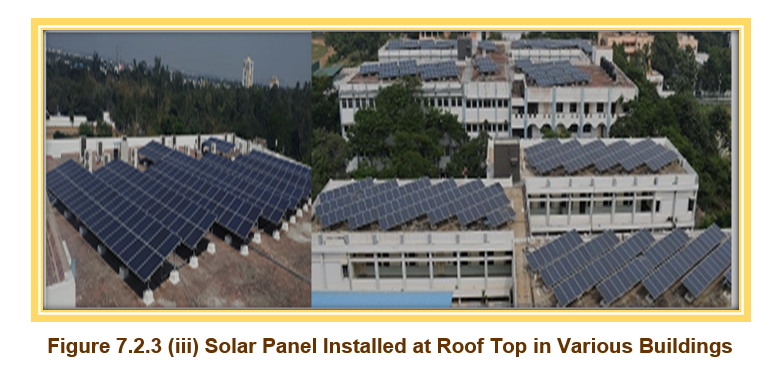
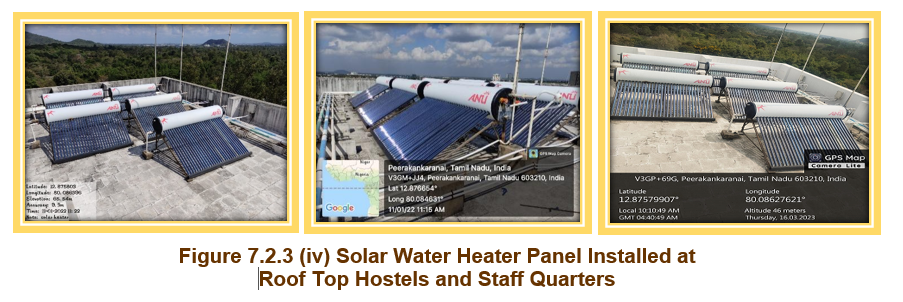
Innovative technologies and collaborative approaches further enhance BSACIST’s carbon management efforts. The implementation of zero-export devices for solar power management, solar water heating systems, and energy-efficient building designs demonstrate a holistic approach to sustainability. The solar water heating systems, with a total capacity of 39,500 litres, are estimated to save approximately 24 lakhs in power consumption annually. Additionally, student-driven projects, such as solar street lighting installations, showcase the institute’s commitment to engaging the academic community in sustainable practices.
C.Driving Sustainability: The Role of Eco-Friendly Vehicles in BSACIST’s Green Transportation Initiative
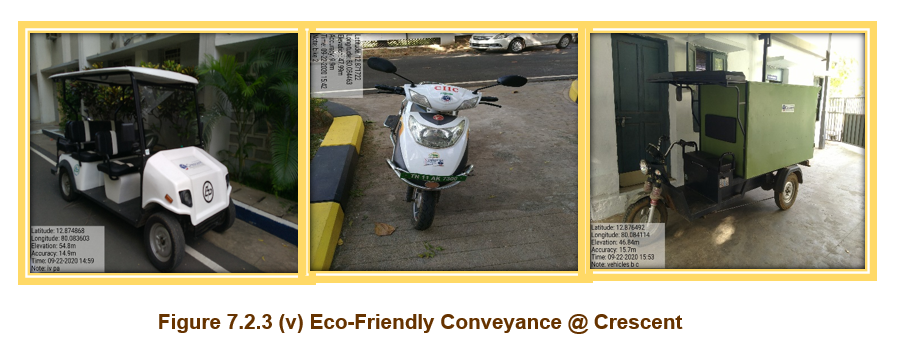
The integration of eco-friendly vehicles into the university’s transportation system highlights a practical application of BSACIST’s sustainability values, encouraging a shift toward cleaner mobility solutions while reducing overall campus emissions.
Pollution Free Environment | ||
1 | Battery Operated Golf cart(Buggy) | 7 Nos. |
2 | Electric Bike | 2 Nos. |
3 | Eco Friendly Load vehicle | 2 Nos. |
4 | Bi cycles | 55 Nos. |
5 | Tricycles | 3 Nos. |
Carbon foot print / Capita | ||||||
Activity Data | Type | unit | GHG | Emission factor | Quantity | CO2 emission /year |
Transportation | petrol | litres | KgCO2e | 2.196 | 1300 | 2855 |
diesel | litres | 2.65 | 381461 | 1010872 | ||
Electricity | kWh | KgCO2e | 1.2 | 4376492 | 5251791 | |
Paper consumption | kg | KgCO2e | 0.683 | 21900 | 14958 | |
Water consumption | water supply | cum | KgCO2e | 0.8 | 160611 | 128489 |
Solid waste | kg | KgCO2e | 3.7 | 259560 | 960372 | |
Total CO2 Emission Per Year | Kg | KgCO2e | 7369336 | |||
Over all carbon foot print / year | Ton | 7369 | ||||
Total population (avg) | 7000 | |||||
Carbon Foot Print per capita in Ton | 1.05 | |||||
National average per capita | 1.58 Ton/Capita/Year |
Actual CO2 emission | 1.05 Ton/Capita/Year |
% of CO2 emission – on National avg. | 66.63% |
% of CO2 reduced from National avg. | 33.37% |
CARBON OFFSETTING
Total Carbon Emission : 7369 tons/year | ||||
Classification of Green Areas | Area | Unit | CO2 (avg.) absorption rate t/year | Total CO2 absorption ton/year |
Area of Tree – ref Google Map | 2 | Acre | 160 | 336 |
Lawn & plant area | 14 | Acre | 15 | 211 |
Beema Bamboo | 2.5 | Acre | 80 | 200 |
Total green area in acre | 9 | Acre | ||
Total CO2 Absorption | 747 | |||
% of CO2 offset within the campus | 10.13% | |||
% of Green Area |
|
|
| 37.86% |
10 % of Carbon foot print is offset by the above environment – friendly measures in campus.
Calculation:
Carbon Offsetting
Total trees green area – 19 Acres
Total Co2 absorption ton/year – 747 tones
Over all carbon foot print/year (Co2 Emission) – 7369 tones
% of Co2 → offsetting within campus
(747 / 7369 X 100) – 10.13%
Bal: 90% to be offset by planting more trees or trading
% of Linear area (19/50 Acres – carbon foot print) – 38%
Carbon Footprint
Total Co2 Emission per year: Kg – 7369336
Over all carbon foot print / year = 7369336
———— – 7369 tones
1000
Total Population (Avg.) – 7000 (students)
Carbon foot print per Capita in Ton = 7369
——– – 1.05
7000
National Avg. per emission – 1.58 / ton / capita / year
Actual Co2 Emission – 1.05 / ton / capita / year
% of Co2 Emission on National Avg. 1.05
—— X 100 – 66.46%
1.58
% of Co2 reduced from National Avg. 100 – 66.46 – 33.54%
E. Visioning Net-Zero: The Roadmap to Transformative Environmental Stewardship
The institute’s carbon management strategy represents a forward-thinking approach to environmental stewardship. While the current initiatives offset 10% of carbon emissions within the campus, BSACIST has a clear plan to address the remaining 90% through continued tree planting, exploring carbon trading options, and implementing increasingly sophisticated sustainable technologies. The ultimate goal is to transform the campus into a net-zero energy environment that not only minimizes its carbon footprint but also serves as a model for sustainable institutional development. By consistently innovating and implementing cutting-edge green technologies, BSACIST demonstrates that comprehensive carbon management is not just an environmental necessity but an achievable and impactful institutional commitment.