
Crescent Sustainability Initiatives
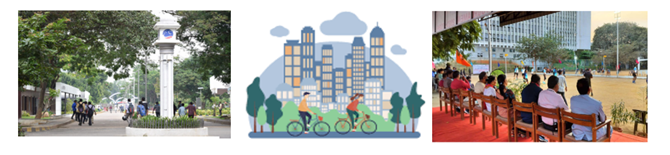
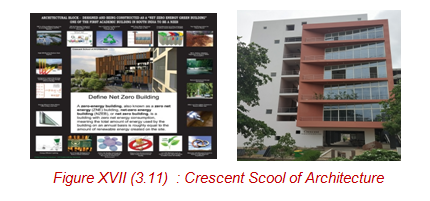
B.S. Abdur Rahman Crescent Institute of Science and Technology emphasizes the importance of sustainable cities and communities, aligning with Sustainable Development Goal 11 (SDG 11). The institute serves as a custodian of heritage and environment, ensuring that both urban and rural communities benefit from its initiatives. The campus features a large Convention Centre, equipped with modern facilities, and promotes public access to libraries that have transitioned to e-resources, making information accessible to everyone. Additionally, the institute actively engages with the community through sports events and cultural programs, fostering a sense of unity and shared heritage. The institute also prioritizes affordable housing for students and staff, with multiple hostels and residential quarters designed to accommodate a diverse population. The construction practices adopted are eco-friendly, utilizing sustainable materials such as recycled concrete and low-VOC paints, contributing to a greener campus. The Crescent School of Architecture is notable for its design as a Net Zero Energy building, showcasing the institute’s commitment to sustainability. Progress in implementing these initiatives has been measured, indicating significant advancements in achieving the targets.
Public Access to Buildings, Libraries, Green Spaces, Arts & Heritages
A.Community Hub: BSACIST’s Commitment to Accessible Event Spaces:
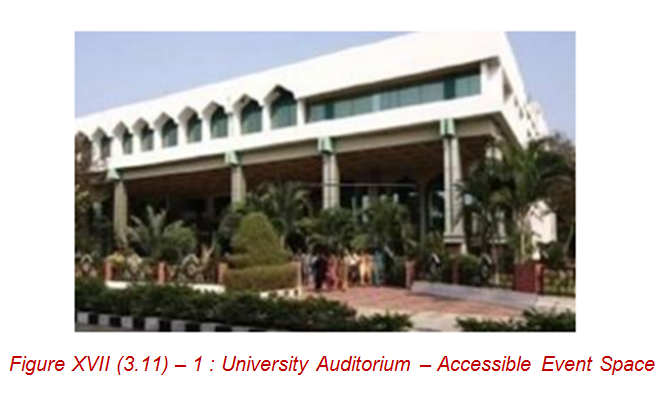
- B.S. Abdur Rahman Crescent Institute boasts of a very large Convention Centre which houses an auditorium of 1500 seating capacity and three sophisticated seminar halls of seating capacity 300, 200 and 100.
- Set in bewitching landscape, this wonderful building has lofty pillars whose beauty is enhanced in turn by a series of small arches. As one enters the Convention Centre, a breath-taking expansiveness fascinates the visitor.
- The auditorium accommodates 1500 persons in 2 galleries on the ground and mezzanine levels. Equipped with state-of-the-art sound and light systems. The centre has been designed for the best acoustics and space utilization
B. Open Access Revolution: BSACIST’s Dedication to Public E-Resource Sharing:
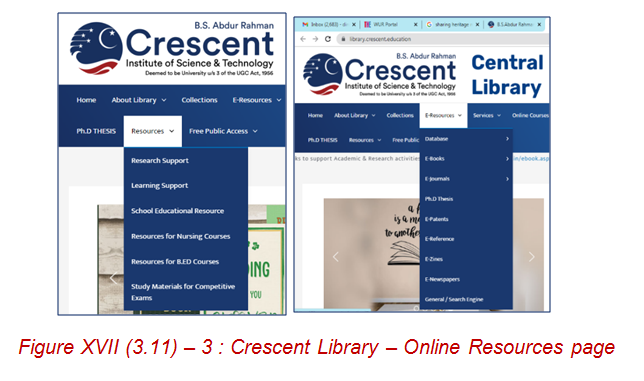
The revolution, which took place in information and communication technology (ICT) has made a paradigm shift in the route to access library & information centres. Realizing the importance of e-access and its advantages, the library has shifted its focus towards open access as well paid subscription to e-Books.
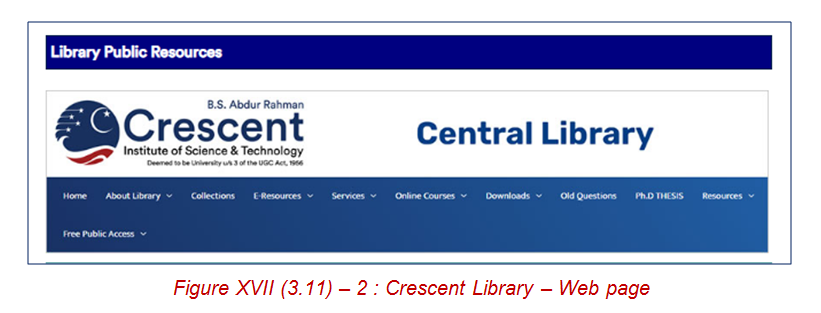
These e-Resources can be accessed from anywhere at any time through any device by anyone, including the common public (those who are not a member of our Institution).
C. B.S. Abdur Rahman Crescent Institute Unveils Sports Village for Community Engagement
B.S. Abdur Rahman Crescent Institute of Science and Technology (BSACIST) has opened its Sports Village to the public. By providing access to its state-of-the-art sports facilities, BSACIST encourages participation from local communities and fosters a spirit of camaraderie and healthy competition. The Sports Village serves as a venue not just for the institute but as a shared space for promoting athletic talent and nurturing future sporting events. This initiative highlights BSACIST’s commitment to enhancing community engagement through sports and physical education.
Mini Marathon – 2023
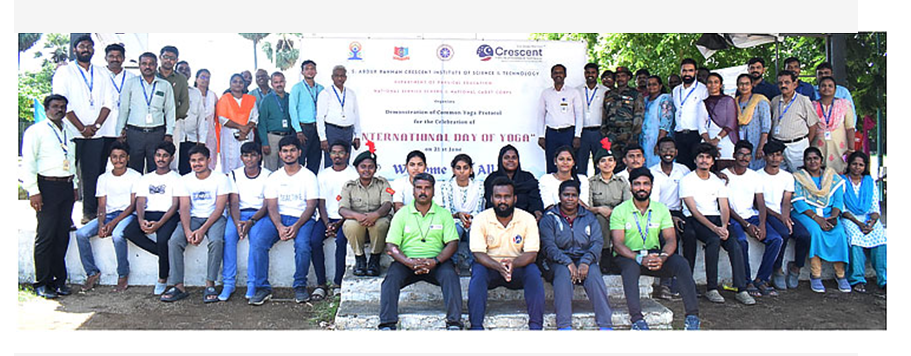
• Event : 10th International Day of Yoga
• Organized by : DEPARTMENT OF PHYSICAL EDUCATION, NCC & NSS
• Date : 21.06.2024
• Venue : Crescent Sports Village
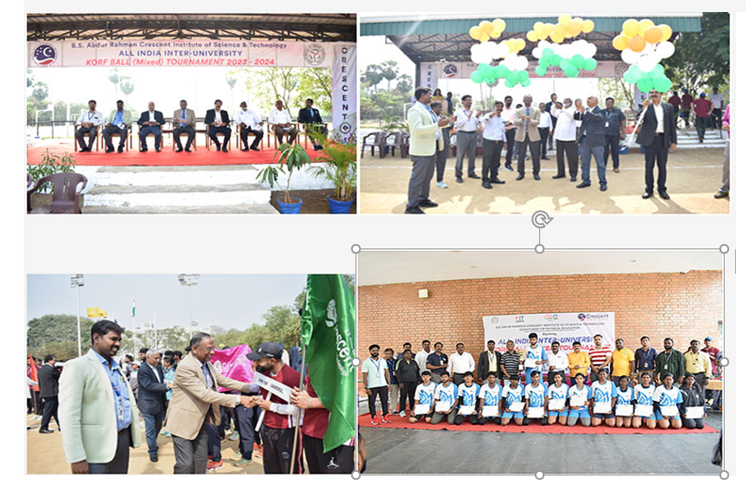
ALL INDIA INTER UNIVERSITY KORFBALL – MIXED TOURNAMENT 2023-24
• Event : KORFBALL – MIXED
• Organized by : ALL INDIA INTER UNIVERSITY
• Date : 01.03.2024 to 03.03.2024
• Venue : BSA CRESCENT IST
• Place / Position : IV PLACE
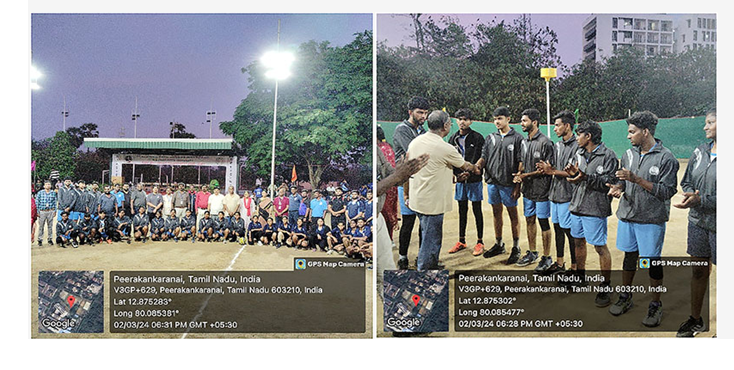
ALL INDIA INTER UNIVERSITY KORFBALL – WOMEN TOURNAMENT 2023-24
• Event : KORFBALL – MIXED
• Organized by : ALL INDIA INTER UNIVERSITY
• Date : 01.03.2024 TO 03.03.2024
• Venue : BSA CRESCENT IST
• Place / Position : IV PLACE
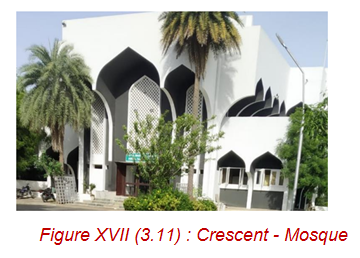
In campus, two prayer halls, one in Men’s Hostel and another in Institute campus. Women prayer hall is separately available in Hostel, Convention Centre & Community hall. These Prayer Halls are used by all the students, staff, and parents who ever visited the campus.
E . AFFORDABLE HOUSING FOR STUDENTS & STAFFS
S.No | Name of the Building | Built ups area in sft. | Covered area |
1 | Men’s Hostel Annexure | 23,398.20 | G+2 (RCC) |
2 | Mosque (college) | 10,554.20 | G+1 (RCC) |
3 | P.G. Hostel | 49,445.20 | G+3 (RCC) |
4 | Men’s Hostel Dining Hall (Old) | 21,596.40 | G+1 (RCC) |
5 | Men’s Hostel Dining Hall (New) | 4,536.00 | G (GI Sheet) |
6 | Men’s Hostel Main Building | 107,395.60 | G+3 (RCC) |
7 | Men’s Hostel New Block (A) | 38,141.00 | G+6 (RCC) |
8 | Men’s Hostel New Block -B | 38,141.00 | G+6 (RCC) |
9 | Men’s Hostel New Block – C | 38,181.49 | G+6 (RCC) |
10 | Men’s Hostel New Block – D | 38,141.53 | G+6 (RCC) |
11 | Mechanical Lab – I | 3,744.30 | GI sheet roof |
12 | Community Hall | 2,350.70 | GI sheet roof |
13 | Principal Quarters | 3,177.80 | G+1 (RCC) |
14 | Professors Quarters – 1 | 9,548.40 | G+2 (RCC) |
15 | Staff Quarters (AP)- 2 | 6,183.90 | G+2 (RCC) |
16 | Staff Quarters – 3 | 2,343.40 | G+1 (RCC) |
17 | Staff Quarters – 4 | 2,365.40 | G+1 (RCC) |
18 | Staff Quarters – 5 | 5,676.60 | G+1 (RCC) |
19 | Staff Quarters – 6 | 2,906.40 | G+2 (RCC) |
20 | Ladies Hostel Main Block | 39,234.80 | G+3 (RCC) |
21 | TBAK – Hostel (Annex) | 32,371.60 | G+3 (RCC) |
22 | Ladies Hostel Prayer Hall | 682.80 | G GI Sheet |
23 | Ladies Hostel Dining Hall | 1,000.00 | G GI Sheet |
24 | Parents waiting hall in men’s Hostel | 1,500.00 | G – Prefab |
25 | Essential Staff Quarters (GFRG) | 5800.00 | G+1(RCC) |
Table XVII (3.11)-1 : Details of the Staff Quarters in the Campus
HOSTELS (Boys & Girls)
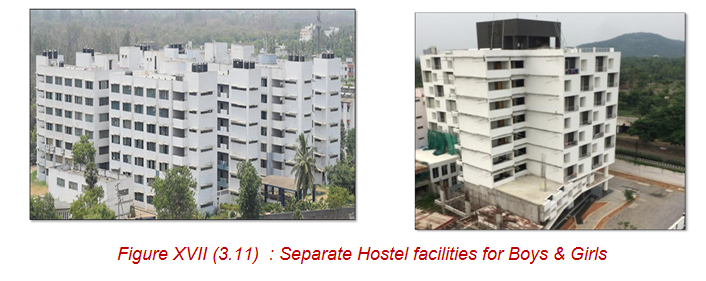
Separate Men’s Hostel complex with six multi-storied blocks containing 492 rooms shall accommodate 1708 boys including 54 AC rooms. Another complex with three multi-storeyed blocks containing 200 rooms shall accommodate 500 girls including 27 AC Rooms.
STAFF QUARTERS AND GUEST HOUSE
The residential accommodations of Teaching and Non Teaching staff are adequately furnished with following facilities.
1. 24 hrs Power backup.
2. Wi-Fi Connectivity
3. Cable, DTH Connection
4. Community Centre,
5. Vehicle Parking space for 4 wheeler and 2 wheeler
6. Elevator facility
7. Water Treatment Plant
8. Solar Water Heaters
9. RO Drinking Water
10. Children’s Park
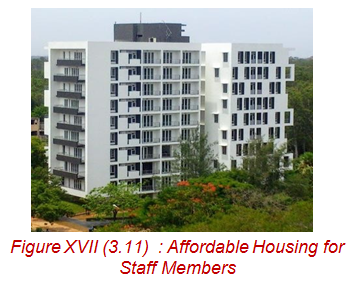
Figure XVII (3.11) – 12 : Affordable Housing for Staff Members
Green Building In Construction
- Sustainable and eco-friendly campus development has been adopted with following materials
- Grass Crete: Method of laying Grass paver flooring, walkways, sidewalks and driveways to improve storm water absorption and drainage
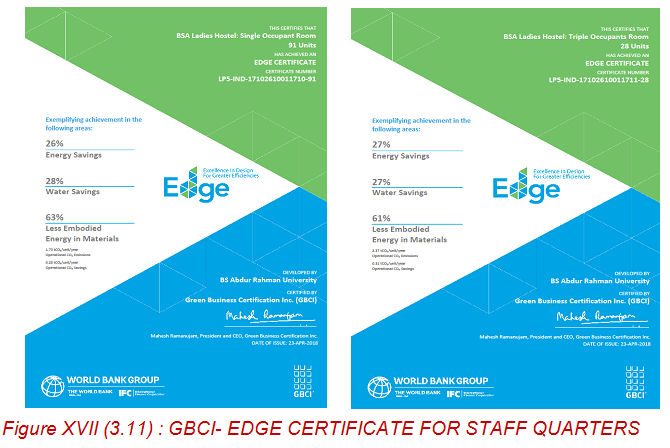
- Ash Crete: Fly ash (recycled) content with cement is being used for all Reinforced Cement concrete works.
- Low – VOC paints: Painting with low VOC less than 50gm/liter is using for all painting works – Nippon and Berger
- Engineered wood: MDF (Medium Densified Fibre) wood used for interior partition, doors and furniture’s.
- Structural Insulated Panels (SIP): Foam board wall panels are used for prefab structures such as class room and indoor game space.
- Insulated Concrete Forms: GFRC Technology being adopted to construct parent waiting guest rooms and essential staff quarters.
- Steel: Steel roof panels (recyclable) used for workshop roofing.
- Composites: Roof panels made of composite materials such as foam sandwiched between two metal sheets used for prefab class room ceiling.
- Fibreglass: Fibreglass is also used in insulation in the form of Fibreglass batts for interior partition works.
- AAC Blocks: Autoclaved Aerated Concrete blocks (non- toxic product) are used for the construction of all buildings to reduce low environmental impact.
- Thermatek Roof tile: Heat Resistant Terrace tiles are used for all buildings.
- VAV system: Variable air volume HVAC system is adopted to reduce energy consumption
Figure XVII (3.11) – 14 : GBCI-EDGE GREEN BUILDING CERTIFICATION FOR LADIES HOSTEL
CRESCENT SCHOOL OF ARCHITECTURE BLOCK, IS DESIGNED AS A NET ZERO ENERGY BUILDING AND REGISTERED UNDER USGBC-LEED GOLD CERTIFICATION
New Crescent School of Architecture block, is designed as a Net Zero Energy building and registered under USGBC-LEED Gold certification.
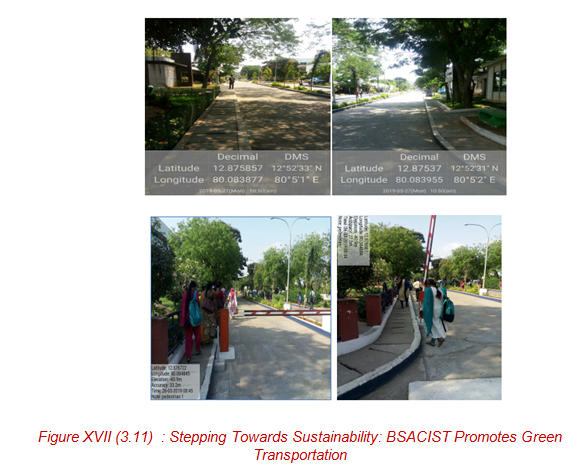
F. PEDESTRIAN PRIORITY ON CAMPUS
EDUCATIONAL OUTREACH
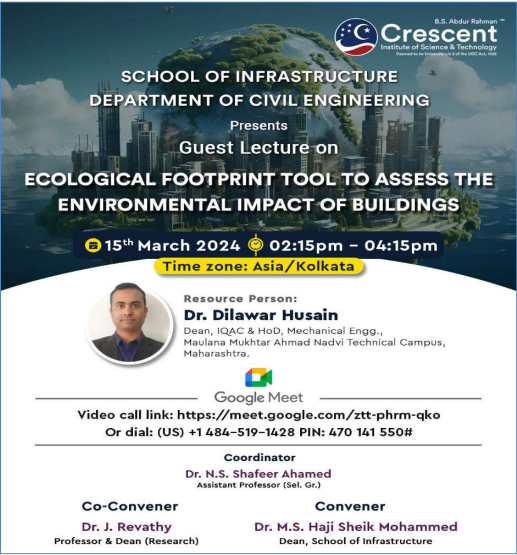
A guest lecture organized by BSACIST’s Department of Civil Engineering, titled “Ecological Footprint Tool to Assess the Environmental Impact of Buildings,” was held on 15 March 2024 via Google Meet. Dr. Dilawar Hussain spoke on calculating the carbon footprint of buildings by analyzing materials, manpower, techniques, and equipment, presenting a simple ecological footprint assessment tool. The session, coordinated by BSACIST faculty, attracted both offline and online attendees, including M.Tech and PhD students, and concluded with thanks from the organizers. The outcome highlighted that participants can evaluate and compare the environmental impacts of different buildings, contributing to SDG 11 and a greener environment.

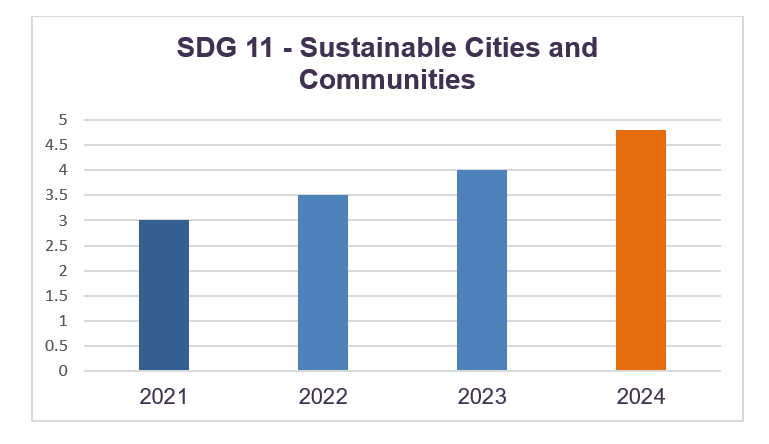
SDG 11: Sustainable Cities and Communities
| 4 to 5 | There is significant progress in effective implementation compared to the previous year |
| 3 to 4 | The necessary processes/activities (Support and expenditure on arts and heritage, sustainable transportation and housing) have been implemented |
| 2 to 3 | There is an explicit plan to address the ‘Sustainable Cities and Communities’ and necessitated processes have been initiated |
| 1 to 2 | There is an understanding and willingness to contribute effectively for achieving the UN targets of SDG 11 |
| 0 to 1 | There is no/partial willingness and plan to contribute for achieving the UN targets of SDG 11 Sustainable Cities and Communities |
SDG ACCORD REPORT 2025
B.S. Abdur Rahman Crescent Institute of Science and Technology (BSACIST), this positions the institute not only as a learner but as a contributor to national and regional SDG policy dialogues. The 2024 entry on relationships with regional NGOs and government for SDG policy underscores an ongoing posture of engagement with policy ecosystems, aligning institutional activity with policy development, monitoring, and adaptive management. This alignment suggests BSACIST can translate its SDG work into formal policy input, scenario modelling, and accountability mechanisms that inform broader regional development trajectories.
The 2025 SDG Accord report highlights that most signatories are moving toward embedding sustainability at an organizational level, with many reporting up-to-date sustainability policies endorsed by senior leadership. For BSACIST, the implication is to articulate a clear, leadership-backed sustainability policy or action plan that directly references SDGs most relevant to the institute’s mission and operations. Given the 2024 emphasis on engaging with government and regional NGOs, BSACIST could position its policy inputs as anchored in the connected governance and partnerships depicted in the report, ensuring that policy submissions, stakeholder consultations, and adaptive management are institutionally codified rather than ad hoc activities.
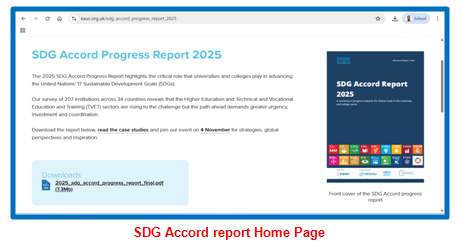
The SDG Accord Progress Report 2025 frames universities and colleges as pivotal agents for implementing the United Nations Sustainable Development Goals through whole-institution approaches. The thematic focus on Learning and Teaching reveals that while progress is ongoing, Learning and Teaching remains the least mature operational area for many signatories. BSACIST should view this as a guide to invest in curriculum integration of SDGs, faculty development, and assessment practices that explicitly test sustainability knowledge. The report notes significant barriers such as limited time for staff development and inadequate integration of sustainability into curricula. BSACIST can address these barriers by allocating dedicated funding and time for professional development, integrating SDG-related outcomes into degree programs, and creating standardized assessments that measure students’ sustainability competencies.
The progress report emphasizes the value of evidence-based case studies and peer learning. BSACIST can contribute through documenting and sharing successful Learning and Teaching innovations—for example, climate pedagogy initiatives, service-learning projects, and interdisciplinary modules that map to SDG4 (Quality Education), SDG 6 (Clean Water and Sanitation), SDG 7 (Affordable and Clean Energy) and SDG17 (Partnerships for the Goals). By contributing BSACIST-specific case studies to the SDG Accord platform, the institute would participate in a global knowledge network, enabling replication and contextual adaptation across similar universities and colleges in the region.
The results section of the report highlights top SDGs influenced by signatories and the priority SDGs for the upcoming year. In the last year, SDG4, SDG13, and SDG 6 (Clean Water and Sanitation), SDG 7 (Affordable and Clean Energy) were prominent, with SDG17 as a top priority for partnerships. For BSACIST, this pattern suggests focusing efforts on education quality, climate action initiatives, and strengthening collaborative frameworks with industry, government bodies, and civil society. Establishing formal partnerships and joint programmes with regional NGOs and the government can advance SDG implementation while creating opportunities for funding, capacity-building, and scalable impacts.
The report documents the internal and external support needs identified by signatories, with budget, dedicated staff capacity, and funding from external sources highlighted as top needs. BSACIST should prepare a resource plan that secures funding streams for SDG-aligned activities, including staff training, climate-related research, and curriculum transformation. Engaging government and sector partners can help unlock external support, align institutional priorities with national development plans, and provide procurement or grant-based pathways to sustain SDG initiatives over multiple years.
Finally, the BSACIST context benefits from the report’s emphasis on evaluating new partnerships and governance improvements. The Accord notes that sustainability work benefits from cross-departmental collaboration and a shared, mission-driven culture. BSACIST can leverage its 2024 policy-involvement experience to foster cross-disciplinary governance structures, establish an SDG steering committee, and implement a transparent reporting framework that communicates progress to internal and external stakeholders. By aligning these governance practices with the SDG Accord methodology, the institute can demonstrate measurable progress toward embedding the SDGs into education, research, operations, and community engagement.