
A. From Access to Opportunity – BSACIST’s Pledge through Scholarships and Educational Access
BS Abdur Rahman Crescent Institute of Science and Technology (BSACIST) is dedicated to fostering an inclusive learning environment and lifelong education opportunities for all, with a particular focus on individuals from economically weaker backgrounds. This aligns with UN Sustainable Development Goal 1 (No Poverty) by supporting scholarship programs and community engagement that reduce poverty and empower students to pursue higher education. The institute honors the visionary legacy of Dr. B.S. Abdur Rahman, whose philanthropic leadership funded “Not for Profit” institutions aimed at empowering women and marginalized groups, including free Ramadan scholarships through the Zakath Fund totaling over Rs. 3 Crore annually.
Dr. B.S. Abdur Rahman’s expansive educational philanthropy established a broad network of institutions and programs designed to uplift the needy, including Seethakathi Trust and All India Islamic Foundation, which supported 12 educational ventures across urban and rural Tamil Nadu. BSACIST remains committed to educational equity by prioritizing access for school dropouts and individuals unable to continue higher education, regardless of caste, creed, sex, or religion. The institute’s Lifelong Learning Access Policy further reinforces this commitment, ensuring that high-quality educational resources are available to all and promoting social equity as a cornerstone of sustainable development.
Empowering Low-Income Students Through Financial Aid and Access
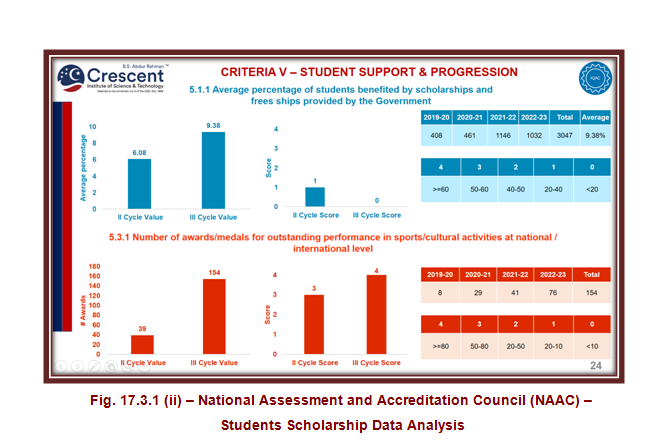
The NIRF / NAAC scholarship analysis provides a rich evidence base for measuring poverty-related outcomes at Crescent Institute, particularly in the context of SDG 1: No Poverty. The data show growing access to government and institutional scholarships across 2019–2024, with notable increases in the total number of students receiving aid and rising enrolments in both undergraduate and postgraduate programs. This uplift indicates progress in reducing financial barriers to education for economically disadvantaged groups, a core objective of SDG 1. The scholarship distribution, government support coverage, and donor-funded programs collectively contribute to broader financial inclusion and improved learning outcomes for vulnerable students.
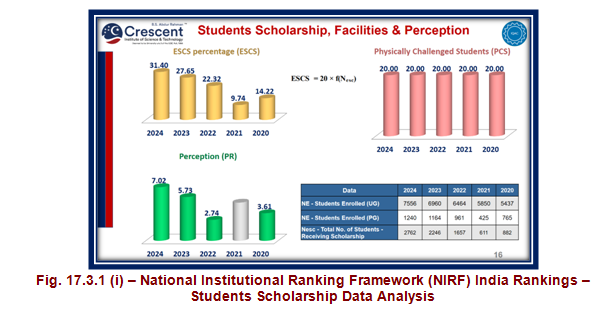
The analysis highlights both heavy-weight and light-weight metrics relevant to SDG 1. Heavy-weight metrics emphasize outcomes such as the share of students benefiting from scholarships, research funding, Ph.D. qualifications among faculty, and research outputs. These indicators reflect structural changes that can reduce poverty through better educational and professional opportunities. Light-weight metrics focus on access and process improvements, including increased seats for reserved categories, promotion of fellowships and transparent fund disbursement.
BSACIST commits to expanding access to education by launching a flagship scholarship program with a total endowment of up to 2 crore INR starting in the upcoming academic year.
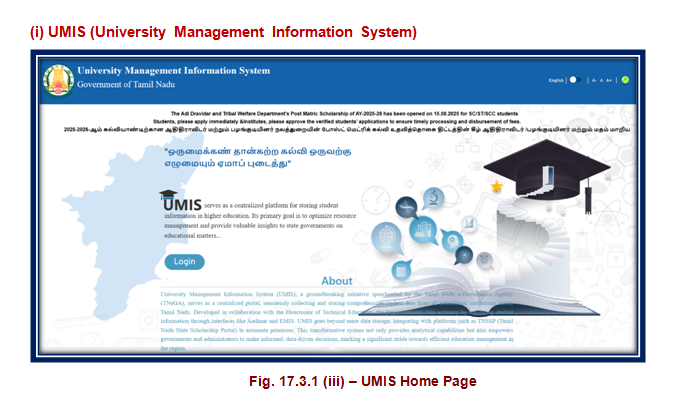
University Management Information System (UMIS), a groundbreaking initiative spearheaded by the Tamil Nadu e-Governance Agency (TNeGA), serves as a centralized portal, seamlessly collecting and storing comprehensive student data from all educational institutions across Tamil Nadu. Developed in collaboration with the Directorate of Technical Education, the project ensures data accuracy by validating student information through interfaces like Aadhaar and EMIS. UMIS goes beyond mere data storage, integrating with platforms such as TNSSP (Tamil Nadu State Scholarship Portal) to automate processes. This transformative system not only provides analytical capabilities but also empowers governments and administrators to make informed, data-driven decisions, marking a significant stride towards efficient education management in the region.
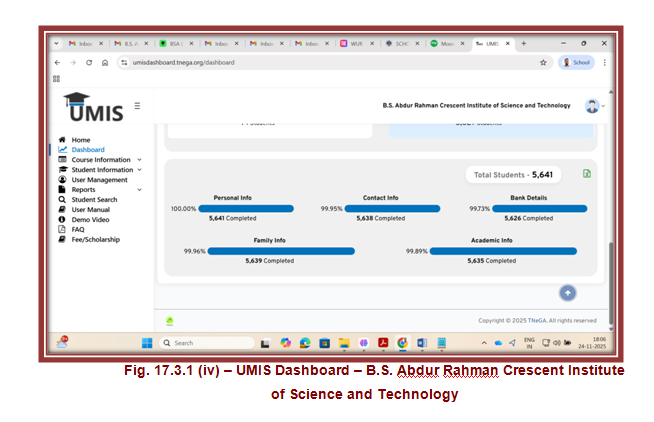
The students of BSACIST are encouraged to registered their data in the UMIS portal. The dashboard data demonstrates our ability to track and accelerate equitable access to higher education for disadvantaged students (both Male and Female) by monitoring key completion metrics (Personal Info, Contact Info, Bank Details, Family Info, and Academic Info) across the enrolment pipeline. The near-perfect completion rates—Personal Info (100%), Contact Info (99.95%), Bank Details (99.73%), Family Info (99.96%), and Academic Info (99.89%)—signal strong data governance and streamlined disbursement processes that reduce financial and informational barriers for students from economically weaker backgrounds. By translating these insights into targeted outreach, timely scholarship disbursements, and transparent reporting under the Scheme framework, Crescent Institute can improve enrolment retention, promote gender parity in higher education, and measurably advance SDG 1 through data-driven, poverty-reducing interventions.
(ii) Pudumai Penn Scheme
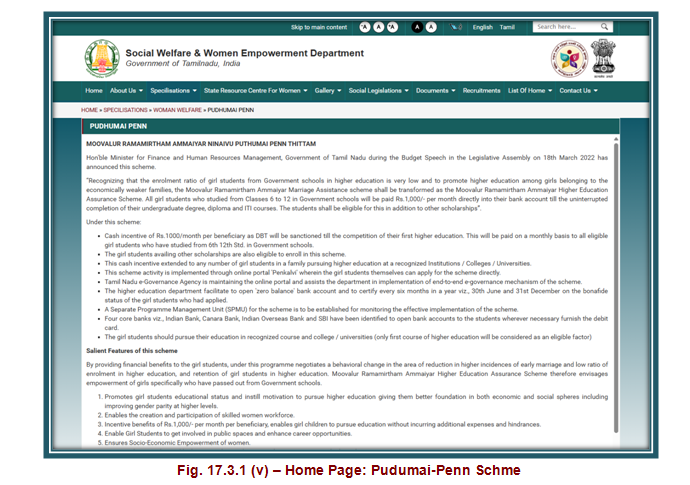
B.S. Abdur Rahman Crescent Institute of Science and Technology supports by actively expanding access to higher education for economically disadvantaged girls, leveraging the Tamil Nadu government’s Moovalur Ramamirtham Ammaiyar Higher Education Assurance Scheme, also known as Pudhumai Penn. This program’s core objective—reducing early marriage, improving female enrollment and retention in higher education, and fostering socio-economic empowerment—resonates with our institutional commitment to equity and inclusive excellence. By aligning with the government’s multi-tier governance model (State Steering Committee, State Monitoring Committees, and District Monitoring Committees) and embedding a dedicated Programme Management Unit (SPMU), Crescent Institute can mirror this structured approach within its own scholarship operations. The synergy between public policy and university-level initiatives enhances our capacity to reach underrepresented girls from Government school backgrounds, reduces barriers to access, and elevates the overall regional contribution to SDG 1 targets. Within the Sustainability Ratings framework, the initiative strengthens Indicators 1.1 (targeted financial support reach) and 1.2 (access to financial assistance and information) by expanding need-based aid, information campaigns, and application support tailored to female students who face unique social and economic challenges.
To operationalize this alignment, Crescent Institute can implement a multi-stakeholder scholarship program modelled after Pudhumai Penn’s tiered governance—establishing a Scholarship Governance Council, a female-students-focused Outreach & Guidance Wing, and campus-based Selection Committees with transparent eligibility criteria. The program would provide direct financial support for eligible female students from Government schools pursuing undergraduate and postgraduate study, along with parallel investments in information access, mentorship, and career development opportunities.
C. OUTREACH INITIATIVES
EEGAI – Donating Books
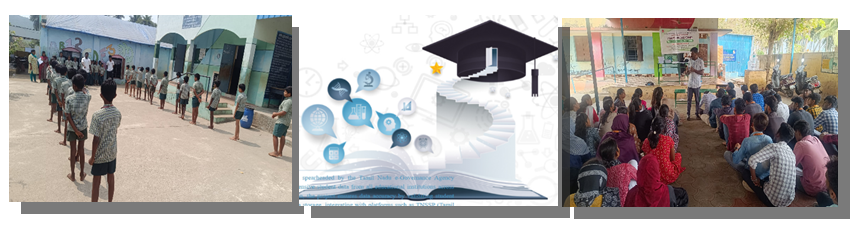
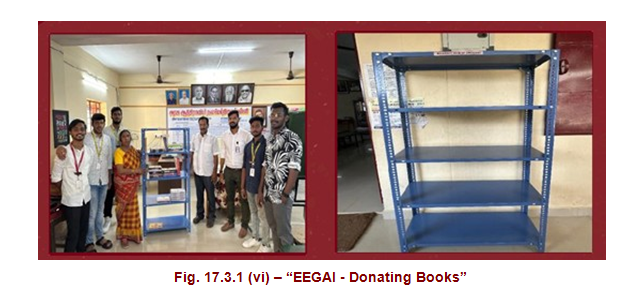
The “EEGAI – Donating Books” initiative aligns with SDG 1 by directly reducing educational expenses and expanding access to learning resources for students from economically disadvantaged backgrounds. By collecting and distributing pre-loved or donated books, Crescent Institute lowers the total cost of education, enabling more students to participate in core courses, self-study, and exam preparation without the prohibitive burden of purchasing new textbooks. This initiative also strengthens financial inclusion by reducing ancillary costs associated with learning, such as reference materials and course packs, thereby decreasing dropout risk attributable to poverty. Crescent Institute can establish a Donations and Resource Allocation Unit responsible for intake, cataloging, and distribution of books to eligible economically disadvantaged students.
Date: March 15, 2024
Venue: Urapakkam Government Secondary School
Project Chairperson: RTR. Zunaid Abbas
Total Number of Beneficiaries: 100+
FOOD DISTRIBUTION DRIVE
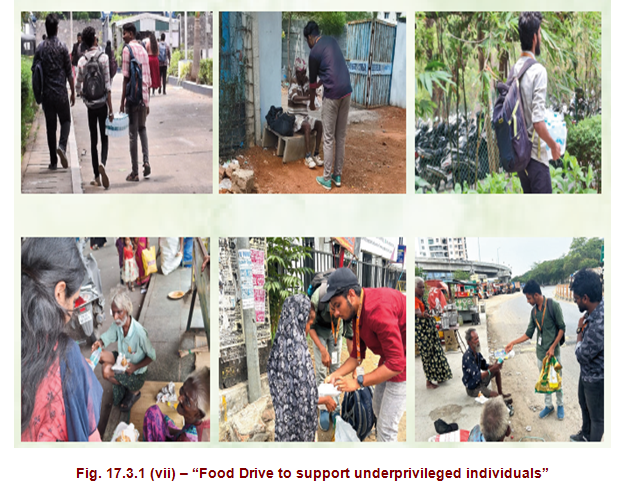
The Crescent Energy Club organized a Food Drive to support underprivileged individuals by providing nutritious meals and to create awareness among students on the importance of youth participation in addressing hunger and poverty. The initiative aligned with SDG 1 – No Poverty and SDG 2 – Zero Hunger, promoting social responsibility and sustainable community welfare.
A total of ₹5620 was raised with the support of around 50 volunteers. From this, ₹4400 was utilized to distribute food to nearly 200 needy people in and around Vandalur, contributing to hunger relief and community well-being. The event successfully demonstrated the impact of collective action and encouraged continued efforts toward supporting vulnerable communities.
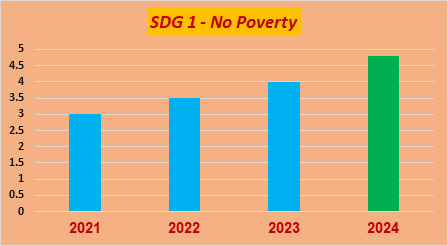
Rubrics for SDG 1: No Poverty
| 4 to 5 | There is significant progress in effective implementation compared to the previous year |
| 3 to 4 | The necessary processes/activities (Support to students based on income, assistance to local start-ups) have been implemented |
| 2 to 3 | There is an explicit plan to address the ‘No Poverty’ and necessitated processes have been initiated |
| 1 to 2 | There is an understanding and willingness to contribute effectively for achieving the UN targets of SDG 1 |
| 0 to 1 | There is no/partial willingness and plan to contribute for achieving the UN targets of SDG 1 No Poverty |
SDG ACCORD REPORT 2025
B.S. Abdur Rahman Crescent Institute of Science and Technology (BSACIST), this positions the institute not only as a learner but as a contributor to national and regional SDG policy dialogues. The 2024 entry on relationships with regional NGOs and government for SDG policy underscores an ongoing posture of engagement with policy ecosystems, aligning institutional activity with policy development, monitoring, and adaptive management. This alignment suggests BSACIST can translate its SDG work into formal policy input, scenario modelling, and accountability mechanisms that inform broader regional development trajectories.
The 2025 SDG Accord report highlights that most signatories are moving toward embedding sustainability at an organizational level, with many reporting up-to-date sustainability policies endorsed by senior leadership. For BSACIST, the implication is to articulate a clear, leadership-backed sustainability policy or action plan that directly references SDGs most relevant to the institute’s mission and operations. Given the 2024 emphasis on engaging with government and regional NGOs, BSACIST could position its policy inputs as anchored in the connected governance and partnerships depicted in the report, ensuring that policy submissions, stakeholder consultations, and adaptive management are institutionally codified rather than ad hoc activities.
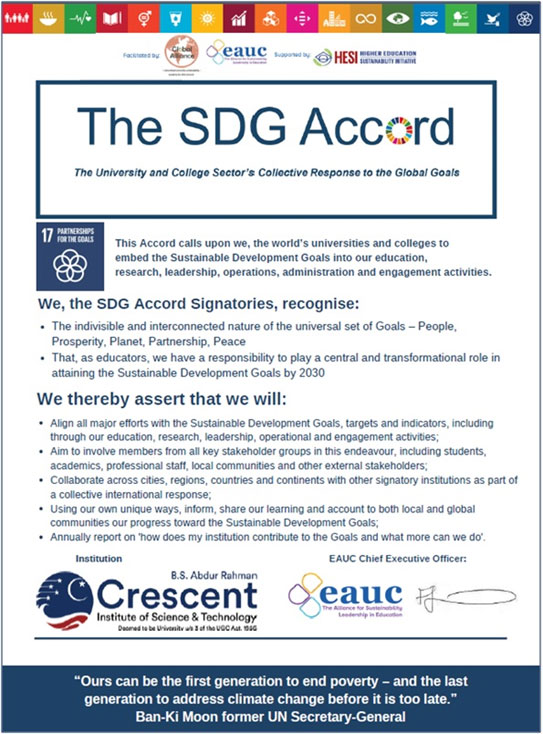
Figure XVII (3.1)-1 – SDG Accord report

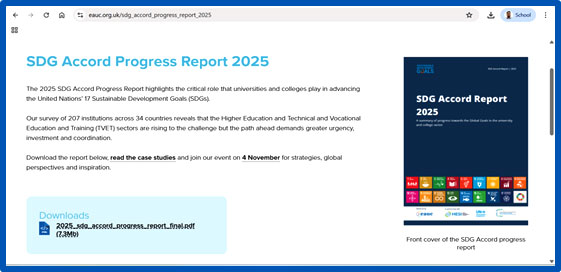
The SDG Accord Progress Report 2025 frames universities and colleges as pivotal agents for implementing the United Nations Sustainable Development Goals through whole-institution approaches. The thematic focus on Learning and Teaching reveals that while progress is ongoing, Learning and Teaching remains the least mature operational area for many signatories. BSACIST should view this as a guide to invest in curriculum integration of SDGs, faculty development, and assessment practices that explicitly test sustainability knowledge. The report notes significant barriers such as limited time for staff development and inadequate integration of sustainability into curricula. BSACIST can address these barriers by allocating dedicated funding and time for professional development, integrating SDG-related outcomes into degree programs, and creating standardized assessments that measure students’ sustainability competencies.
The progress report emphasizes the value of evidence-based case studies and peer learning. BSACIST can contribute through documenting and sharing successful Learning and Teaching innovations—for example, climate pedagogy initiatives, service-learning projects, and interdisciplinary modules that map to SDG4 (Quality Education), SDG 6 (Clean Water and Sanitation), SDG 7 (Affordable and Clean Energy) and SDG17 (Partnerships for the Goals). By contributing BSACIST-specific case studies to the SDG Accord platform, the institute would participate in a global knowledge network, enabling replication and contextual adaptation across similar universities and colleges in the region.
The results section of the report highlights top SDGs influenced by signatories and the priority SDGs for the upcoming year. In the last year, SDG4, SDG13, and SDG 6 (Clean Water and Sanitation), SDG 7 (Affordable and Clean Energy) were prominent, with SDG17 as a top priority for partnerships. For BSACIST, this pattern suggests focusing efforts on education quality, climate action initiatives, and strengthening collaborative frameworks with industry, government bodies, and civil society. Establishing formal partnerships and joint programmes with regional NGOs and the government can advance SDG implementation while creating opportunities for funding, capacity-building, and scalable impacts.
The report documents the internal and external support needs identified by signatories, with budget, dedicated staff capacity, and funding from external sources highlighted as top needs. BSACIST should prepare a resource plan that secures funding streams for SDG-aligned activities, including staff training, climate-related research, and curriculum transformation. Engaging government and sector partners can help unlock external support, align institutional priorities with national development plans, and provide procurement or grant-based pathways to sustain SDG initiatives over multiple years.
Finally, the BSACIST context benefits from the report’s emphasis on evaluating new partnerships and governance improvements. The Accord notes that sustainability work benefits from cross-departmental collaboration and a shared, mission-driven culture. BSACIST can leverage its 2024 policy-involvement experience to foster cross-disciplinary governance structures, establish an SDG steering committee, and implement a transparent reporting framework that communicates progress to internal and external stakeholders. By aligning these governance practices with the SDG Accord methodology, the institute can demonstrate measurable progress toward embedding the SDGs into education, research, operations, and community engagement.