

Crescent Sustainability Initiatives
Quality Education (SDG 4)
Issue : 04; Revised on 2023
| Policy Created on | July 2009 |
| 1st Revision amended on | IQAC Meeting held on 27th October 2017 |
| 2nd Revision amended on | IQAC Meeting held on 31st March 2021 |
| 3rd Revision amended on | IQAC Meeting held on 16th June 2023 |
Responsible Executive : Director (IQAC)
Responsible Office : Internal Quality Assurance Cell, Student Affairs, Estate Office, Academic Office, Library and SDG Cell
Contacts : Registrar, Director (IQAC)
The revised policy has been approved in the 18th Meeting of the Internal Quality Assurance Cell (IQAC) held on 16.06.2023.
1. Statement of Policy
The B.S. Abdur Rahman Crescent Institute of Science and Technology is committed to ensuring inclusive and equitable quality education and promoting lifelong learning opportunities for all. This policy aims to enhance access to educational resources and foster a culture of continuous learning, aligning with the United Nation’s Sustainable Development Goal 4 (SDG 4).
2. Objectives
- Equitable Access: Ensure that all individuals, regardless of gender, socio-economic background, race, religion, or disability, have access to quality education and lifelong learning opportunities.
- Community Engagement: Actively involve the local community in educational initiatives, promoting awareness and participation in lifelong learning programs.
- Resource Availability: Provide free access to educational resources, including libraries, digital materials, and workshops, to facilitate continuous learning.
3. Policy Principles
- Lifelong Learning Opportunities: The Institute will offer a range of programs, workshops, and resources aimed at enhancing skills and knowledge for individuals of all ages.
- Inclusivity: All educational initiatives will be designed to be accessible to diverse populations, including marginalized and underrepresented groups.
- Public Engagement: The Institute will extend its facilities and resources to the community, ensuring that educational opportunities are available to all.
4. Lifelong Learning Measures
4.1 Public Resources (Lifelong Learning)
- Access to Campus Facilities: The Institute will provide free access to its facilities, including libraries, computer labs, and meeting spaces, for community members and local organizations.
- Special Coaching Programs: Organize coaching sessions for higher secondary students, focusing on subjects requested by local schools, conducted in both on-site and online formats.
4.2 Workshops and Training Programs
- Vocational Training Events: Conduct workshops on relevant topics, such as technology, legal awareness, and design, to enhance practical skills and knowledge in the community.
- Collaborative Learning: Encourage partnerships with local schools and organizations to facilitate educational outreach and skill development initiatives.
4.3 Online Resources and Open Access
- Digital Learning Materials: Provide open access to educational materials, including video lectures, course notes, and research papers, to promote self-directed learning.
- Online Courses: Develop and offer online courses that cater to various interests and skill levels, ensuring accessibility for all learners.
4.4 Community Engagement Initiatives
- Educational Outreach Activities: Organize events and competitions for local school children, fostering a connection between higher education and the community while promoting early learning.
- Legal Aid and Awareness Programs: Offer legal education and resources to community members, ensuring access to justice and legal knowledge.
5. Monitoring and Evaluation
The effectiveness of the lifelong learning measures will be regularly assessed through participant feedback and community engagement metrics. Adjustments will be made based on evaluations to improve the policy’s impact continuously.
This revised policy document reflects the commitment of B.S. Abdur Rahman Crescent Institute of Science and Technology to promote lifelong learning and educational equity. By implementing these measures, the Institute aims to empower individuals and communities, contributing to the broader goals of sustainable development and social welfare.

Table IV – 1: Promotion / Implementation/ Evidence of Policy
| Public Resources (lifelong learning) | https://crescent.education/iqac-csi-sdg4-431-2023-24-4/ |
| Public Events (lifelong learning) | https://crescent.education/iqac-csi-sdg4-432-2023-24/ |
| Vocational Training Events (lifelong learning) | https://crescent.education/iqac-csi-sdg4-433-2023-24/ |
| Education Outreach Activities Beyond Campus | https://crescent.education/iqac-csi-sdg4-434-2023-24/ |
| Policy for Life-Long Learning Access Policy | https://crescent.education/iqac-csi-sdg4-435-2023-24/ |
Workshop on “Applications of Electrical and Electronics Engineering in Modern Life” for Higher Secondary School Students (for +2 students)

BSACIST is deeply committed to SDGs related to Quality Education by offering free, hands-on education programs to nearby school students especially the Higher Secondary (Eleventh and Twelfth) students for creating, engaging, practical exposure towards Electrical and Electronics Engineering and to understand the concepts and to get an experience in the core subjects namely, Maths , Physics and Chemistry to inspire interest in higher education.
By bridging school and university learning through immersive demonstrations and mentorship, we aim to empower every student to pursue their academic and career aspirations. This outreach underscores our belief that accessible STEM education opens doors to a brighter, more equitable future.

Poster for the Workshop on “Applications of Electrical and Electronics Engineering in Modern Life” for Higher Secondary
School Students (for +2 students)
Objectives of the Workshop:
- Expose higher secondary students to real-world electrical and electronics engineering applications.
- Demonstrate hands-on lab-based learning to foster practical understanding of concepts.
- Highlight career and higher education pathways in electrical and electronics engineering.
- Build partnerships with schools and colleges to extend BSACIST’s educational outreach.
Target Beneficiaries:
- Higher secondary (+2) students from nearby schools. The students from the following Schools attended the workshop.
- Velammal Matriculation Higher Secondary School
- Crescent Matriculation Higher Secondary School
- Sri Vishwa Vidyalaya Higher Secondary School
- Gurukula Higher Secondary School
- Sri Sankara Higher Secondary School
- Santhosh Vidyalaya Higher Secondary School
- Zion Matriculation Higher Secondary School
- Bharathiyar Matriculation Higher Secondary School
- St. Anne Matriculation Higher Secondary School
Content and Demonstrations:
Demonstrated projects emphasize practical applications:
- Door opening alarm,
- Smart dustbin,
- Sensor-based systems,
- Automated robot arm,
- Regenerative braking in ev, and
- Automated homes.
These projects illustrate cross-cutting themes: renewable energy, automation, IoT, and smart devices—supporting SDG 7 (Affordable and Clean Energy), SDG 9 (Industry, Innovation and Infrastructure), and SDG 11 (Sustainable Cities and Communities).
Facilities and Resources:
Use of BSACIST labs like PLC lab, Power Electronics lab, Electric Vehicle lab provides hands-on experiences with modern infrastructure, reinforcing SDG 9 through exposure to advanced engineering environments.
Skills Development:
- Hands-on experience with automation, sensor networks, and EV technologies improves practical STEM competencies.
Expected Outcome – Educational Impact:
- Increased awareness of EEE applications among non-university students.
- Enhanced interest in pursuing engineering education, potentially boosting BRASCIST’s future enrollments from local communities (SDG 4, SDG 9).
Expected Outcome – Social Impact:
- Strengthened ties with the local community and educational ecosystem, contributing to more equitable access to STEM opportunities (SDG 10).
Event Photos:


Attendance (sample):

To ensure that access to various facilities, resources, and activities is accessible to all (Faculty, staff, students, alumni and public) regardless of ethnicity, religion, disability, immigration status or gender. To start Libraries/Digital Libraries and reading rooms for the use of the Public in general. These objectives were extracted from the Memorandum of Association of the sponsoring body of the Institution and the Rules and Regulations of the statutory body implemented by the Institution. The University takes great pride in making the world know that the resources of the University can be used even by persons who are not studying on campus. The facility is open to all irrespective of any discrimination. Therefore, the University envisages the promotion of not only its students but whoever is interested in educating themselves. The aim is precisely, the welfare of society as a whole. For the same reason, it provides huge access not alone to the library but also to the online courses, video lecture materials and other facilities which students/the public want to access. Any student who is endowed with intellectual ability is promoted and encouraged to navigate his skills and achieve great success. The University has been organizing events in the public domain by conducting public lectures, various events, and educational events and ensure maximum public participation. The University also offers vocational training to the public, free of cost and this has enabled many persons to secure jobs and earn their livelihood. Many families are benefitted from this and in this way the University ensures that it is always in the service of the community. The various departments of the University have also organized many extension activities beyond the campus which has benefitted the students in the nearby schools, the people of small hamlets in the vicinity of the University, the small towns and the city areas which is appreciated by the people who are the beneficiaries of such activities. Last but not the least, the University takes pride in providing access to education to all, those who seek knowledge and wisdom, regardless of their ethnicity, religion, community gender or disability. This was the vision and mission envisaged by its founders.
There are a total of about 190 video lectures, 53 PPTs & 68 pdf files developed for different courses by our faculty members of all the departments.
These lectures are available for public access to enhance life-long learning skills.
Public users can access the course materials through the URLs of the respective department e-learning portal as given below.
Report on “Certificate Course on Safety Instrumentation Systems”
25th January 2024 – 31st January 2024
Organized by Department of Electronics and Instrumentation Engineering

Mode : Online (Google Meet)
Poster for the Certificate Course on Safety Instrumentation Systems
PREAMBLE
This certificate course titled “Safety Instrumentation Systems” was organized by the Department of Electronics and Instrumentation Engineering to educate the students and industry persons about the concepts of functional safety. The predominant goal of this certificate course was to prepare the participants to analyze qualitative risks in industries with consequences and to identify and assess the various risk factors. This course was crafted in such a way that enriches the knowledge of students in safety instrumentation systems.
This course was open to the final year students of Instrumentation and chemical engineering, operators/engineers from manufacturing industries, engineers from EPC companies, faculties, technicians from academic institutions.
The Resource Person for the Course is
Mr. Ameer Asik, Certified Safety Engineer, President , Sales (Wind) – ABB, Norway.
The Course content delivered in Webinar is given below:
Agenda – DAY 1
• What is Safety and What is Risk?
• What if Functional Safety? Why is important?
• International Standards (e.g. IEC61506)
• What is a BPCS ?
• What is a SIS & its major components
• SIS, SIF & SIL
Agenda – DAY 2
• Key components of a SIS – continued
• Terminology – IEC61506 vs IEC61511
• Modes of Operation (of a SIF)
• SIS – Key design attributes
• HFT, SFF, PFDavg, PST
• Failure Definitions & Classification
• SIS Lifecycle
Agenda – DAY 3
• Wrap-up (Key points to remember)
• Architectures
• Achieving Hardware safety Integrity
• Proof Testing
• Diagnostic Coverage
• Safety Recycle Management
Agenda – DAY 4
• MTBF (Mean time between failures)
• FIT (Failure in Time)
• Safety Manual (A Glance)
• Practical Examples on SIL Achievement
• Cybersecurity
Agenda – DAY 5
• Excise using redundancy (1002) & Proof Test Interval adjustment
• Guidelines for selection of SIS components
• Q & A
Also, the feedback about the session were collected from all the participants for carrying out improvement in the upcoming courses.
All the participant received participation certificate and study material to further improve their knowledge.
Following are the details of registered candidates:
Sl. No | Name of the Participant | Organization |
1. | Maniraj p | M/s. Innovative Instruments And Controls, Chennai |
2. | Mahesh | M/s. ENVEA India Pvt Ltd, Chennai |
3. | Mohideen Basheer | M/s. Project Engineer Automation, SEL ILC, Bahrain. |
4. | Mohammed Yusuf | M/s. Senior Instrument and Control Technician, ABJ Engineering and Contracting Company, Kuwait |
5. | Mohamed Syed Ibrahim . M | M/s. Sethu Institute Of Technology, Virudhunagar |
6. | Rayyaan Mohamed Abubakkar | M/s. St. Joseph’s College of Engineering, Chennai |
7. | Kathiravan S | M/s. Sri Sairam Engineering College Chennai |
8. | Ashraf M | M/s. Sri Sairam Engineering College, Chennai |
9. | Dr.S.Selvakumar | Head / Department of Mechanical Engineering, BSACIST |
10. | Sakeena | BSACIST |
11. | Khadersharieefshaik | BSACIST |
Live Interaction during the course

DAY 1 : Live Interaction screenshots during the Course on International Standards (e.g. IEC61506)

DAY 4 : Live Interaction screenshots


Live Interaction screenshots
PARTICIPATION CERTIFICATE (SAMPLE)

Feedback Analysis on the Certification Course
| Analysis | Inference |
 |
71% of the participants felt that the speakers knowledge is Excellent and 29% felt it’s good. |
 |
More than 55% of the participants will use this course information immediately. |
 |
More than 85% of the participants felt that the speakers knowledge is Excellent and good. |
 |
More than 57% of the participants felt the 100% of the content is new to them. Remaining 29% of participants felt that 75% of content is new to them. |
 |
All the participants felt excellent and good about the teaching aids used |
 |
More than 85% of the participants felt that the knowledge gained by the event is good and excellent. |
 |
All the participant agreed that the material presented was in an organized manner |
 |
All the participants felt that the program has achieved its objective |
 |
Overall assessment of the event is good and excellent. |
To ensure that access to various facilities, resources, and activities is accessible to all (Faculty, staff, students, alumni and public) regardless of ethnicity, religion, disability, immigration status or gender. To start Libraries/Digital Libraries and reading rooms for the use of the Public in general. These objectives were extracted from the Memorandum of Association of the sponsoring body of the Institution and the Rules and Regulations of the statutory body implemented by the Institution. The University takes great pride in making the world know that the resources of the University can be used even by persons who are not studying on campus. The facility is open to all irrespective of any discrimination. Therefore, the University envisages the promotion of not only its students but whoever is interested in educating themselves. The aim is precisely, the welfare of society as a whole. For the same reason, it provides huge access not alone to the library but also to the online courses, video lecture materials and other facilities which students/the public want to access. Any student who is endowed with intellectual ability is promoted and encouraged to navigate his skills and achieve great success. The University has been organizing events in the public domain by conducting public lectures, various events, and educational events and ensure maximum public participation. The University also offers vocational training to the public, free of cost and this has enabled many persons to secure jobs and earn their livelihood. Many families are benefitted from this and in this way the University ensures that it is always in the service of the community. The various departments of the University have also organized many extension activities beyond the campus which has benefitted the students in the nearby schools, the people of small hamlets in the vicinity of the University, the small towns and the city areas which is appreciated by the people who are the beneficiaries of such activities. Last but not the least, the University takes pride in providing access to education to all, those who seek knowledge and wisdom, regardless of their ethnicity, religion, community gender or disability. This was the vision and mission envisaged by its founders.
There are a total of about 190 video lectures, 53 PPTs & 68 pdf files developed for different courses by our faculty members of all the departments.
These lectures are available for public access to enhance life-long learning skills.
Public users can access the course materials through the URLs of the respective department e-learning portal as given below.
School of Mechanical Sciences:

School of Infrastructure:
School of Social Sciences and Humanities:
Crescent School of Pharmacy:
School of Physical and Chemical Science:
Crescent School of Business:
School of Electrical and Communication Sciences:
School of Computer Information and Mathematical Sciences:
School of Life Sciences:
Others:
Click here to view the Website
eBooks
The revolution, which took place in information and communication technology (ICT) has made a paradigm shift in the route to access library & information centres. Realizing the importance of e-access and its advantages, the library has shifted its focus towards open access as well paid subscription to e-Books.
e-Journals
PhD Theses of B S Abdur Rahman Crescent Institute of Science & Technology
E-Theses
OLD QUESTIONS
E-Patents
| Canadian, European, Indian Patent design and trademark office, United States |
E-Reference
Free Online Courses
E-NewsPaper
About 10,000 newspapers worldwide
Free Online Courses
| Swayam, NPTEL, Coursera, Khan Academy, Edx, Academicearth |
Research Support Resources
Plagiarism
| About Plagiarism, Turnitin – Plagiarism Checker |
Journal Finder
| Elsevier Journal Finder, Springer Journal Suggester, Scopus Journal Analyzer, Manuscript matcher, IEEE Publication Recommender, AUTHOR SERVICES – Taylor & Francis, Springer Author Academy |
Journals List
| Scopus Indexed Journals, Web of Science Indexed Journals, UGC CARE Journals |
Reference Management Tools
| Mendeley, EndNote, ReadCube Papers, Zotero |
Writing Tools
| Grammarly, Wordtune, Prowritingaid, Ginger |
Citation Generator
| Citation Machine, Bibliography, Easy Bib |
Fellowships and Scholarships
Learning Support Resources
| National Digital Library, Spoken Tutorial, NPTEL, SWAYAM e-PG Pathshala, Virtual Labs |
Study Materials for Competitive Exams
| ICT Initiatives of Ministry of Education, Government of India |
| Copyright Guide for Indian Libraries |
Resources on Demand
The main objective of ‘Resources on Demand’ scheme is to empower the rural community by providing authentic information to support their day-today life. Keeping the above in mind, the Central Library will provide resources / information without violating the copy-right act. Those who need any resources are requested to contact the Librarian at librarian@crescent.education
Conclusion: A Vision for Inclusive Education
The various initiatives undertaken by B.S. Abdur Rahman Crescent Institute of Science and Technology reflect a robust commitment to lifelong learning and community engagement. By providing free access to educational resources and actively involving the community in learning opportunities, the university is not only fulfilling its mission but also contributing to the broader goal of educational equity and social welfare. The vision of the founders continues to guide the institution in its efforts to serve society and promote knowledge for all.
BSACIST is pleased to organize a public-facing executive education program that emphasizes the critical role of quality education in shaping a resilient, innovative, and inclusive society. Building on BSACIST’s track record of NEP-aligned initiatives, vocational training, and specialized workshops (including electrochemical corrosion techniques and IFRS insights), this program will deliver hands-on, practitioner-led sessions designed for working professionals, educators, and public sector participants. By integrating experiential learning, industry partnerships, and accessible formats (with no registration fees where feasible), BSACIST will demonstrate how high-quality pedagogy, modern curricula, and governance reforms translate into measurable outcomes—better employability, lifelong learning, and equitable access to education. The institute will collaborate with universities, industry bodies, and government partners to ensure content is relevant, scalable, and aligned with SDG 4, thereby reinforcing the public value of quality education and reinforcing BSACIST’s leadership in executive education and lifelong learning.
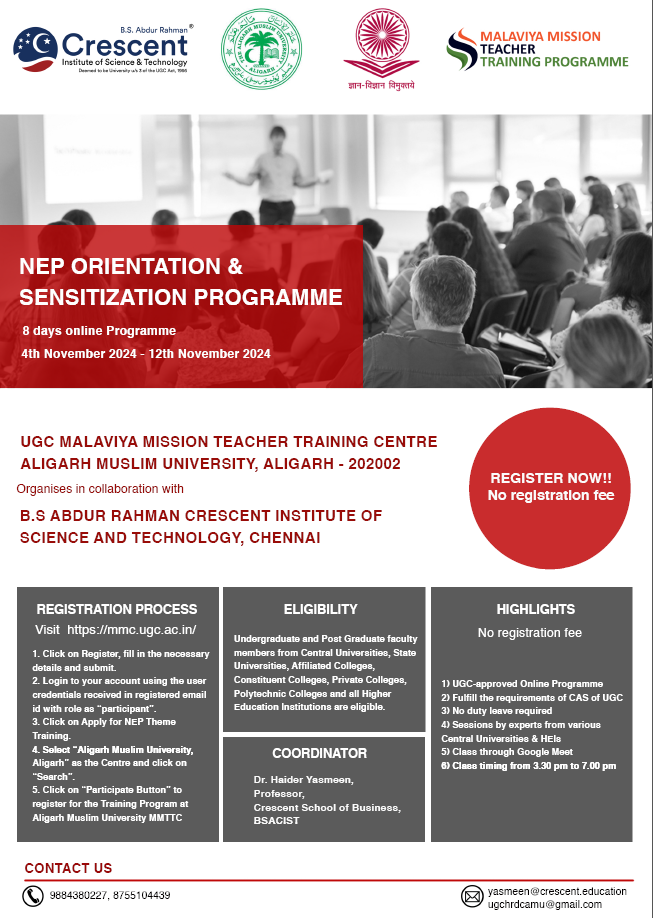
Poster for NEP Orientation & Sensitization Program
The NEP-Nov 2024 online orientation organized by UGC Malaviya Mission Teacher Training Centre in collaboration with Crescent Institute of Science and Technology (BSACIST) exemplifies BSACIST’s commitment to SDG 4: Quality Education. By delivering an eight-day, online, expert-led program to undergraduates and postgraduates from diverse institutions, BSACIST expands access to high-quality educational experiences beyond traditional classrooms. The event feature set—lectures by eminent professors, industry professionals, and NEP 2020 governance sessions—demonstrates a robust, practice-oriented approach that translates policy-level insights into actionable knowledge for a broad audience, thereby democratizing educational opportunity and fostering lifelong learning.
The programme emphasizes experiential learning and interdisciplinary engagement, aligning with BSACIST’s aim to elevate educational quality through collaborative design and real-world relevance. Activities such as e-content creation, integration of AI and technology in curricula, and discussions on inclusive pedagogy reflect a commitment to modernizing pedagogy while ensuring inclusivity and accessibility. By coordinating with multiple universities and offering no registration fee, BSACIST not only enhances its own educational offerings but also strengthens public understanding of NEP 2020, teacher education reforms, and governance in higher education—embodying SDG 4’s mandate to provide inclusive, equitable, and quality education for all.
REPORT
EDUCATIONAL EVENT – POSTER FOR THE EVENT
08 Days Online NEP 2020 Orientation and Sensitization Programme
The 8 days online-National Education Policy Programme (2020) was a great eye-opener for the course coordinator and the course participants. The programme is a joint initiative of UGC Malaviya Mission Teacher Training Centre, Aligarh Muslim University, Aligarh and BSA Crescent Institute of Science and Technology, Chennai. The Malaviya Mission Teacher Training Programme is laid down in the Career Advancement Scheme (CAS) of UGC.
The programme was basically meant for undergraduate and post graduate faculty members from central universities, state universities, affiliated colleges, constituent colleges, private colleges, polytechnic colleges and all higher education institutions. The sessions were handled through on- line mode using google meet platform and was scheduled in the afternoon, during off working hours. No duty leave was required to be obtained. Each session was scheduled for 1 hour and 30 minutes. Two sessions were fixed in a day and a total of 16 sessions were scheduled for 8 days. Twenty-two (22) participants, both from Crescent and from other universities participated in the programme (both lists provided below).
- Eminent Professors from Central Universities, Industry Professional and experts from Ministry of Education were chosen as speakers to provide orientation and sensitize participants on the various dimensions of National Education Policy (2020). On day 1-1st slot, we had Prof. Asiya Choudhary from the Department of Commerce, AMU, speaking on the importance of Entrepreneurship Development. She emphasized on the fact that we need to create more job providers rather than job seekers in order to increase the job employment opportunities every year, thereby contributing to India’s economy, which continues to remain as one of the fastest-growing economies of the world. The focus should be on becoming an entrepreneurial university. On day 1-2nd slot, Prof. Sajid Jamal from Department of Education, AMU pointed out that designing interesting and industry relevant curriculum and pedagogy would facilitate in the holistic growth of students.
- The 2nd day-1st slot and 3rd day-1st slot was on e-content creation. The session was conducted by Prof. Aasim Zafar from Dept of CSE, AMU. The speaker, very diligently touched upon several important topics such as need for on-line teaching, e-PG Pathshala, development of MOOC courses by university professors, funding for development of MOOC courses, Swayam platform for MOOCs, life-cycle of MOOC course etc. The participants found the sessions to be very useful and interesting. On 2nd day-2nd slot, Prof. MN Mustafa from School of Education, Central University of Kerala highlighted the complimenting role of teaching and research. He focused on ethics integrity value addition and quality when it comes to research.
- For day 3-2nd slot, Ms. Farha Haider, Data Scientist, Nokia, Canada was invited to speak on the significance of Integrating AI & Technology in Academic Curriculum, both at school and university level. She made it very clear that the students should start preparing themselves for a futuristic world where AI, Machine Learning, Robotics will be used extensively in businesses across the globe. A number of new jobs will be created in the place of old jobs which might soon become obsolete. She also underlined the fact that university-school connect and industry-school connect are equally important as industry-university connect, because the foundation needs to be strong right from school education. She pointed out the differences across countries with regard to integration of AI and technology in academic curriculum.
- The 4th day, slot 1 was handled by Prof. Masroor Alam, Dept. of Civil Engineering, ZHCET, AMU on the topic, Climate Change and Problem of Pollution. He stressed that people are not realizing the ill-effects that global warming and pollution would have on the entire world. He explained very clearly the concept of greenhouse effect, glacier melting, sea-level rising and increase in concentration of CO2, which demands our immediate attention. He said there is an urgent need to introduce a lot of courses on environmental sustainability for sensitization in schools and universities, conducting awareness program and carrying out research studies pertaining the same in order to avoid further damage to the planet.
- The 2nd slot of the 4th day was taken over by Prof. Nasreen, Department of Education, AMU, on Handling Student Diversity and Inclusive Education where she focused on the necessity to have diversity of students in educational institution. She also reiterated the need to create an environment where all students experience a sense of belongingness and are valued, respected, and safe. All students need to have equal access to learning opportunities, especially children with special need, from marginalized section and children in difficult circumstances as highlighted by NCF (National Curriculum Framework, India).
- On day 5, 1st slot, Prof. Anisur Rahman, JMI spoke on the Current Opportunities & Challenges of Higher Education in India and in the 2nd slot, Dr. Shaheer Siddiqui, Dept. of Education, AMU, spoke on Indian Pedagogy. Prof. Shaheer spoke about ancient evolution of pedagogy and how modern education is built on the foundation of the ancient education system. He started off with Shri Aurobindo’s Philosophy, the five levels of education and continued with Charles Darwin’s theory, the poems of Sufis, Upanishads, inspirations from Adi Shankara’s Vedanta, Swami Vivekananda’s teachings etc. He highlighted what was told by Shri Rabindranath Tagore that only education will give us freedom of mind, freedom of heart and freedom of will. His session was very inspiring and resourceful.
- On day 6th-1st slot, the session was on the topic Teacher Centric and Student Centric Approach, Prof. Asmer Beg from Dept. of Politics, AMU, explained very clearly that teaching students is like science, whether it is teacher centric approach or student centric approach or a combination of both, the teaching-learning should be on the basis of logic and fact. Only then education will have positive impact on students.
- The 6th Day-2nd slot was handled by Prof. Anjan Chakravarty, Director, UGC MMTTC, North Bengal University, Siliguri. He spoke about the significance of Interdisciplinary Research Collaboration. There is a compelling need to collaborate with other specializations in order to come out with better research findings and solutions to solve societal problems.
- The 7th day, slot 1 was conducted by Prof. Jasim Ahmad, IASE, Jamia Millia Islamia, on the topic Holistic & Multidisciplinary Education and slot 2 was handled by Dr. Shefali Nagpal, BPS Mahila University, Sonepet on the topic An Overview of Indian Knowledge System (Indigenous Knowledge). She shared that IKS is based on deep understanding of human beings, nature and existence. She gave example of Aurvedic medicines belonging to India’s traditional health care system.
- The last day, 1st session was handled by Dr. Shakila T. Shamsu, Officer on Special Duty (OSD), NEP, Ministry of Education, Govt of India, New Delhi. She spoke on Governance & Management of Higher Education as Envisaged in NEP 2020. Her session was very dynamic leading to a number of queries on the different facets of NEP (2020) from the participants. The speaker answered all the queries very patiently and clearly.
- The last session by Prof. Kidwai, former Director, UGC-HRDC, AMU was very experience driven and inspiring. His topic for deliberation was on “Academic Leadership”. This was the most important topic of the NEP programme, because, if an academic leader does not have the charisma and is not having the required traits and persona of a good leader, then the whole academic system fails, jeopardizing the growth and development of students, faculty members, society and country as a whole.
- The 8 days programme ended with a valedictory session by the team, AMU wherein feedback was provided by the participants. On the whole, the participants felt it was a very knowledge driven programme and appreciated every speaker for their amazing and expert lecture session. The Director of MMTTC, AMU, Prof. Faiza Abbasi congratulated the coordinator for the smooth execution of the programme. The participants also appreciated the coordinator of the programme for constantly keeping them interested and connected with the speakers.
Resource Persons-Programme Schedule
Day No. | Date | Session I (3.30 – 5:00 p.m.) |
| Session II (5.30 – 7.00 p.m.) |
1. |
04.11.2024 Monday | Prof. Asiya Choudhary Department of Commerce, AMU Entrepreneurship Development | Prof. Sajid Jamal Department of Education, AMU Curriculum Design & Development | |
2. |
05.11.2024 Tuesday |
Prof. Aasim Zafar Dept. of Computer Science, AMU e-Content Creation-I | Prof. MNM Alias Mustafa Dean, School of Education, Central University of Kerala, Kasargod Interconnectivity of Teaching & Research | |
3. | 06.11.2024 Wednesday | Prof. Aasim Zafar Dept. of Computer Science, AMU e-Content Creation-II | Ms. Farha Haider Data Scientist, Canada Integrating AI & Technology in Curriculum | |
4. |
07.11.2024 Thursday | Prof. Masroor Alam Dept. of Civil Engg., ZHCET, AMU Climate Change and Problem of Pollution | Prof. Nasrin Department of Education, AMU Handling Student Diversity and Inclusive Education | |
5. |
08.11.2024 Friday | Prof. Anisur Rahman JMI, New Delhi Current Opportunities & Challenges of Higher Education in India | Dr. Shaheer Siddiqui Dept. of Education, AMU Indian Pedagogy | |
6. |
09.11.2024 Saturday | Prof. M. Asmer Beg Dept. of Political Science, AMU Teacher Centric & Student Centric Methods of Teaching | Prof. Anjan Chakravarty Director, UGC MMTTC North Bengal University, Siliguri Interdisciplinary Research Collaboration | |
7. |
11.11.2024 Monday | Prof. Jasim Ahmad IASE, Jamia Millia Islamia, New Delhi Holistic & Multidisciplinary Education | Dr. Shefali Nagpal BPS Mahila University, Sonepat An Overview of IKS | |
8. |
12.11.2024 Tuesday | Dr. Shakila T. Shamsu Former OSD, NEP, Ministry of Education, Govt of India, New Delhi Governance & Management of Higher Education as Envisaged in NEP 2020 | Prof. A.R. Kidwai Former Director Erstwhile UGC HRDC, AMU Academic Leadership |
Participant’s List
S.No. | Name | Designation | Institutional Address | Affiliated University |
1. | Dr. V. Viswanath | Assistant Professor | Government First Grade College, Bangarpet | Bangalore University, Bangalore |
2. | Thameemul Ansari Juvairiyyah Habib Mohamed | Assistant Professor | Crescent School of Pharmacy | B.S. Abdur Rahman Crescent Institute of Science & Technology |
3. | Mr. Santhosh George | Assistant Professor | Pavanatma College | Mahatma Gandhi University, Kottayam |
4. | Sabiyath Fatima Nakeeb | Professor | BSACIST | B.S. Abdur Rahman Crescent Institute of Science & Technology |
5. | Dr. Bhaskar Jyoti Sarmah | Assistant Professor | Jorhat Institute of Science and Technology | Assam Science and Technology University |
6. | Miss. Srijita Majumdar | Assistant Professor | Chandernagore College | The University of Burdwan |
7. | Dr. R.A.M. Jainaf Nachiya | Assistant Professor | B.S. Abdur Rahman Crescent Institute of Science and Technology | B.S. Abdur Rahman Crescent Institute of Science & Technology |
8. | Dr. Sipra Samanta | Assistant Professor | Haldia Government College | Vidyasagar University, Midnapore |
9. | Dr. Susmita Basu | Assistant Professor | Haldia Government College | Vidyasagar University, Midnapore |
10. | Dr. Pawan Kumar Tripathi | Assistant Professor | Jagadguru Rambhadracharya Divyang State University, Chitrakoot | Jagadguru Rambhadracharya Handicapped University |
11. | Dr. Jose Prakash Dharmian | Assistant Professor | Crescent School of Pharmacy | B.S. Abdur Rahman Crescent Institute of Science & Technology |
12. | Dr. Kannan G. | Associate Professor | B.S. Abdur Rahman Crescent Institute of Science and Technology | B.S. Abdur Rahman Crescent Institute of Science & Technology |
Participant’s List
13. | Raja Navamanisubramanian | Assistant Professor | Crescent School of Pharmacy | B.S. Abdur Rahman Crescent Institute of Science & Technology |
14. | Prakash R. | Associate professor | Crecent School of Pharmacy | B.S. Abdur Rahman Crescent Institute of Science & Technology |
15. | Mohamed Sheik Sirajuddeen Mohamed Abdullah | Associate Professor | B.S. Abdur Rahman Crescent Institute of Science and Technology | B.S. Abdur Rahman Crescent Institute of Science & Technology |
16. | Kehkeshan Fatma | Assistant Professor | Women’s College, Aligarh Muslim University | Aligarh Muslim University, Aligarh |
17. | Dr. Md. Sahnewaz Sanu | Assistant Professor | Pandit Deendayal Upadhyaya Govt. Model College, Katlicherra | Assam University, Silchar |
18. | Dr. Rohit Sagar | Assistant Professor | Shri Ram Murti Gupta Govt. P.G. College, Chharra, Aligarh | Raja Mahendra Pratap Singh State University, Aligarh |
19. | Dr. Arshi Ayub Ansari | Assistant Professor | Mahila Vidyalaya Degree College, Aminabad, Lucknow | University of Lucknow |
20. | Dr. Sadaf Haneef | Assistant Professor | Women’s College, AMU, Aligarh | Aligarh Muslim University, Aligarh |
21. | Dr. Saran Pal Singh | Professor | Pandit Deen Dayal Upadhyay Rajkiya Mahavidyalaya, Tilhar, Shahjahanpur | Mahatama Jyotiba Phule Rohikhand University, Bareilly |
22. | Dr. Md. Salim Zaweed | Assistant Professor | Presidency University | Presidency University |
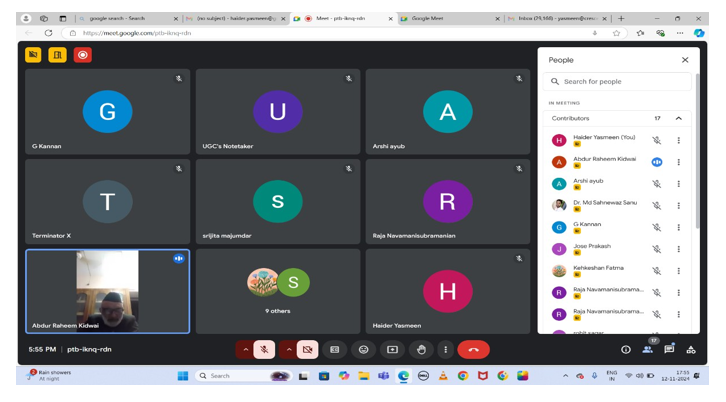
EDUCATIONAL EVENT 1B – SCREENSHOT FOR THE EVENT
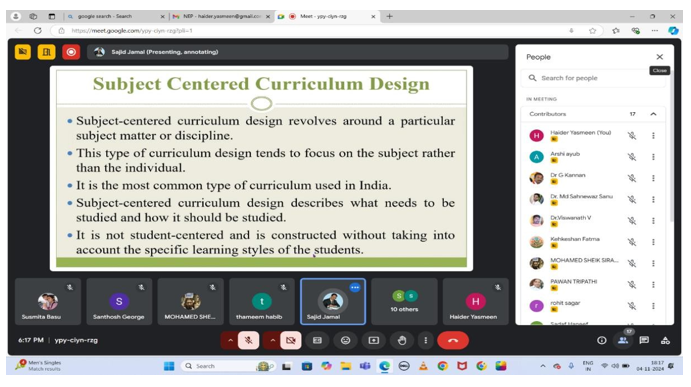
EDUCATIONAL EVENT – SHARING THE COURSE CONTENT
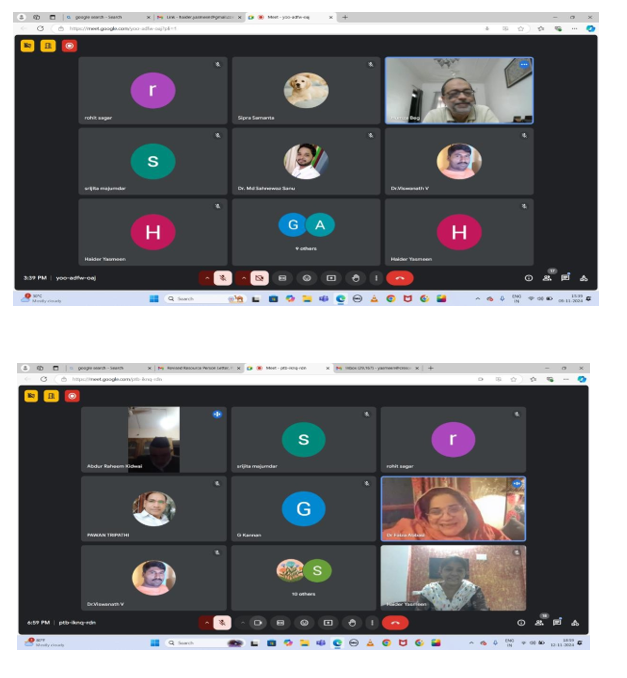
EDUCATIONAL EVENT – ONLINE LECTURE CONTENT
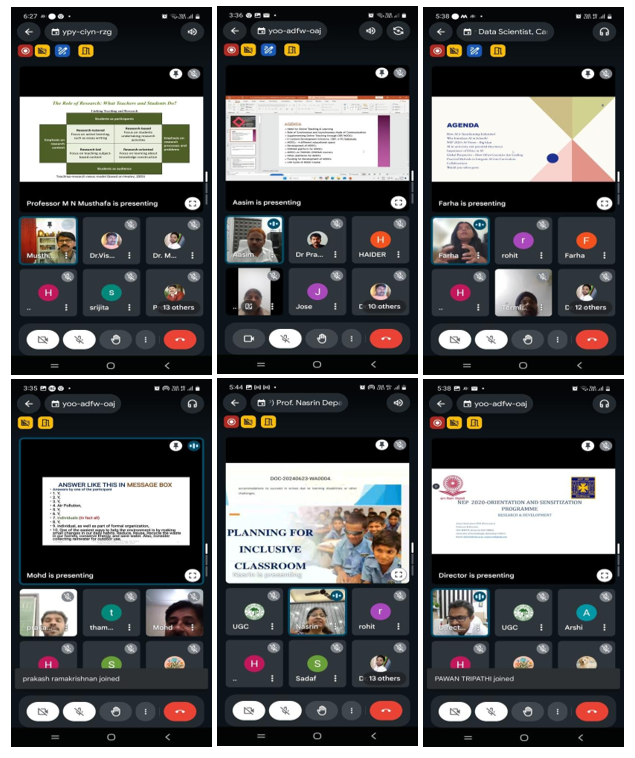
EDUCATIONAL EVENT – ONLINE LECTURE – A SNAPSHOT
The NEP Programme ended on a positive note with lots of though provoking learnings. Sharing the salient features of NEP for your reference (doc attached).
Thank You
Prof. Dr. Haider Yasmeen Coordinator-NEP (2020)
24.11.2024
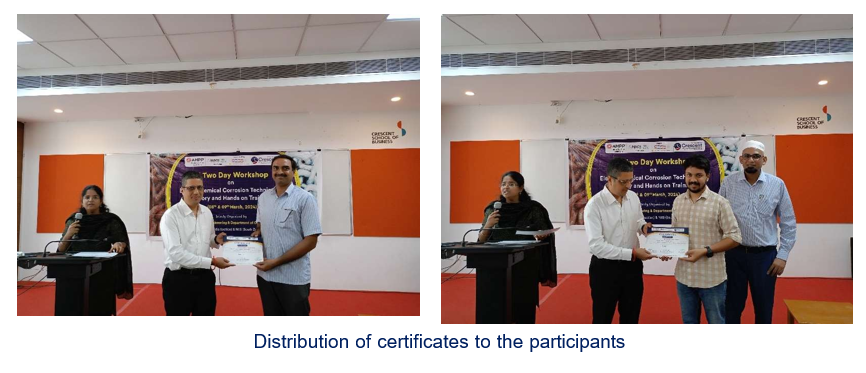
A two-day workshop on “Electrochemical Corrosion Techniques: Theory and Hands-on Training” was organized by the Department of Civil Engineering, and Department of Chemistry, B.S. Abdur Rahman Crescent Institute of Science & Technology in association with AMPP India section (SZ) & NIIS (SZ) on 08.03.2024 and 09.03.2024.
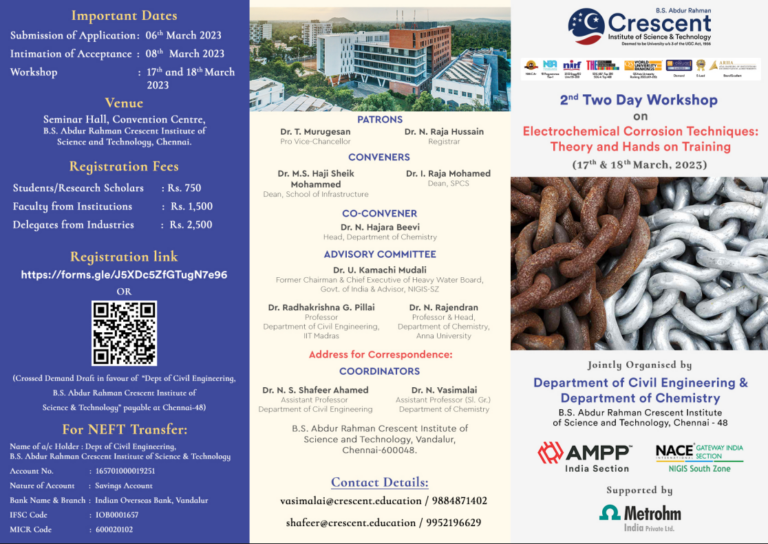
BROCHURE OF THE WORKSHOP
REPORT
SCHOOL OF INFRASTRUCTURE
DEPARTMENT OF CIVIL ENGINEERING
Ref. : 766/Dean(SoI)/0424 Date: 04.04.2024
Date: 08.03.2024 – 09.03.2024 Time: 9.30 am to 4.00 pm
I. Preamble:
A two-day workshop on “Electrochemical Corrosion Techniques: Theory and Hands-on Training” was organized by the Department of Civil Engineering, and Department of Chemistry, B.S. Abdur Rahman Crescent Institute of Science & Technology in association with AMPP India section (SZ) & NIIS (SZ) on 08.03.2024 and 09.03.2024.
II. ABOUT THE SPEAKERS AND TOPICS
• Advanced Electrochemical Techniques: Dr. S. Ningshen, Head, CSTD & CEPS, IGCAR, Kalpakkam
• Advanced Techniques of Monitoring – Electrochemical Impedance Spectroscopy: Dr. S. Ramanathan, Professor, Department of Chemical Engineering, IIT Madras
• Corrosion Testing of Steel in Concrete: Dr. Radhakrishna G. Pillai, Professor, Department of Civil Engineering, IIT Madras
• Basics of Electrochemistry, Testing and Monitoring: Dr. S. Rangarajan, Former Head, Water & Steam Chemistry Division, BARCF, Kalpakkam
• Basics of Corrosion and its Forms: Dr. S. C. Vanithakumari, SO/F, Corrosion Science & Technology Division, IGCAR, Kalpakkam
• Electrochemical Behaviour of Coated Steel Rebars in Concrete: Dr. M.S. Haji Sheik Mohammed, Dean, School of Infrastructure, BSACIST
• Inhibitors for Corrosion Protection: Dr. T.M. Sridhar, Assistant Professor & Head (i/c), Department of Analytical Chemistry, Madras University
• Applications of Nanomaterials for Corrosion Control: Dr. N. Vasimalai, Asst. Prof. (Sel. Gr.), Department of Chemistry, BSACIST
• Galvanic Anode Cathodic Protection: Dr. Roopa V, Asst. Prof. (Sr. Gr.), Department of Civil Engg., BSACIST
ABOUT THE SESSION:
The purpose of the two-day workshop is to train postgraduate students, research scholars, faculty members of arts & science and engineering colleges, and industry personnel in electrochemical analytical equipments and related theory. The workshop aims to provide knowledge on the latest advancements in electrochemical corrosion and its control techniques in the fields of science and technology. It is intended to serve as an introduction to the use of electrochemical techniques in corrosion applications, with an emphasis on the use of modern instruments to acquire pertinent data. The workshop also aims to provide practical insight into corrosion aspects and to train participants in the proper interpretation of data for use in corrosion prediction, prevention, and monitoring.
The session details and programme schedule are given below:
DAY 1 – March 8, 2024 (Friday) |
| |
Time | Topic | Speaker / Resource Person |
8.30 – 9.30 a.m. | Registration | |
9.30 – 9.35 a.m. | About the Workshop | Dr. M.S. Haji Sheik Mohammed Dean, School of Infrastructure, BSACIST |
9.35 – 9.45 a.m. | Felicitation & Inauguration of Workshop | Dr.S.Ningshen Head, CSTD & CEPS, IGCAR, Kalpakkam |
9.45 – 10.30 a.m. | Basics of Corrosion and its Forms | Dr. S.C. Vanithakumari, SO/F, Corrosion Science & Technology Dicision, IGCAR, Kalpakkam |
10.30 – 11.15 a.m. | Basics of Electrochemistry, Testing and Monitoring | Dr.S.Rangarajan, Former Head, Water & Steam Chemistry Division, BARCF, Kalpakkam |
11.15 – 11.30 a.m. | Tea Break | |
11.30 – 12.30 noon | Advanced Electrochemical Techniques | Dr.S.Ningshen Head, CSTD & CEPS, IGCAR, Kalpakkam |
12.45 – 2.00 p.m. | Lunch Break | |
2.00 – 3.00 p.m. | Corrosion Testing of Steel in Concrete | Dr. Radhakrishna G Pillai, Professor, Department of Civil Engineering, IIT Madras |
3.00 – 4.00 p.m. | Hands-on Training on Basic Electrochemical Testing Techniques | Faculty members of BSACIST & Research Scholars of IIT Madras and BSACIST |
4.00 p.m. | High Tea | |
DAY 2 – March, 9, 2024 (Saturday) |
| |
Time | Topic | Speaker / Resource Person |
9.00 – 9.30 a.m. | Galvanic Anode Cathodic Protection | Dr. Roopa V, Asst Professor (Sr. Gr.), Department of Civil Engineering, BSACIST |
9.30 – 10.00 a.m. | Electrochemical Behaviour of Coated Steel Rebars in Concrete | Dr. M.S. Haji Sheik Mohammed Dean, School of Infrastructure, BSACIST |
10.30 – 11.00 a.m. | Applications of Nanomaterials for Corrosion Control | Dr. N. Vasimalai, Asst. Professor (Sel. Gr.) Department of Chemistry,BSACIST |
11.00 – 11.15 a.m. | Tea break | |
11.15 – 12.00 a.m. | Inhibitors for Corrosion Protection | Dr. T.M. Sridhar, Assistant Professor, Head (i/c), Department of Analytical Chemistry, University of Madras. |
12.00 – 01.00 p.m. | Advanced Techniques of Monitoring – Electrochemical Impedance Spectroscopy | Dr. S. Ramanathan, Professor, Department of Chemical Engineering, IIT Madras |
12.45 – 2.00 p.m. | Lunch Break | |
2.00 – 3.30 p.m. | Hands – on Training on Advanced Electrochemical Testing Techniques | Dr. S. Ramanathan, Professor, Department of Chemical Engineering, IIT Madras Research Scholars of IIT Madras and BSACIST |
3.30 to 3.45 p.m. | MCQ on Topics of Day 1 and 2 | Research Scholars of BSACIST |
4.00 to 4.30 p.m. | Valediction, Certificate Distribution & High Tea | |
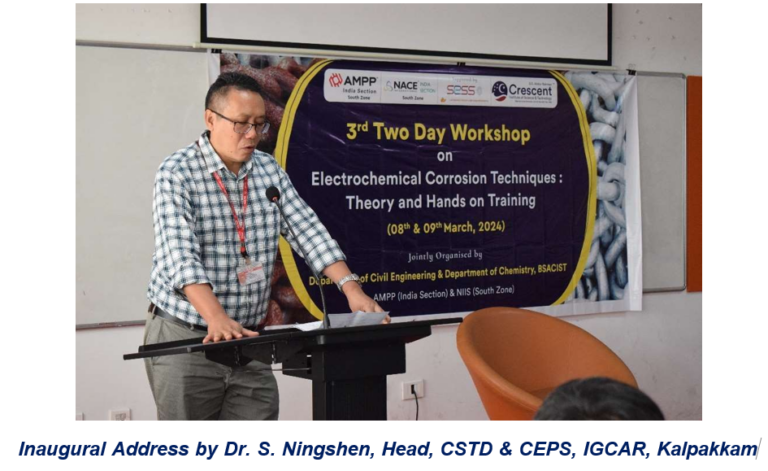
Dr. Mohd. Umar recited the Qirath and the workshop began with the blessings of almighty.
Dr. M.S. Haji Sheik Mohammed, Dean, School of Infrastructure, briefed about the workshop and the workshop was inaugurated by Dr. S. Ningshen, Head, CSTD & CEPS, IGCAR, Kalpakkam.
Following the inaugural ceremony, the speakers delivered the thematic lectures on the various topics as per the schedule. All the lectures were very informative and interesting to the participants.
During the Hands-on training session, the participants were exposed to various electrochemical testing techniques / experiments such as Electrochemical impedance spectroscopy, impressed voltage test, half cell potential test, macrocell corrosion test, carbonation test and the determination of chloride threshold etc. The participants were also facilitated to perform the experiments under the mentoring of expertise faculty and research scholars.
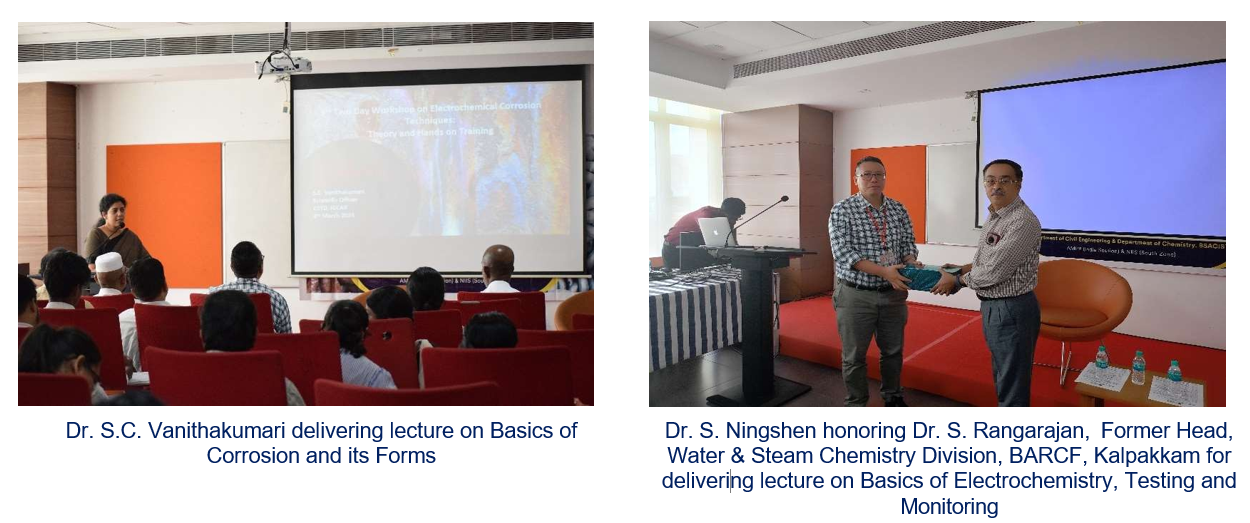
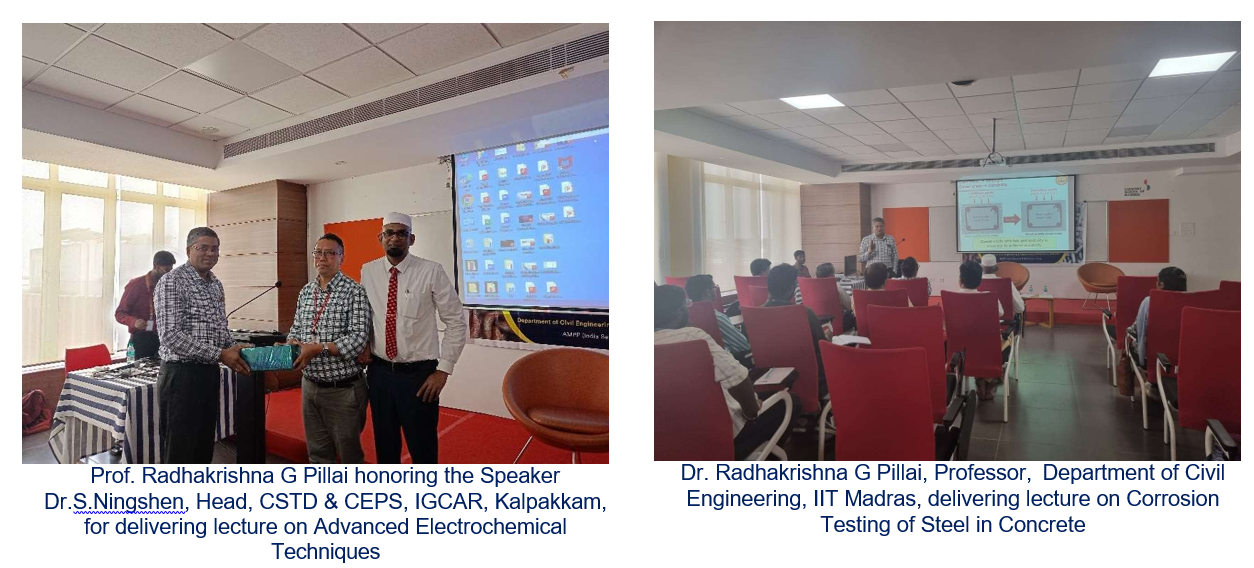
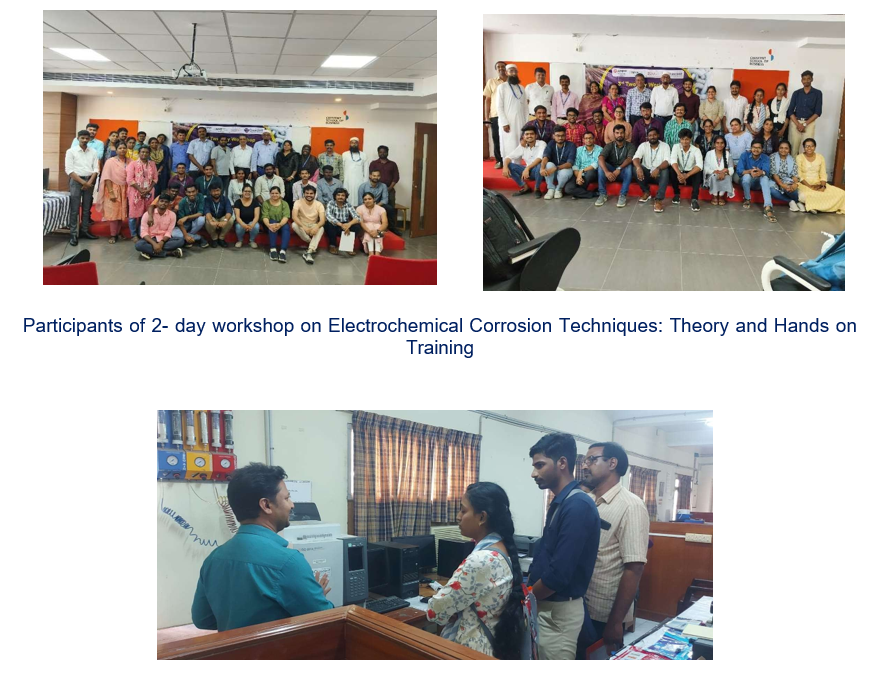
Hands on training session on 8th March 2023 (Afternoon) at Chemistry Laboratory
The following are the details of participants of ECT 2024:
S.No |
Name |
Designation |
Institution |
1 |
Ms. Benisha P.V |
Research Scholar |
University of Madras |
2 |
Ms. Dharshini A |
Research Scholar |
Anna University |
3 |
Mr. Dilrabin K |
Research Scholar | National Institute of Technology, Calicut |
4 |
Ms. Hemalatha C |
Research Scholar | B.S. Abdur Rahman Crescent Institute of Science and Technology |
5 |
Ms. Immaculate Mercy J |
Research Scholar | B.S. Abdur Rahman Crescent Institute of Science and Technology |
6 |
Mr. Jabastin S |
Research Scholar |
University of Madras |
7 |
Mr. Prem Kumar S |
II Year, Msc., Chemistry |
Vivekananda College, Madurai |
8 |
Mr. Ranjith Kumar R |
II Year, Msc., Chemistry |
Vivekananda College, Madurai |
9 |
Ms. Siani Michel |
Research Scholar | National Institute of Technology, Calicut |
10 |
Ms. Srividya T |
Research Scholar | SRM Institute of Science and Technology |
11 |
Mr. Suriyapandi M |
II Year, Msc., Chemistry |
Vivekananda College, Madurai |
12 |
Mr. Symonds Fradrick J |
Research Scholar | B.S. Abdur Rahman Crescent Institute of Science and Technology |
13 |
Ms. Cheranmadevi P |
Research Scholar |
Anna University |
14 |
Mr. Muniyan P |
Research Scholar |
Anna University |
15 |
Ms. Veera Muthammal V |
Research Scholar | B.S. Abdur Rahman Crescent Institute of Science and Technology |
16 |
Mr. Ashar Eqbal | II Year, M.Tech., Structural Engineering | B.S. Abdur Rahman Crescent Institute of Science and Technology |
17 |
Ms. Charumathi M | I Year, M.Tech., Structural Engineering | B.S. Abdur Rahman Crescent Institute of Science and Technology |
18 |
Ms. Divyalakshmi M |
II Year, M.Sc Chemistry | B.S. Abdur Rahman Crescent Institute of Science and Technology |
19 |
Mr. Hirthik Ramkumar A | I Year, M.Tech., Structural Engineering | B.S. Abdur Rahman Crescent Institute of Science and Technology |
20 |
Mr. Inzamam Ul Haq A |
I Year, M.Sc., Chemistry | B.S. Abdur Rahman Crescent Institute of Science and Technology |
21 | Mr. Mohammed Yasin A M | II Year, M.Tech., Structural Engineering | B.S. Abdur Rahman Crescent Institute of Science and Technology |
22 |
Mr. Muhammed Ibrahim L | I Year, M.Tech., Structural Engineering | B.S. Abdur Rahman Crescent Institute of Science and Technology |
23 |
Mr. Narendran P |
II Year, M.Sc Chemistry | B.S. Abdur Rahman Crescent Institute of Science and Technology |
24 |
Mr. Naveen E | I Year, M.Tech., Structural Engineering | B.S. Abdur Rahman Crescent Institute of Science and Technology |
25 |
Mr. Praveen J | I Year, M.Tech., Structural Engineering | B.S. Abdur Rahman Crescent Institute of Science and Technology |
26 |
Ms. Priya M | II Year, M.Sc., Chemistry | B.S. Abdur Rahman Crescent Institute of Science and Technology |
27 |
Mr. Saran T | I Year, M.Tech., Structural Engineering | B.S. Abdur Rahman Crescent Institute of Science and Technology |
28 |
Mr. Nabeel Abdullah | Final Year, B.Tech., Civil Engineering | B.S. Abdur Rahman Crescent Institute of Science and Technology |
29 |
Mr. Ramesh Kumar R |
Assitant Professor | Ramakrishna Mission Vivekananda College , Chennai |
30 |
Mr. Sahik Davood | I Year, M.Tech., Structural Engineering | B.S. Abdur Rahman Crescent Institute of Science and Technology |
31 |
Dr. Sivaramakrishnan S |
Associate Professor | Sairam Institute of Technology, Chennai |
32 | Ms. Mary Rebekah Sharmila S |
Research Scholar | B.S. Abdur Rahman Crescent Institute of Science and Technology |
33 |
Ms. Abirami R |
Research Scholar |
University of Madras |
34 |
Ms. Bidisha Panda |
Internship Student | B.S. Abdur Rahman Crescent Institute of Science and Technology |
35 |
Dr. Purnima |
Post Doctrate | Indian Institute of Technology, Madras |
36 |
Dr. Krishna Unni A S |
Post Doctrate | Indian Institute of Technology, Madras |
37 |
Mr. Umesh Hule |
Research Scholar | Indian Institute of Technology, Madras |
38 |
Ms. Shefali Aggarwal |
Research Scholar | Indian Institute of Technology, Madras |
39 |
Ms. Swapna S | II Year, M.Sc., Chemistry | B.S. Abdur Rahman Crescent Institute of Science and Technology |
A Quiz was conducted at the end of 2 days workshop. The first three winners were Mr. Umesh Hule, Ms. Shefali Aggarwal and Dr. Purnima. They were awarded with cash prizes of Rs. 1000 , Rs.750 and Rs. 500 respectively. The certificate for participation was distributed to the participants by Dr. S. Ramanathan, Professor, Department of Chemical Engineering, IIT Madras. Vote of thanks was proposed by Dr. N . H a j a r a B e e v i , Head, Department of Chemistry. The organizers heartly thank and acknowledge the support from sponsors M/s. Sri Easwari Scientific Solution Pvt Ltd, Chennai and M/s. Leading Edge Lab Equipments limited, Coimbatore for the smooth conducte of ECT 2024.
III. OUTCOME
The outcomes of the two-day workshop on electrochemical corrosion and its control techniques include:
- Providing an introduction to the use of electrochemical techniques in corrosion
- Emphasizing the use of advanced electrochemical instruments and techniques to acquire pertinent data.
- Offering insight knowledge on practical aspects of
- Providing an opportunity for participants to acquire knowledge on state-of-the-art instruments in laboratory sessions designed to complement the lecture sessions.
- Emphasizing techniques for proper interpretation of data for use in corrosion prediction, prevention, and monitoring.

POSTER FOR THE EVENT
REPORT

GOOD SAMARITAN LAW – A REPORT
The University Grants Commission (UGC) has issued a notification to raise awareness about the Good Samaritan Law. In accordance with the notification above, the Office of Student Affairs jointly with the Crescent Blood Donors Club and the Crescent Legal Aid Committee of Crescent School of Law is conducted an important awareness session on the Good Samaritan Law on October 3rd, 2024. The members of the committee with the guidance of Faculty Co-ordinator Ms. Tamilselvi Jagadeesan and Dr. M.A. Saleem Ahmed conducted various programs. This initiative encourages bystanders to assist accident victims without fear of legal repercussions.
On the 3rd October 2024, The Crescent Legal Aid Committee in collaboration with Crescent Blood Donors and Crescent awareness club coordinated an event with the aim to spread awareness regarding Good Samaritan Law through various aspects. In that the Crescent Legal Aid Committee choose to spread awareness regarding Good Samaritan law in case of road accidents with reference to Motor Vehicle Act.

MEMBERS OF CRESCENT LEGAL AID COMMITTEE AND CRESCENT BLOOD DONORS CLUB
AGENDA
Good samaritan law awareness event
12:40-12:50 welcome address
12:50 – 1:00 Drama with discussion – CLC
1:00-1:10 Speech -SAC
1:10-1:15 quiz -CLC
1:15 – 1:20 – oath
WELCOME ADDRESS

WELCOME ADDRESS
The welcome address began with a warm greeting to Attendees. The speaker expressed gratitude for their presence and highlighted the significance of the event. The purpose of the event was clearly stated, emphasizing its importance and relevance to the audience.
DRAMA WITH DISCUSSION

DRAMA PERFORMANCE – FOSTERING DEEPER UNDERSTANDING
Drama was performed by the members of Crescent Legal Aid Committee. The drama performance was captivating and thought- provoking, effectively conveying the intended message. The key themes explored in the drama and discussion were identified and analyzed, fostering deeper understanding and appreciation.
SPEECH
The speaker issued a strong call to action, urging the audience to take concrete steps to address the issue and create positive change. The speech concluded with a hopeful message, inspiring the audience to become active participants in promoting awareness and making a difference.The key points related to the issue were highlighted, providing the audience with valuable information and insights.
QUIZ AND PAMPHLET DISTRIBUTION
The quiz was successfully conducted using Google Forms by Crescent Legal Aid Committee, providing a convenient and efficient method for participants to take the assessment. Along with Quiz, the committee also done pamphlet distribution highlighting the objectives of awareness program and providing insights about the role as a responsible citizen.It provided them detail insights regarding the awareness of being a Good Samaritan and helped them to wake up from there fear of legal consequences.

DETAIL INSIGHTS REGARDING THE AWARENESS OF BEING A GOOD SAMARITAN

PAMPHLET DISTRIBUTION HIGHLIGHTING THE OBJECTIVES OF AWARENESS
OATH
At last the event ended with The Good Samaritan Oath. The oath outlines the core principles of compassion, respect, and non- discrimination in offering aid. Individuals who take the oath commit to providing assistance to the best of their ability without seeking personal gain or reward. By taking the oath, individuals contribute to a culture of compassion and support for those in need, potentially saving lives and reducing suffering.

OATH – PRINCIPLES OF COMPASSION, RESPECT, AND NON- DISCRIMINATION IN OFFERING AID

Poster for Disaster Preparedness Awareness Program
The Tamil Nadu Fire and Rescue Services Department, Chengalpattu District and B.S. Abdur Rahman Crescent Institute of Science and Technology (Crescent Institute), jointly organized a “Disaster Preparedness Awareness Program” with a focus on inclusive education, safety culture, and Sustainable Development Goals (SDGs). The program engaged a broad spectrum of stakeholders—students, faculty, non-teaching staff, technical staff, administrative staff, hostel workers, and the general public—demonstrating practical fire safety measures, the handling of household liquids and gases, and the use of multiple fire extinguishers for different fire scenarios (oil, electricity, and dry materials). A key objective was to foster a culture of prevention, readiness, and responsible action across the campus and surrounding community, reinforcing Crescent Institute’s commitment to education for all and aligning with Sustainable Development Goals, which emphasizes equitable access to educational resources.
The program was organized on the college grounds (Playground) to provide an accessible, interactive, and large-scale demonstration that could accommodate varied audiences, including non-students and community members. Engaging Third Year Engineering students pursuing Disaster Management provided a direct link between academic learning and practical, situational awareness, enabling experiential learning that complements theoretical coursework. The initiative demonstrates Crescent Institute’s dedication to safety culture and social responsibility, extending education beyond traditional learners to the broader community.


Key Objectives
• To enhance fire safety awareness among all campus stakeholders and nearby residents.
• To demonstrate practical fire prevention and emergency response techniques, including household hazardous material handling and the use of different types of fire extinguishers.
• To promote proactive and coordinated responses to fire incidents, reducing risk and potential harm.
• To embed the value of inclusive education by providing open access to educational resources and safety training materials, aligning with SDG targets for inclusive and equitable education.
Program Design and Implementation
• Collaboration: The event was a joint effort between TNFRS Department, Chengalpattu District, and Crescent Institute, leveraging the expertise of fire safety professionals and academic faculty.
• Audience Inclusivity: The program deliberately included students, faculty, non-teaching staff, technical and administrative personnel, hostel workers, and the general public, ensuring that knowledge reaches all campus communities and surrounding neighborhoods.
• Hands-on Training: Demonstrations focused on the practical handling of household liquids and gases and the correct use of various fire extinguishers suited to different fire types (oil/oil-based fires, electrical fires, and solid materials).
• Venue and Logistics: The College Playground served as a suitable open-air venue to accommodate large-scale demonstrations and interactive sessions, with safety protocols in place to ensure participant well-being.
• Educational Depth: The sessions integrated theoretical context with practical demonstrations to reinforce learning outcomes and confidence in application during real incidents.

Outcomes and Impact
• Enhanced Awareness: Participants gained a clearer understanding of fire risks, preventive practices, and safe response measures during emergencies.
• Skill Development: Attendees acquired hands-on familiarity with fire extinguishers and basic evacuation procedures, contributing to improved preparedness.
• Community Reach: By including non-students and staff beyond the academic cohort, the program extended safety education to a broader audience, reinforcing a campus-wide safety culture.
• Academic-Industry Synergy: The involvement of Third Year Disaster Management students bridged academic study with practical field experience, enriching the curriculum and real-world relevance.

There was No Registration Fee for the participants attending the Quiz Programme.
Objective: Demonstrate how targeted online technical quizzes foster foundational STEM knowledge, confidence, and STEM career interest among 11th–12th graders, contributing to SDG 4 (Quality Education) and SDG 9 (Industry, Innovation, and Infrastructure) with ripple effects on SDG 5 (Gender Equality) and SDG 10 (Reduced Inequalities) through expanded access.

List of Participants:
• P S ANUSRI — Chinmaya Vidhyalaya Hr. Sec. School — 12th
• SHAGILAN U — LFC Mat Hr Sec School — AMMOOR — 12th
• SIVA.I — Sri Rama Krishna Higher Secondary School — 12th
• KEERTHANA M — Sri Ramakrishna Hr Sec School, Tisaiyanvilai — 12th
• M SUGI — Sri Ramakrishna Hr Sec School, Tisaiyanvilai — 12th
• ANUSUYA (Anusuya) — Sri Ramakrishna Higher Secondary School — 11th or 12th indicated across entries (12th on some lines)
• ARUNA.A — Sri Ramakrishna Higher Secondary School — 12th
• KALAIMAGAL S V I D H Y A — GGHSS Pattukkottai? (listed with school names across rows)
• VIDHYA — GGHSS Pattukkottai? (appears with multiple entries)
• ANU — THISAYANVILLAI SECSCHOOL (Thisaiyanvillai Secondary School) — 12th
• IMTHIYASM — National Academy
• VENKATESH — Sri Ramakrishna Higher Secondary
• S.JAYASRI — Sri Ramakrishna Higher Secondary/ THISAYANVILLAI SECSCHOOL
• ABINAYAG — Crescent Higher Secondary
• MOHAMMEDUMAR —Sri Ramakrishna Higher Secondary
• KEERTHIKASHANMUGAM — (listed with multiple schools)
• DINESHKARTHIK — (listed with Sri Ramakrishna/Hr Sec varieties)
• RAJA — Crescent School
• SHAGILANU — AMMOOR / LFC MAT HR SEC SCHOOL
• SIVA — Sri Rama Krishna Higher Secondary School
• PSANUSRI — Chinmaya Vidhyalaya Hr. Sec. School
• ARSHADKASIM — Sri RamakrishnaHr Sec / Thisayanvillai
• ANNEMHEMANTHREDDY — National Academy / Crescent
• VERESISIVASHANKAR — Sri Ramakrishna Higher
• SIVAIYAPPAN (Sivaiyappan) — Sri Ramakrishna
List of Participants – Scanned Copy

Poster for Online technical quiz Event

Prize Winners:
The winners were recognized for their outstanding performance in the event, and encouraged with cash awards as follows:
S.No | Name of the Participant | Name of the School | Mark Scored out of 25 | Prize | Prize Amount (Rs) |
1 | P S ANUSRI | Chinmaya Vidhyalaya Hr.Sec School | 19 | First | 850 |
2 | SHAGILAN U | LFC MAT HR SEC SCHOOL AMMOOR | 15 | Second | 500 |
3 | SIVA.I | Sri Rama Krishna Higher secondary school | 15 | Second | 500 |
4 | KEERTHANA M | Sri Ramakrishna Hr Sec school Tisaiyanvilai | 13 | Third | 400 |
Proof for the Payment of Prize Money (Sample) :

Poster for proof for the payment of prize money
B.S. Abdur Rahman Crescent Institute of Science and Technology’s Crescent Legal Aid Committee recently spearheaded a meaningful outreach activity titled “Breaking Barriers: Understanding Gender Equity and Girls’ Rights.” at Rajeswari Vedachalam Government Arts and Science College, Chengalpattu. The one-day legal awareness program was designed to empower students and the broader college community with essential knowledge on gender equity and girls’ rights, addressing issues facing women’s rights in India. The program integrated legal guidance, cultural context, and practical resources to help participants understand their rights and the legal protections available to them.
The event featured a ceremonial inauguration and distinguished sessions that connected gender equity with everyday realities. A notable highlight was the handing over of five sanitary napkin vending and disposal machines, emphasizing women’s health, hygiene, and dignity within educational institutions. Sessions included insights on gender equity through Tamil literature, discussions on domestic violence laws, helplines, and support mechanisms for issues such as stalking and forced marriages. These activities demonstrated BSACIST’s commitment to translating legal knowledge into actionable, community-facing initiatives that promote safety, empowerment, and informed civic participation.


BREAKING BARRIERS
One-Day Legal Awareness Program on
“Breaking Barriers: Understanding Gender Equity and Girls’ Rights”
Date: October 8, 2024
Venue: Rajeswari Vedachalam Government Arts and Science College, Chengalpattu
Introduction
On October 8, 2024, Crescent Legal Aid Committee organized a Legal Awareness Program titled “Breaking Barriers: Understanding Gender Equity and Girls’ Rights.” This initiative aimed to empower students with knowledge on gender equity and girls’ rights, addressing pressing issues surrounding women’s rights in India. The event was a collaborative effort involving Crescent School of Law’s Legal Aid Committee, faculty coordinators, and student coordinators, under the guidance of the Dean of Crescent School of Law, Dr. C. Chockalingam.
Event Highlights
- Ceremonial Start:
The event began with the “Tamil Thai Vazhthu” and a lamp-lighting ceremony, symbolizing the formal inauguration. The Dean delivered the welcome address, emphasizing the importance of gender equity and quoting renowned social reformers for inspiration.
- Guest Felicitations and Presidential Address:
Mrs. A.S. Kumari, Chairperson of the Tamil Nadu State Women’s Commission, delivered the presidential address. She discussed gender equity laws, dowry prevention, sexual harassment, and the importance of self-respect, drawing insights from social reformer Thanthai Periyar.
Handing Over of Sanitary Napkin Vending & Disposal Machine

HANDING OVER OF SANITARY NAPKIN VENDING AND DISPOSAL MACHINE
- A key focus of the event was the handing over of five sanitary napkin vending and disposal machine to Rajeswari Vedachalam Government Arts and Science College, Chengalpattu. This initiative, generously sponsored by both faculty and student coordinators, underscored the program’s commitment to promoting women’s health and hygiene in educational institutions.
- The machine was officially handed over by the Dean, alongside faculty and studentorganizers, symbolizing proactive steps toward addressing menstrual health challenges faced by young women. The initiative not only provides necessary hygiene resources but also contributes to the ongoing efforts to normalize conversations around menstrual health, which is essential for achieving gender equity.
Key Sessions
- Session by Mr. P.B. Prince Gajendra Babu:
Addressing gender equity, Mr. Babu utilized Tamil literature to underscore cultural values related to gender equity and highlighted the fundamental rights of women.
2. Session by Mrs. Poongodi Prakash:
Mrs. Prakash discussed domestic violence laws, helpline services, and provided information on support mechanisms for issues like stalking and forced marriages.

KEY SESSION – ADDRESSING GENDER EQUITY
Acknowledgments
Special thanks to the dignitaries, speakers, organizers, and participants for their contributions to this enlightening and impactful event.
Coordinators
- Faculty Coordinators:
Dr. M.A. Saleem Ahmed, Ms. J. Tamilselvi, Mr. J. Perumalsamy, Ms. G. Banupriya
- Student Coordinators:
S. Vinoth, R. Swathi, K. Yashvita, S. Swaminathan, M. Shajitha Banu, J. Ruthrachallam, K. Saravanan, R. Mohammed Hissam, Ananditha Ashok, S. Raghul Kanna, T. Varun, S. Mohamed Jasim, K. Suriya Prakaash, M. Vijay
B.S. Abdur Rahman Crescent Institute of Science and Technology demonstrates a strong commitment to quality education through broad outreach activities for the local community, as evidenced by its NSS special camp and NSS-Youth Red Cross collaborations. The seven-day Green India Clean India camp, conducted at Keerapakkam with village surveys, Health and Safety Programs, Blood Donation Drives, Stress Management, Reading Challenges, Self-Defense Sessions, First Aid Awareness, and Sports Outreach, Showcases Hands-on Learning, Civic Responsibility, and Intergenerational Engagement. These activities foster practical skills, health awareness, leadership, and community empowerment, reinforcing BSACIST’s dedication to accessible, experiential education beyond the campus.
NATIONAL SERVICE SCHEME
SPECIAL CAMP REPORT

“NOT ME BUT YOU”

NSS – SPECIAL CAMP – POSTER
INTRODUCTION
The seven days special camp has been organized by the N.S.S. units of B.S. Abdur Rahman Crescent Institute of Science and Technology at Panchayat Union Middle School, Keerapakkam Village, Kattankulathur Union, Chengalpattu District during the period of 21.02.2024 to 27.02.2024.
National Service Scheme (NSS) special camp offers numerous opportunities for personal growth, community impact, and societal change. NSS special camps provide a platform for individuals to actively contribute to society. By engaging in community service initiatives, participants become agents of change, empowering themselves and others to address pressing social issues. Encouraging participation in NSS special camps cultivates a sense of civic responsibility among youth. By taking ownership of community development projects, participants learn the importance of active citizenship and the role they can play in shaping a better society. Engaging in the planning, coordination, and execution of camp activities helps develop leadership qualities. Participants learn to communicate effectively, collaborate with diverse teams, and make informed decisions, preparing them to lead in various spheres of life. By promoting sustainable practices and empowering local communities, participants contribute to long-term socio- In camp, engaging in community service exposes participants to new experiences, challenges, and perspectives. Through hands-on involvement in projects, individuals discover their strengths, passions, and areas for growth, fostering personal development and self-awareness.
By actively participating in NSS special camps, individuals serve as catalysts for positive change within their communities. Their enthusiasm, dedication, and tangible contributions inspire others to get involved, creating a ripple effect of goodwill and collective action. NSS special camps provide a platform to celebrate the spirit of service and altruism. Participants experience firsthand the joy and fulfillment that come from making a difference in the lives of others, reaffirming the value of service as a fundamental human endeavor.
Ultimately, participation in NSS special camps equips individuals with the knowledge, skills, and motivation to become agents of social transformation. By harnessing their collective efforts and leveraging their experiences, participants contribute to building a more inclusive, equitable and sustainable world for future generations. NSS special camps offer opportunities for participants to forge meaningful connections and create lasting memories. Bonding with fellow volunteers over shared experiences and common goals fosters a sense of camaraderie and belonging that extends beyond the duration of the camp.
In essence, Our institute NSS special camp serve as catalysts for personal, social, and societal change, empowering individuals to become active participants in shaping a brighter future for themselves and their communities.
INVITATION

NSS – SPECIAL CAMP – INVITATION

NSS – SPECIAL CAMP – PROGRAM SCHEDULE
DAY-1 21.02.2024
The seven-day N.S.S. Special Camp commenced with great enthusiasm and excitement. The inaugural ceremony took place in the presence of distinguished guests and officials from the Crescent Institute. The ceremony served as an inspiring start to the camp, setting the tone for the days ahead. The inaugural ceremony was held at Panchayat Union Middle School, Keerapakkam Village, Kattankulathur Union, Chengalpattu District at 2.00 p.m.
Dr.T.Murugesan, Vice-Chancellor, B.S.A. Crescent Institute of Science & Technology, Dr.N.Thajuddin, Pro- Vice Chancellor, BSACIST, Dr.N.Raja Hussain, Registrar, BSACIST, Dr.Mohamed Ismail, Dean Academic, BSACIST, Dr.Ayub Khan Dawood, N.S.S. Coordinator, BSACIST, Mrs.Selvasundari Rajendran, President, Keerapakkam Panchayat graced the occasion. Nearly 120 NSS student volunteers participated in the inaugural function During the inaugural ceremony, the participants were introduced to the camp’s schedule, rules, and guidelines. The inaugural ceremony set a strong foundation for the participants’ engagement in the upcoming activities.
The initial phase of the N.S.S. Special Camp laid a strong foundation of purpose and unity among participants, fueling their motivation and enthusiasm throughout the seven-day program. Through the formation of groups and the delegation of specific tasks, the camp organizers efficiently organized activities, providing participants with opportunities to demonstrate their skills and contribute meaningfully to the community.
The program commenced with a recitation of the Qirat followed by the Tamil Thaivalthu, setting a respectful and inclusive tone. Dr. Ayub Khan Dawood, the N.S.S. Coordinator at B.S.A.C.I.S.T., extended a warm welcome to the gathering. Mrs. Selvasundari Rajendran, President of Keerpakkam village, delivered an inspiring presidential address, while Mrs. G. Shanthi, Headmistress of Panchayat Union Middle School, expressed gratitude to the management of B.S.A.C.I.S.T. and the entire N.S.S. team for their invaluable support.

OPENNING WITH THE GRACE OF GOD – PRAYER

WELCOME ADDRESS – NSS COORDINATOR DR. AYUB KHAN DAWOOD
Camp coordinators provided a comprehensive overview of planned activities, stressing the significance of each participant’s role in achieving camp objectives. Emphasis was placed on teamwork, discipline, and dedication. Participants were grouped based on interests and skills to ensure effective task execution. Detailed guidelines were provided to approach tasks creatively and collaboratively, fostering innovation and maximizing impact while maintaining respect and inclusivity toward the local community.
An organized schedule facilitated effective time management, ensuring successful task completion. Incorporating reflection sessions and interactive workshops allowed for meaningful discussions and insights, enriching participants’ experiences throughout the camp.

HONOURING WITH MUTUAL RESPECTS
Followed by the inauguration, NSS volunteers were assigned for village survey activity. The NSS Village Survey represents a pivotal endeavor by the National Service Scheme to comprehensively understand the dynamics of rural communities. Through this survey, we aim to delve into the intricate fabric of village life, identifying areas of improvement, unearthing latent potentials, and forging pathways towards holistic development.
DAY-2 22.02.2024
On the second day, the focus was on the Blood Donation Camp in collaboration with Dr. MGR Medical University which is a beacon of hope, a testament to the spirit of altruism and compassion that defines humanity. It’s not just an event; it’s a lifeline for those in need, a symbol of solidarity, and a platform for individuals to make a tangible difference in the lives of others.
At the heart of the NSS Blood Donation Camp lies the noble act of giving – giving the gift of life, giving hope to the sick and the suffering, giving back to the community in a profound and meaningful way. It’s a selfless gesture that knows no boundaries, transcending differences of race, religion, or creed, uniting us all in a common cause.
The Blood Donation Camp, supported by the medical experts and technicians from Dr. MGR Medical University, was meticulously organized to prioritize the safety and well-being of all participants. The dedicated medical team diligently implemented stringent measures to uphold hygiene standards throughout the event.
Prior to blood donation, every potential donor underwent a thorough screening process conducted by experienced medical professionals. This encompassed comprehensive assessments of vital indicators such as hemoglobin levels, blood pressure, and overall health status to ascertain eligibility for donation. Upon successfully clearing the screening, eligible donors proceeded with the blood donation process under the careful supervision of the medical team. The collection of blood units was carried out with precision and efficiency, ensuring the comfort and safety of donors throughout the procedure.
Following their generous contribution, donors received attentive post-donation care, including adequate rest and nourishment. The vigilant monitoring by medical professionals continued to guarantee the well-being of donors, promptly addressing any immediate medical needs or concerns that arose.

NSS SPECIAL CAMP – DAY 2 – BLOOD DONATION BY STUDENT

NSS SPECIAL CAMP – DAY 2 – POSTER FOR BLOOD DONATION CAMP
Invitation

DONORS OF THE CAMP
In essence, the collaboration with Dr. MGR Medical University’s proficient medical personnel ensured that the Blood Donation Camp was executed seamlessly, fostering a secure and supportive environment for donors to contribute to this noble cause.
The second session of Day 2 was Stress Management handled by Mrs.Muthulakshmi, Counselor & Physiologist, BSACIST.
Since, Students often face immense pressure to perform well academically, which can lead to stress and anxiety, Stress management sessions can equip students with tools to cope with academic stress more effectively, improving their overall academic performance.
The Guest speaker focused on students Emotional well-being , time management skills, Health promotion, Building Resilience etc. College life can be emotionally taxing, with students dealing with various personal challenges, relationships, and transitions. She taught how to prioritize tasks, manage their time efficiently, and create realistic schedules to reduce overwhelm.
As Chronic stress can have detrimental effects on physical health, including weakened immune function and increased risk of illness, She also educated students about the importance of self-care practices such as exercise, nutrition, and sleep hygiene for maintaining overall health. She taught to value resilience-building skills, such as problem-solving, positive thinking, and seeking social support.
Overall, stress management sessions provided students with practical tools and strategies to navigate the challenges of college life more effectively, promoting their overall well-being and success.
Day 3 : 23.02.2024
Reading Challenge event for NSS volunteers and school students:
Reading Challenge event for students was an excellent way to promote literacy, foster a love for reading, and encourage community engagement.
Dr. Paneerselvam, Coordinator, Readers Club, BSACIST graced the event along with his club members. Readers club members volunteered the event.

READING CHALLENGE – PROMOTING LITERACY AND FOSTERING LOVE FOR READING
The second session of Day 3 was Self Defense event through holistic approach to physical and mental well-being. The session was handled by Mr.Abdurrahim Salih, Founder, V5 Innovations & GV Institute of Acupuncture and TCM treatment Center, Chennai.
He highlighted the benefits of this holistic approach, such as enhancing physical fitness, improving mental focus and resilience, and promoting overall health and vitality. He ensures that practitioners have a deep understanding of both traditional Chinese healing modalities and self-defense principles.
He emphasized the connection between mind and body in self-defense training, incorporating TCM principles such as Qi cultivation, breath control, and mindfulness practices. He taught students how to harness their inner strength and focus to enhance their self-defense skills.
Day 6: 26.02.2024
First Aid Awareness by Mr.Neelagandan Sankar, ALERT-NGO, Chennai
The First Aid Awareness Event for Students was organized with the aim of equipping students with essential life-saving skills and promoting a culture of safety and preparedness within the student community.
The guest speaker raised awareness about the importance of First Aid and its role in saving lives. He educated students about basic First Aid techniques and procedures. He empowered students to act as first responders in emergency situations. He fostered a sense of responsibility and community involvement in promoting safety and well-being.
Guest speaker gave live demonstrations to simulate real-life emergency scenarios. Students observed how to respond effectively to situations such as cardiac arrest, bleeding injuries, and allergic reactions, and practiced their skills under the guidance of experienced instructors. Overall, this session enhanced confidence and readiness to respond to medical emergencies.
Second session of Day 6:
Sports Outreach Program by NSS Volunteers for School Students
The Sports Outreach Program organized by NSS (National Service Scheme) volunteers aimed to promote physical fitness, teamwork, and community engagement among school students. This initiative, held at Govt. Panchayat union middle school students on 26.02.2024 provided an opportunity for NSS volunteers to mentor and inspire young athletes while fostering a spirit of sportsmanship and camaraderie.
This encouraged school students to participate in sports and physical activities for overall health and well-being. It strengthens the bond between NSS volunteers and the school students through sports outreach initiatives.
NSS volunteers conducted competitions for all standard students. NSS volunteers served as referees, coaches, and mentors, providing guidance and support throughout the games. School students actively participated with enthusiastically.
Impact and Future Steps
The 2024 activities achieved increased community awareness, stronger local partnerships, and amplified outreach through media coverage and institutional documentation. To strengthen future impact, the report suggests expanding tailored lectures or demonstrations in local schools, developing reusable outreach kits, and implementing standardized metrics to track reach, engagement, and observed behavioral changes. Establishing ongoing student-led outreach clubs and broader partnerships with NGOs and panchayats would promote continuity and scalability of the SDG outreach beyond campus.